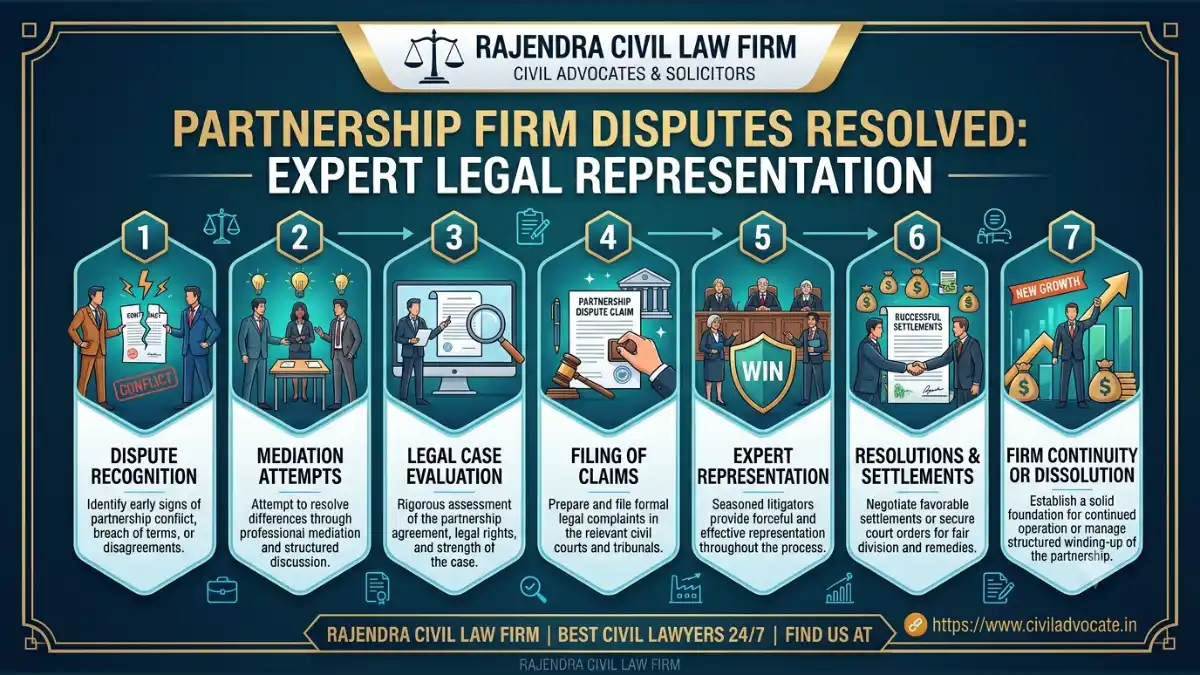
Partnership Firm Disputes Resolved: Expert Legal Representation
In this article (12 sections)
- Rights, Duties, Capital, Profits, and Management
- Registration and Section 69 of the Partnership Act
- Profits, Drawings, Capital, and Firm Accounts
- Misappropriation, Fraud, and Misuse of Partnership Assets
- Retirement, Dissolution, and Partner Exit
- Judicial Dissolution Under Section 44
- Arbitration Clauses in Partnership Deeds
- Choosing the Correct Civil or Commercial Forum
- Consumer Commissions and Special Forums
- Evidence, Negotiation, Mediation, and Settlement
- Urgent Injunctions and Protection of Partnership Assets
- Frequently Asked Questions About Partnership Firm Disputes
Rajendra Civil Law Firm | Civil Advocates & Solicitors
Resolving Partnership Firm Disputes: Legal Remedies and Expert Representation
Strategic legal representation for partnership disputes involving dissolution, accounts, profits, assets, management, registration, arbitration, and recovery.
Partnership Law
Partner Rights
Analyse the partnership deed, capital, profits, duties, management powers, and exit rights.
Dispute Resolution
Dissolution & Accounts
Address dissolution, rendition of accounts, asset distribution, liabilities, and settlement.
Commercial Litigation
Civil Courts & Arbitration
Use the appropriate court, commercial forum, arbitral tribunal, or mediation process.
Chennai Legal Support
24/7 Assistance
Urgent support for injunctions, account protection, notices, arbitration, and partner disputes.
Quick answer: Partnership disputes require analysis of the partnership deed, Partnership Act, registration status, accounts, evidence, jurisdiction, and dispute-resolution clause. The proper remedy may involve negotiation, mediation, arbitration, civil litigation, dissolution, accounting, injunctions, or recovery proceedings.
Understanding Partnership Firm Disputes Under Indian Law
The Partnership Deed Controls the Starting Point
Rights, Duties, Capital, Profits, and Management
Read the Partnership Deed Before Taking Legal Action
A partnership dispute usually begins with disagreement about rights, duties, money, management, or business control. Therefore, the partnership deed becomes the first document requiring detailed legal review. The deed may define capital contributions, profit shares, salaries, drawings, authority, retirement, and dissolution. It can also prescribe notice periods and dispute-resolution procedures. Some deeds contain arbitration clauses covering disputes between partners. Others provide specific mechanisms for valuation or exit. Consequently, lawyers should never rely on oral summaries of partnership terms. The executed deed and later amendments should receive priority. Bank mandates and statutory filings can also reveal the practical management structure. Emails may show how partners interpreted disputed clauses during business operations. Furthermore, past conduct can become relevant when contractual language appears uncertain. A careful review can identify contractual rights before litigation begins. It can also reveal whether a proposed claim concerns partnership rights or separate commercial rights.
Partners should then create a chronology covering formation, capital contribution, business expansion, disputes, notices, and subsequent conduct. This chronology helps separate old grievances from current causes of action. Moreover, it can identify when a partner allegedly breached the partnership arrangement. Payment records can show capital contributions and withdrawals. Accounting records can reveal profit distributions and unexplained transactions. Board-like minutes can establish management decisions, although partnerships do not use corporate governance automatically. Therefore, the firm’s actual governance depends on the deed and Partnership Act. Counsel should also identify changes in partners, retirement notices, death, insolvency, and reconstitution. These events can affect dissolution and accounting rights. A complete chronology reduces contradictions in pleadings and correspondence. It also helps determine limitation issues before proceedings commence. Ultimately, early document analysis often prevents an avoidable procedural mistake. That approach allows the legal strategy to follow evidence rather than emotion.
Registration and Section 69 of the Partnership Act
Why Registration Status Can Decide Maintainability
Registration status can materially affect a partner’s ability to enforce contractual rights through court proceedings. Section 69 restricts certain suits by partners of unregistered firms. It also restricts certain contractual suits by unregistered firms against third parties. Therefore, lawyers should verify registration before drafting a civil suit. The Register of Firms can provide important evidence concerning the firm’s registered particulars. Partner names should also match the relevant registration record. However, Section 69 contains important statutory exceptions. A suit for dissolution of a firm remains within the stated exception. The same applies to accounts of a dissolved firm and certain property-realisation rights. Consequently, registration does not eliminate every possible remedy. The distinction between a prohibited contractual claim and an exempt dissolution claim remains critical. In January 2025, the Supreme Court considered this issue in a partnership dispute. The Court held that non-registration barred the particular recovery claim. It indicated dissolution and rendition of accounts as the appropriate route under the statutory exception. Therefore, counsel should classify the claim before filing proceedings.
The registration issue can become especially important when partners seek money recovery. A partner may describe the claim as an account settlement. Yet the pleading must accurately establish the legal basis for that relief. Courts examine the substance of the claim rather than labels alone. Therefore, drafting strategy should address Section 69 expressly where relevant. Counsel should obtain the firm’s registration certificate and current partner particulars. Changes in partners may also require examination of filing history. Furthermore, a firm may have tax registrations without satisfying every partnership-registration requirement. GST registration, PAN records, and income-tax filings do not replace analysis under the Partnership Act. The legal team should therefore distinguish statutory registrations by purpose. This review can prevent an expensive jurisdictional or maintainability objection. It also helps determine whether alternative remedies remain available. The Supreme Court’s 2025 decision reinforces the importance of this classification. Consequently, registration should become an early litigation-screening question.
Financial Control and Partnership Accounting
Profits, Drawings, Capital, and Firm Accounts
Rendition of Accounts Can Resolve the Core Dispute
Many partnership disputes ultimately concern money rather than personal disagreements. Partners may dispute profits, drawings, capital accounts, expenses, loans, or business withdrawals. Therefore, accounting evidence often determines the practical value of the dispute. The partnership deed should establish the agreed profit-sharing ratio. It may also prescribe partner remuneration and interest on capital. Bank statements can then be compared against accounting entries. Tax returns may provide another independent source for turnover and profit analysis. GST returns can also reveal declared business activity where applicable. Consequently, a forensic review may identify unexplained withdrawals or undisclosed transactions. The review should distinguish legitimate business expenditure from partner-specific benefits. Personal expenses charged to the firm require particular scrutiny. Similarly, related-party transactions can create disputes concerning fiduciary duties. A partner seeking accounts should preserve all available financial records. The legal remedy may include rendition of accounts and consequential recovery. Therefore, financial reconstruction should begin before a final settlement proposal.
An accounting dispute can also involve firm assets, liabilities, receivables, loans, inventory, and goodwill. Each category requires separate valuation and documentary support. Property owned by the firm may require title verification and independent valuation. Stock records can require physical verification and reconciliation with accounting systems. Receivables require confirmation and aging analysis. Bank loans require examination of guarantees and outstanding liabilities. Therefore, dissolution accounting cannot rely upon a single balance sheet. The parties should identify disputed entries separately from undisputed figures. An independent chartered accountant can assist with complex financial reconciliation. However, accounting conclusions do not replace the court’s legal determination. Counsel should connect the financial findings with contractual and statutory rights. This approach can narrow issues before mediation or arbitration. It can also reduce unnecessary allegations concerning every transaction. Consequently, a structured accounts statement often becomes the foundation for meaningful settlement.
Misappropriation, Fraud, and Misuse of Partnership Assets
When a Partnership Dispute Also Raises Criminal Issues
Some partnership disputes involve allegations of diversion, falsification, cheating, breach of trust, or document manipulation. Such allegations require separate civil and criminal analysis. A commercial disagreement does not automatically establish criminal liability. Therefore, counsel should identify the specific conduct and applicable legal ingredients. The Bharatiya Nyaya Sanhita, 2023 governs substantive criminal offences from July 2024. The Bharatiya Nagarik Suraksha Sanhita, 2023 governs criminal procedure. The Bharatiya Sakshya Adhiniyam, 2023 governs the current general evidence framework. Consequently, criminal allegations should receive evidence-based scrutiny. Bank records, electronic communications, invoices, digital access logs, and accounting data may become important. A partner alleging fraud should preserve original records before systems change. Conversely, an accused partner should avoid destroying or altering disputed records. Police involvement may arise where facts disclose an independent cognizable offence. Chennai matters may involve the competent police station based on territorial facts. The Mogappair and Ambattur police jurisdictions can become relevant for incidents occurring there. However, police jurisdiction depends on the actual alleged offence and place.
Civil remedies and criminal remedies can sometimes proceed independently. Yet parallel proceedings require careful coordination to avoid inconsistent factual positions. Therefore, a civil suit should not casually reproduce unverified criminal allegations. Similarly, a criminal complaint should not become a substitute for ordinary accounting relief. Counsel should identify whether the dispute concerns property, money, documents, or dishonest conduct. The available evidence should then guide the appropriate forum. Where immediate preservation becomes necessary, legal counsel can consider suitable interim measures. Digital evidence requires special attention under the BSA framework. Bank records may also require formal production through proper evidentiary procedures. Consequently, evidence preservation should precede aggressive litigation whenever possible. If police action becomes necessary, counsel can assist with complaint drafting and representation. If the allegation remains essentially contractual, civil remedies may remain central. A balanced strategy protects both the firm’s assets and the partners’ legal rights.
Dissolution, Arbitration, Courts, and Commercial Remedies
Dissolution and Exit From a Partnership
Retirement, Dissolution, and Partner Exit
Retirement Is Different From Dissolution
Firstly, Retirement and dissolution produce different legal consequences under partnership law. A partner may retire while the remaining partners continue the business. Dissolution, however, concerns ending the partnership relationship between partners. Therefore, the deed should be examined before describing an exit as dissolution. Retirement provisions may require notice, valuation, settlement, or consent. A partnership at will has a specific statutory mechanism for dissolution by notice. Section 43 addresses dissolution by notice for a partnership at will. Consequently, the date specified in a valid notice can become legally significant. Public notice may also matter for liability to third parties after dissolution. Section 45 addresses continuing liability until public notice in relevant circumstances. Therefore, partners should not assume that internal notice alone ends every external liability. Counsel should coordinate bank, tax, licensing, vendor, and customer communications. The firm’s assets should also receive appropriate protection during transition. An orderly exit can prevent later disputes about authority and representation.
Retirement can require settlement of the outgoing partner’s financial entitlement. That calculation may involve capital, accumulated profits, goodwill, loans, and pending liabilities. The partnership deed may prescribe a valuation formula. If no workable formula exists, accounting evidence may become necessary. Therefore, independent valuation can help reduce disputes over goodwill and business assets. A retiring partner should also consider continuing liabilities to third parties. The remaining partners should update statutory and banking records where required. Customers and suppliers may also need accurate information concerning authorised representatives. Consequently, public communications should avoid statements that create unnecessary legal exposure. Where disputes arise, counsel can negotiate a structured retirement settlement. The agreement should identify payment dates, releases, tax treatment, and future claims. Arbitration clauses may also govern disputes concerning retirement. Therefore, the exit document should address both financial and operational consequences.
Judicial Dissolution Under Section 44
When a Court Can Dissolve the Firm
Section 44 permits court-ordered dissolution on specified statutory grounds. These grounds include permanent incapacity and prejudicial conduct by a partner. Persistent breach of management agreements can also support dissolution. A partner’s conduct may make continued partnership impracticable. Transfer of a partner’s entire interest can create another statutory ground. A business that cannot operate except at a loss can also support dissolution. Finally, the court may apply the just and equitable ground. Therefore, dissolution is not limited to a single form of misconduct. Evidence should establish why continuation of the partnership has become impracticable. Business records can demonstrate persistent losses or operational deadlock. Emails can establish repeated management breaches or refusal to cooperate. Witness evidence may also become relevant concerning business conduct. Consequently, a dissolution suit requires more than general dissatisfaction between partners. Counsel should identify the exact statutory ground and supporting evidence. The prayer can also address accounts, assets, liabilities, and consequential relief. Proper pleading prevents the dissolution claim from becoming unnecessarily broad.
The just and equitable ground requires particularly careful factual presentation. Courts consider the nature of the relationship and circumstances surrounding continuation. Therefore, partnership deadlock may require detailed evidence concerning mutual confidence and management. However, ordinary disagreement does not automatically justify judicial dissolution. Counsel should establish why continued association has become commercially or legally impracticable. The court can then determine the appropriate relief based on the evidence. A dissolution decree may require subsequent accounting and distribution. Consequently, dissolution should be planned as a process rather than a single order. The firm may have receivables that require collection after business closure. It may also have liabilities requiring settlement before final distribution. Goodwill can require valuation before allocation between partners. Therefore, lawyers should prepare a post-dissolution asset and liability schedule. This approach reduces disputes after the court declares dissolution. It also supports an efficient final accounting process.
Arbitration Clauses in Partnership Deeds
When Partnership Disputes Should Go to Arbitration
A partnership deed may contain an arbitration agreement covering disputes between partners. Therefore, counsel should inspect the arbitration clause before filing a civil suit. The clause may cover management disputes, accounts, dissolution, valuation, or all partnership affairs. Recent Supreme Court authority confirms that partnership disputes can fall within an arbitration agreement. In February 2025, the Supreme Court considered disputes involving dissolution and legal heirs. The Court recognised arbitration where the partnership deed specifically covered dissolution disputes. Recent Madras High Court decisions have similarly examined arbitration clauses after dissolution notices. Therefore, dissolution does not automatically extinguish every arbitration agreement. The precise clause and dispute determine the arbitration route. Counsel should also consider interim protection under the Arbitration and Conciliation Act. Section 9 can provide court-based interim measures before or during arbitration. Section 17 empowers the arbitral tribunal concerning interim measures after constitution. Consequently, urgent asset-protection applications require prompt strategic assessment.
Arbitration can address partner-to-partner disputes involving accounts, shares, salary, and management. However, an arbitral tribunal may face limits concerning third-party rights. Recent Madras High Court decisions have distinguished inter-partner disputes from liquidation involving third parties. Therefore, the arbitration clause should be read with the Partnership Act and arbitration statute. A Section 11 application can seek appointment of an arbitrator when statutory conditions exist. The arbitration agreement should be identified clearly within the partnership deed. Notice under Section 21 may also become relevant before arbitration commences. Counsel should preserve the contractual dispute-resolution sequence. Furthermore, limitation must be examined before issuing the arbitration notice. A 2025 Supreme Court decision demonstrates that limitation can defeat stale partnership recovery claims. Therefore, arbitration should not be treated as a limitation-free remedy. Early legal review can protect both jurisdiction and substantive claims.
Civil Courts, Commercial Courts, Consumer Forums, and Tribunals
Choosing the Correct Civil or Commercial Forum
City Civil Court and Ordinary Civil Proceedings
Partnership disputes may require civil court proceedings when arbitration does not apply. Chennai disputes can involve the City Civil Court or other competent civil courts. Jurisdiction depends upon territorial, pecuniary, subject-matter, and statutory requirements. Therefore, lawyers should identify the correct court before filing. The CPC provides the general procedural framework for civil suits. Order XXX contains important procedural rules concerning suits involving firms. Partners can also face specific rules concerning appearance and liability. A suit may seek dissolution, accounts, injunctions, declaration, recovery, or other civil remedies. The partnership registration issue must also receive attention under Section 69. Consequently, the plaint should identify the firm’s status accurately. Interim applications can protect assets, records, bank accounts, or business property where legally justified. However, injunctions require appropriate factual and legal foundations. Counsel should also consider limitation and court-fee requirements. Proper forum selection can prevent procedural objections and unnecessary delay.
Commercial disputes may fall within the Commercial Courts Act where statutory requirements apply. The specified-value rules determine whether a dispute enters the commercial-court framework. Section 12A can require pre-institution mediation where the suit does not seek urgent interim relief. Therefore, commercial partnership litigation may require mediation before institution. The statutory mediation period has a defined framework and can affect limitation computation. Counsel should assess whether the dispute qualifies as a commercial dispute. Business agreements, partnership operations, trade transactions, and commercial assets may create qualifying disputes. However, not every dispute involving a business automatically satisfies the statutory definition. The pleadings should identify the commercial nature and specified value correctly. Consequently, procedural compliance should occur before filing the suit. The Commercial Courts Act can also influence case management and timelines. Early legal advice helps determine whether ordinary civil or commercial procedure applies.
Consumer Commissions and Special Forums
When Consumer Forums May Become Relevant
A partnership firm dispute between partners ordinarily belongs to partnership or commercial law forums. Consumer jurisdiction generally requires a qualifying consumer transaction under the Consumer Protection Act, 2019. Therefore, partners should not treat the District Consumer Commission as a general business-dispute forum. A firm purchasing goods for commercial purposes may face consumer-status objections. The Act contains specific exclusions concerning commercial purpose. Consequently, consumer jurisdiction depends upon the actual transaction and statutory definition. A partnership firm can still encounter consumer litigation in other capacities. For example, a firm may provide services to individual consumers. Conversely, a partner may personally qualify as a consumer for a separate transaction. The State Commission and NCDRC operate within their statutory jurisdictional framework. Therefore, counsel should distinguish partnership claims from genuine consumer claims. The Consumer Protection Act provides specialised remedies for defects and service deficiencies. Those remedies differ from dissolution and partnership-accounting relief. Correct classification prevents forum shopping and unnecessary procedural challenges.
Special tribunals may become relevant when partnership operations intersect with regulated sectors. Tax disputes can involve statutory appellate authorities rather than civil courts. Insolvency issues may involve the National Company Law Tribunal where statutory conditions exist. Real estate disputes can involve RERA authorities and appellate forums. Debt-related issues can involve the Debt Recovery Tribunal under applicable legislation. Environmental disputes can involve the National Green Tribunal when statutory jurisdiction exists. Therefore, a partnership dispute can have multiple legal dimensions. Counsel should separate each cause of action and identify its proper forum. A single agreement may generate civil, arbitration, regulatory, and criminal questions. However, parallel proceedings require careful coordination. The legal strategy should avoid duplicating the same relief unnecessarily. Evidence should remain consistent across every proceeding. Consequently, forum mapping should form part of the first legal opinion. This approach helps partners understand both immediate remedies and longer-term litigation exposure.
Expert Representation and Practical Dispute Resolution
Evidence, Negotiation, Mediation, and Settlement
Build the Partnership Dispute Evidence File
Strong partnership litigation begins with organised evidence rather than allegations. The first document should usually be the executed partnership deed. Next, collect amendments, registration records, bank statements, accounts, invoices, tax filings, and correspondence. Preserve emails, messages, digital files, and accounting-system records. The Bharatiya Sakshya Adhiniyam now governs general evidence law from July 2024. Therefore, digital evidence requires careful preservation and authenticity analysis. Partners should avoid deleting disputed communications or altering accounting records. Independent backups can protect important financial information. Furthermore, preserve original documents whenever possible. A chronology should connect each document with the relevant business event. Counsel can then identify admissions, contradictions, disputed transactions, and missing evidence. Expert accounting assistance may become necessary for complex financial records. Property valuation may also require independent professional evidence. Consequently, the evidence file should support both settlement and litigation. A complete record allows counsel to advise from facts rather than assumptions.
Negotiation can resolve partnership disputes without the cost of full litigation. However, settlement discussions should protect the client’s legal position. A structured mediation can address financial, operational, and relationship issues simultaneously. The Mediation Act, 2023 provides a broader statutory framework for mediation in India. Commercial disputes can also involve pre-institution mediation under the Commercial Courts Act. Therefore, mediation may become strategically important before filing certain commercial suits. Settlement terms should identify payment schedules and transfer obligations clearly. They should also address bank mandates, statutory filings, assets, liabilities, goodwill, and future claims. Releases should cover the intended claims without creating unintended consequences. Consequently, settlement documents require the same care as litigation pleadings. Counsel should also verify whether arbitration or court proceedings require formal disposal orders. A properly documented settlement can provide a cleaner exit than prolonged partner conflict.
Urgent Injunctions and Protection of Partnership Assets
Protect Bank Accounts, Property, Records, and Goodwill
Urgent intervention may become necessary when one partner threatens partnership assets. Examples include unauthorised withdrawals, property transfers, record destruction, or misuse of firm authority. Therefore, counsel should identify the immediate risk before pursuing final relief. Bank-account disputes can require urgent interim measures. Property disputes may require injunctions against transfer or interference. Business records may require preservation orders or controlled access arrangements. Digital systems can require evidence-preservation protocols. The remedy must match the specific threat and legal entitlement. Courts examine the requirements for interim injunctions under established civil principles. Consequently, a vague allegation of possible harm may not justify emergency relief. Counsel should present documents showing the immediate risk and legal interest. Arbitration clauses can shift interim applications toward Section 9 or Section 17 proceedings. Therefore, the dispute-resolution clause should be checked before filing urgent applications. A rapid but accurate response can protect valuable partnership assets.
Partnership goodwill can become particularly vulnerable during a disputed exit. A departing partner may communicate with customers or suppliers concerning the business relationship. The continuing partners may also dispute who can use the firm’s name. Therefore, the partnership deed should be examined for post-exit restrictions. Any restraint must receive separate legal analysis under applicable law. Customer databases and confidential information can also create contractual issues. Digital access should be reviewed when a partner leaves the firm. Bank authorities and statutory registrations may require prompt updating. Tax and GST records should reflect the lawful business structure. Consequently, operational continuity should form part of every exit strategy. Counsel can prepare notices protecting records, authority, and commercial relationships. If necessary, court or arbitral relief can address urgent interference. The objective remains protection of lawful partnership interests until final settlement or adjudication.
Partnership Dispute Remedies and 24/7 Legal Representation
Core legal strategy: Partnership disputes should be classified before choosing a remedy. The principal routes include negotiation, mediation, arbitration, civil litigation, dissolution, rendition of accounts, injunctions, recovery, and appeals.
| Partnership Issue | Primary Legal Framework | Possible Forum | Potential Remedy |
|---|---|---|---|
| Partner management dispute | Partnership Act and deed | Civil Court or Arbitration | Injunction, declaration, arbitration |
| Dissolution | Sections 39–44 Partnership Act | Civil Court or Arbitration | Dissolution and accounts |
| Partnership accounting | Partnership Act and deed | Civil Court or Arbitral Tribunal | Rendition of accounts and recovery |
| Unregistered firm | Section 69 Partnership Act | Competent Civil Court | Maintainable statutory exceptions |
| Commercial partnership dispute | Commercial Courts Act | Commercial Court | Commercial remedies and injunctions |
| Arbitration clause | Arbitration and Conciliation Act | Arbitral Tribunal | Award, interim measures, accounts |
| Consumer transaction | Consumer Protection Act | District, State Commission or NCDRC | Consumer-specific statutory relief |
| Fraud or criminal conduct | BNS and BNSS | Police and Criminal Courts | Complaint, investigation, bail, defence |
| Digital evidence | BSA | Civil, Commercial or Criminal Forum | Documentary and electronic evidence |
24/7 Legal Support for Partnership Disputes
Partnership disputes can escalate rapidly when access to money, property, or business systems becomes contested. Therefore, timely legal support can protect both commercial operations and litigation rights. Rajendra Civil Law Firm can assist with partnership deed review and dispute assessment. Services can include legal notices, reply notices, negotiation, mediation, arbitration, civil suits, and injunction applications. Counsel can also examine dissolution, retirement, expulsion, accounts, and partner misconduct issues. Commercial disputes may require specified-value and pre-institution mediation analysis. Arbitration disputes may require Section 9, Section 11, Section 16, or Section 34 strategy. Civil proceedings may involve the City Civil Court or other competent courts. Consumer issues require separate maintainability analysis under the 2019 Act. Criminal allegations can require BNS and BNSS advice. Digital evidence can require preservation under the BSA framework. Therefore, legal support should remain coordinated across forums. Urgent consultation can focus first on preventing irreversible financial or operational harm.
Chennai clients may require assistance across Mogappair, Ambattur, Anna Nagar, Egmore, and central Chennai. Local police jurisdiction can matter when a partnership dispute includes alleged criminal conduct. Greater Chennai Police lists T1 Ambattur and T2 Ambattur Estate within the Ambattur policing structure. The official city directory also identifies police stations across Chennai zones. Therefore, the relevant station depends on the place and nature of the alleged offence. Civil partnership disputes should not automatically become police complaints. However, genuine allegations involving forgery, cheating, criminal breach of trust, or document offences require separate assessment. Counsel can coordinate civil and criminal strategy where legally justified. The legal team can also assist with urgent representations and evidence preservation. Consequently, 24/7 support should focus on legal urgency rather than merely availability. The first objective remains protecting assets, evidence, contractual rights, and procedural remedies. A prompt assessment can prevent an avoidable escalation.
Frequently Asked Questions About Partnership Firm Disputes
Can a partner sue another partner for accounts?
Yes, subject to the Partnership Act, registration status, deed, limitation, and forum. Dissolution and accounts receive specific statutory treatment.
Can an unregistered partnership firm seek dissolution?
Section 69 contains an exception for suits seeking dissolution and accounts of a dissolved firm, subject to applicable facts.
Can partnership disputes go to arbitration?
Yes, when a valid arbitration agreement covers the dispute. Courts and arbitrators assess the clause, scope, procedure, and applicable law.
Can a partner obtain an injunction against asset transfers?
Appropriate interim relief may be available when evidence establishes a legal interest and sufficient grounds for urgent protection.
Can a partnership dispute also involve criminal proceedings?
Yes, independent criminal conduct can create separate proceedings. However, ordinary contractual disagreements do not automatically constitute criminal offences.
Which court handles a partnership dispute in Chennai?
Jurisdiction depends on territory, value, subject matter, arbitration clauses, and statutory requirements. Possible forums include civil or commercial courts.
RAJENDRA CIVIL LAW FIRM Civil Advocates & Solicitors | Best Civil Lawyers 24/7 Partnership Disputes | Dissolution | Accounts | Arbitration | Commercial Litigation | Civil Courts | Injunctions | Recovery | Property Disputes
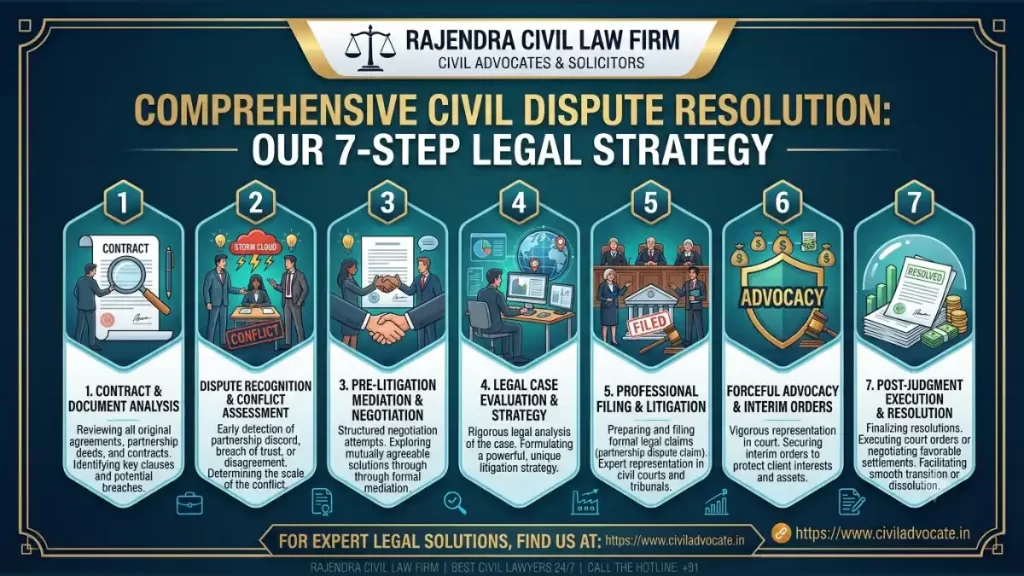
This article is part of our guide: Winning Strategies for Business Litigation: Expert Legal Advice and Representation.