Protecting Intellectual Property: Expert Legal Counsel
In this article (4 sections)
Protecting Intellectual Property - Intellectual property creates valuable business assets across every industry. Therefore, timely legal protection prevents misuse and costly disputes. Rajendra Civil Law Firm delivers strategic legal guidance for creators, startups, companies, professionals, manufacturers, and NRIs. Our team handles copyright, trademark, patent, design, trade secret, licensing, infringement, and unfair competition matters. We prepare documentation with accuracy and legal compliance. Moreover, we represent clients before appropriate judicial and statutory forums. Early legal advice strengthens ownership rights and commercial value. Strong intellectual property portfolios also improve investment opportunities. Indian laws provide effective civil and criminal remedies against unauthorized use. Businesses should register intellectual property before commercialization. Legal due diligence further minimizes future litigation risks. Our lawyers develop practical protection strategies according to each client’s objectives. Professional legal representation saves time, safeguards innovation, and supports sustainable business growth under Indian intellectual property laws.
Protecting Intellectual Property: Expert Legal Counsel - Rajendra Civil Law Firm
Understanding Intellectual Property Rights and Legal Protection
Intellectual property grants exclusive rights over original creations and commercial innovations. These rights encourage creativity, research, technological advancement, and economic development. India protects different intellectual property categories through specialized legislation. Copyright safeguards artistic, literary, musical, and software works. Trademark registration protects brand identity, goodwill, and consumer recognition. Patent protection secures inventions meeting statutory requirements. Industrial designs preserve unique product appearances. Geographical indications protect region-specific products. Plant varieties receive statutory protection under dedicated legislation. Additionally, trade secrets remain protected through contractual obligations and equitable principles. Proper documentation strengthens ownership claims during litigation. Registration creates valuable legal evidence in enforcement proceedings. Businesses should review intellectual property portfolios regularly. Effective legal compliance significantly reduces commercial risks and future disputes.
Types of Intellectual Property Legal Issues
Intellectual property disputes arise across commercial, digital, manufacturing, and technology sectors. Businesses frequently encounter unauthorized copying and brand misuse. However, preventive legal action minimizes financial exposure. Common legal issues include:
- Trademark infringement and passing off.
- Copyright piracy and software infringement.
- Patent infringement claims.
- Design piracy.
- Domain name disputes.
- Trade secret theft.
- Counterfeit goods circulation.
- Licensing agreement breaches.
- Technology transfer disputes.
- Franchise intellectual property conflicts.
Every dispute requires prompt evidence preservation. Legal notices often encourage negotiated settlements before litigation. Proper contractual drafting further reduces future conflicts. Experienced legal counsel identifies suitable enforcement mechanisms according to applicable statutes and commercial objectives.
Laws Governing Intellectual Property Protection in India
Several statutes regulate intellectual property rights throughout India. Each legislation protects distinct commercial interests. Important laws include:
| Law | Primary Protection | Common Legal Issue |
|---|---|---|
| Copyright Act, 1957 | Literary, artistic and software works | Unauthorized copying |
| Trade Marks Act, 1999 | Brand identity | Trademark infringement |
| Patents Act, 1970 | Inventions | Patent violation |
| Designs Act, 2000 | Product appearance | Design piracy |
| Geographical Indications Act, 1999 | Regional products | False representation |
| Information Technology Act, 2000 | Digital offences | Online infringement |
Additionally, Code of Civil Procedure, 1908 (CPC) governs civil proceedings. Bharatiya Nyaya Sanhita, 2023 (BNS) addresses criminal misconduct where applicable. BNSS, 2023 regulates criminal procedure. Bharatiya Sakshya Adhiniyam, 2023 (BSA) governs admissibility and appreciation of evidence during legal proceedings.
Government Authorities Regulating Intellectual Property
Several government departments administer intellectual property rights efficiently. These authorities process registrations, maintain records, and facilitate enforcement. Major authorities include:
- Office of the Controller General of Patents, Designs and Trade Marks.
- Copyright Office.
- Patent Office.
- Trade Marks Registry.
- Design Wing.
- Geographical Indications Registry.
- Customs Authorities.
- Cyber Crime Cells.
- State Police Intellectual Property Enforcement Units.
These authorities cooperate during investigations involving counterfeit goods and digital piracy. Therefore, timely applications improve statutory protection. Professional legal assistance ensures procedural compliance during registration, objections, renewals, and enforcement actions.
Legal Remedies Available for Intellectual Property Infringement
Intellectual property owners possess multiple civil and statutory remedies against infringers. Courts evaluate ownership, infringement, evidence, and commercial damage before granting relief. Civil remedies generally include temporary injunctions, permanent injunctions, damages, rendition of accounts, delivery of infringing materials, and destruction orders. Criminal remedies may apply in specific copyright and trademark offences. Furthermore, customs authorities may detain counterfeit imports under applicable regulations. Arbitration and mediation also resolve commercial licensing disputes efficiently. Settlement agreements often preserve valuable business relationships. Effective evidence collection significantly improves litigation outcomes. Experienced advocates prepare pleadings, documentary evidence, witness examinations, and interim applications carefully. Comprehensive legal strategy maximizes enforcement while minimizing unnecessary commercial disruption.
Forums and Courts Handling Intellectual Property Disputes
Different forums exercise jurisdiction according to dispute nature and statutory provisions. Civil Courts hear several intellectual property matters. Commercial Courts decide high-value commercial disputes involving intellectual property rights. High Courts possess original or appellate jurisdiction under applicable statutes. The Supreme Court considers significant constitutional and appellate issues. Consumer Commissions may examine misleading branding affecting consumers. District Courts hear copyright and trademark disputes where jurisdiction exists. Criminal Courts adjudicate offences prosecuted under applicable laws. Cyber Crime Police Stations investigate online piracy and digital infringement complaints. Mediation Centres facilitate negotiated settlements. Arbitration Tribunals resolve contractual intellectual property disputes efficiently. Appropriate forum selection strengthens procedural efficiency and reduces avoidable litigation delays.
Intellectual Property Litigation Strategy and Preventive Legal Support
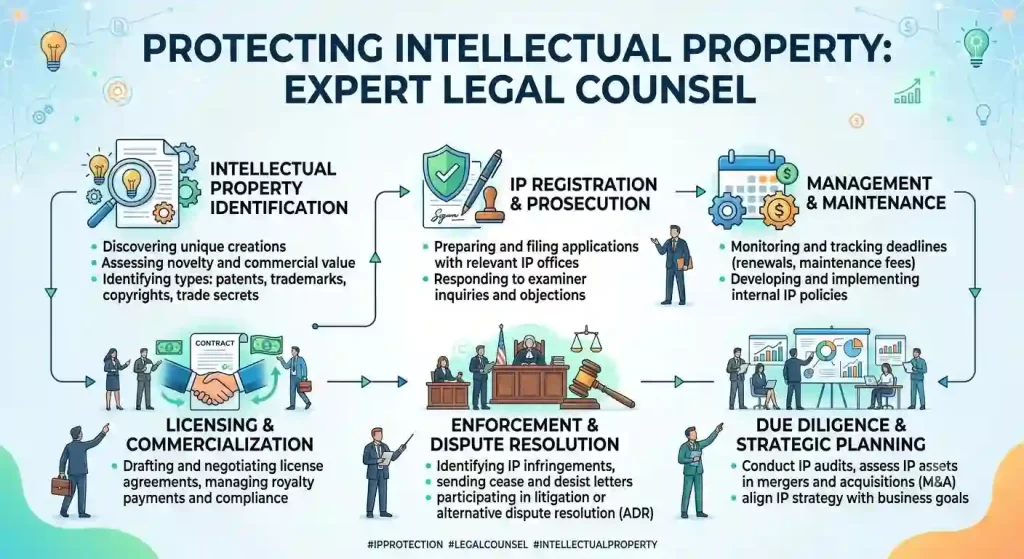
Intellectual property disputes demand prompt action and strategic planning. Therefore, businesses should secure evidence before commencing legal proceedings. Registration certificates, invoices, licensing agreements, source files, and correspondence strengthen legal claims. Rajendra Civil Law Firm prepares cease-and-desist notices, infringement suits, commercial recovery actions, and settlement agreements. Our advocates also conduct legal due diligence before acquisitions and investments. Contract drafting protects confidential information and ownership rights. Additionally, employment agreements should contain intellectual property assignment clauses. Vendor contracts should define ownership of developed works clearly. Preventive legal audits identify compliance gaps before disputes arise. Early intervention reduces litigation costs and business interruption. Comprehensive legal planning ultimately preserves innovation, goodwill, and long-term commercial value.
Intellectual Property Services Offered by Rajendra Civil Law Firm
Businesses require customized legal solutions throughout the intellectual property lifecycle. Accordingly, our firm provides practical legal assistance for diverse industries.
- Trademark registration and opposition.
- Copyright registration and enforcement.
- Patent filing coordination.
- Industrial design protection.
- Trade secret protection.
- Licensing and assignment agreements.
- Franchise documentation.
- Technology transfer agreements.
- Intellectual property due diligence.
- Commercial litigation.
- Interim injunction applications.
- Settlement negotiations.
- Legal notices.
- Counterfeit enforcement actions.
- Online infringement complaints.
Each engagement focuses upon legal compliance, commercial protection, and efficient dispute resolution. Clients receive practical advice tailored to their business objectives and applicable Indian laws.
Jurisdiction and Authorities for Intellectual Property Enforcement
Jurisdiction depends upon statutory provisions, business location, cause of action, and commercial value. Therefore, selecting the correct forum remains essential.
| Authority | Primary Function | Common Proceedings |
|---|---|---|
| District Court | Civil litigation | Copyright suits |
| Commercial Court | Commercial disputes | Trademark infringement |
| High Court | Appeals and original jurisdiction | Patent matters |
| Supreme Court | Constitutional appeals | Significant legal questions |
| Cyber Crime Police Station | Digital investigations | Online piracy |
| Customs Authorities | Border enforcement | Counterfeit imports |
| Arbitration Tribunal | Contract disputes | Licensing disagreements |
| Mediation Centre | Settlement | Commercial negotiations |
Businesses should also preserve electronic evidence under applicable procedural requirements. Strong documentation increases the likelihood of obtaining interim injunctions and damages.
Legal Remedies Available to Intellectual Property Owners
Every infringement requires an appropriate legal remedy. However, timely action remains the strongest protection. Available remedies include:
- Temporary injunction.
- Permanent injunction.
- Damages.
- Rendition of accounts.
- Delivery of infringing materials.
- Destruction of counterfeit goods.
- Anton Piller orders where applicable.
- Mareva injunctions where legally justified.
- Criminal prosecution under applicable statutes.
- Customs border enforcement.
- Arbitration.
- Mediation.
- Settlement agreements.
- Recovery of litigation costs.
Legal remedies vary according to facts, statutory provisions, and available evidence. Experienced advocates evaluate every option before commencing proceedings.
Why Choose Rajendra Civil Law Firm
Rajendra Civil Law Firm delivers practical legal representation across intellectual property disputes and commercial transactions. Our advocates understand evolving business environments and statutory requirements. Therefore, clients receive solutions that balance legal protection with commercial objectives. We prepare registrations, contracts, legal notices, pleadings, and enforcement strategies carefully. Our team also advises startups, manufacturers, software companies, creative professionals, educational institutions, exporters, importers, multinational corporations, and NRIs. Transparent communication strengthens client confidence throughout proceedings. Ethical practice remains our highest priority. Comprehensive legal planning helps businesses safeguard innovation while reducing future litigation risks. Professional representation ultimately protects valuable intellectual property assets across India.
Important Compliance Measures for Businesses
Every organization should adopt preventive compliance measures before commercial expansion. Moreover, periodic legal reviews improve long-term protection.
- Register trademarks before product launch.
- File copyright applications promptly.
- Protect inventions through patent filings.
- Execute confidentiality agreements.
- Maintain invention disclosure records.
- Conduct trademark availability searches.
- Review licensing agreements regularly.
- Monitor online infringement.
- Renew registrations within statutory timelines.
- Preserve ownership documents securely.
Regular compliance strengthens enforceability and investor confidence. Businesses should integrate intellectual property management into their corporate governance framework.
Conclusion
Intellectual property represents valuable commercial capital for every modern enterprise. Therefore, protecting these rights requires proactive legal planning and timely enforcement. Indian intellectual property laws provide comprehensive civil and statutory remedies against infringement. Effective documentation, strategic registrations, and prompt litigation significantly improve legal outcomes. Rajendra Civil Law Firm assists individuals, startups, companies, NGOs, and NRIs across every stage of intellectual property protection. Our legal services include registrations, enforcement, litigation, licensing, compliance, and dispute resolution. Professional legal guidance preserves innovation, enhances market value, and supports sustainable business growth within India’s evolving legal framework.
Frequently Asked Questions
Q1. Why should I register my trademark Registration grants exclusive rights, strengthens enforcement, prevents unauthorized use, and enhances brand value across commercial markets throughout India.
Q2. Can copyright exist without registration Yes. Copyright arises upon creation. However, registration provides stronger evidentiary value during litigation and enforcement proceedings before competent courts.
Q3. Which court hears trademark infringement cases District Courts, Commercial Courts, and High Courts hear trademark disputes according to jurisdiction, valuation, and applicable statutory provisions.
Q4. Can police investigate intellectual property offences Yes. Police and Cyber Crime Police Stations investigate criminal offences involving copyright piracy, counterfeit goods, and related intellectual property violations.
Q5. What evidence supports an infringement claim Registration certificates, invoices, contracts, digital records, expert reports, correspondence, photographs, and witness statements strengthen infringement proceedings effectively.
Q6. How can Rajendra Civil Law Firm assist businesses The firm advises on registrations, licensing, compliance, litigation, enforcement, settlements, commercial contracts, and comprehensive intellectual property protection strategies.
Read More
- Insider’s Guide to Insolvency and Liquidation Proceedings
- Industrial Accident Claims: Championing Your Legal Rights
- Income Tax Litigation: Protecting Your Financial Interests
- Common Causes of Real Estate Disputes and Prevention Measures: A Complete Guide for Property Owners
- Real Estate Dispute Resolution: A Complete Guide for Property Owners
- Copyright Office, Government of India
This article is part of our guide: Resolving Real Estate Disputes: Expert Legal Guidance and Representation.