Expert Representation at National Company Law Tribunal (NCLT)
In this article (7 sections)
- Expert Representation at National Company Law Tribunal (NCLT) - Rajendra Civil Law Firm
- NCLT Jurisdiction, Remedies and Litigation Support
- Frequently Asked Questions
- Expert Representation at National Company Law Tribunal (NCLT)
- NCLT Legal Representation for Corporate Disputes
- NCLT Jurisdiction, Remedies and Litigation Support
- Frequently Asked Questions
Expert representation before the National Company Law Tribunal requires focused knowledge of corporate and insolvency laws. Rajendra Civil Law Firm assists companies, directors, shareholders, creditors, and stakeholders before appropriate NCLT Benches. The Tribunal handles company law matters under the Companies Act, 2013. It also acts as the adjudicating authority under the Insolvency and Bankruptcy Code, 2016. Therefore, each petition requires careful jurisdictional, procedural, and documentary assessment. Our legal support covers pleadings, applications, evidence, hearings, interim relief, and final orders. Additionally, lawyers assess limitation, maintainability, statutory notices, and supporting records before filing. Corporate insolvency matters demand strict attention to statutory timelines. Consequently, early legal advice can prevent avoidable procedural defects and financial exposure. We also coordinate with insolvency professionals when proceedings involve CIRP, liquidation, or creditor claims.
Expert Representation at National Company Law Tribunal (NCLT) - Rajendra Civil Law Firm
Companies Act Matters Before NCLT
NCLT proceedings cover several company disputes affecting shareholders, directors, creditors, and corporate management. The Tribunal addresses oppression and mismanagement petitions under applicable Companies Act provisions. It also considers class actions, share capital reduction, member register rectification, mergers, amalgamations, and company restoration matters. Therefore, legal representation must match the precise statutory remedy. Rajendra Civil Law Firm examines corporate records, shareholder agreements, board resolutions, financial statements, and statutory filings. We also identify conflicts involving directors, promoters, minority shareholders, and controlling groups. Furthermore, counsel can challenge unlawful corporate decisions through appropriate NCLT proceedings. Where necessary, we seek interim protection against prejudicial corporate actions. Legal strategy also considers possible appeals before the National Company Law Appellate Tribunal. Proper documentation strengthens the petition and helps present the dispute clearly.
Insolvency and Bankruptcy Code Representation
Corporate insolvency disputes require specialized representation because the IBC follows defined statutory processes. NCLT exercises jurisdiction over Corporate Insolvency Resolution Process proceedings as the adjudicating authority. Financial creditors, operational creditors, and corporate applicants may initiate appropriate proceedings. Lawyers must assess default, limitation, debt documentation, and statutory requirements before filing. Additionally, counsel assists creditors during admission hearings and subsequent CIRP stages. Representation can cover claims, resolution plans, avoidance applications, liquidation issues, and stakeholder disputes. Personal guarantor insolvency proceedings can also fall within NCLT jurisdiction. Therefore, parties need coordinated legal and commercial strategy throughout the process. Rajendra Civil Law Firm assists clients in protecting recovery rights and corporate interests. We also evaluate settlement opportunities when they offer legally sustainable outcomes.
NCLT Jurisdiction, Remedies and Litigation Support
Chennai NCLT Jurisdiction and Applicable Forums
NCLT Chennai Bench for Tamil Nadu Matters
The NCLT Chennai Bench exercises jurisdiction over Tamil Nadu and Puducherry. Its current address is Corporate Bhawan, UTI Building, Third Floor, No. 29 Rajaji Salai, Chennai. Companies registered within this territorial jurisdiction may face NCLT proceedings there. However, jurisdiction depends upon statutory requirements and the relevant corporate circumstances. Lawyers should verify the appropriate Bench before preparing petitions or applications. Rajendra Civil Law Firm provides representation for Chennai NCLT matters and related appellate proceedings. We assess whether the matter belongs before NCLT, NCLAT, High Court, or another forum. Furthermore, corporate disputes may involve ROC, MCA, IBBI, SEBI, GST authorities, or banks. Effective representation therefore requires coordinated forum selection. Early jurisdictional review reduces unnecessary objections and procedural delays.
NCLT Powers and Available Legal Remedies
NCLT provides statutory remedies across company law and insolvency proceedings. Available remedies depend upon the nature of the dispute and governing legislation. These remedies may include admission of insolvency applications, restoration of companies, and relief against oppression. They may also include directions concerning management, mergers, capital reduction, winding-up, and member records. Creditors can pursue remedies for qualifying financial or operational defaults under the IBC. Parties may also seek appropriate interim directions where statutory requirements support such relief. Additionally, aggrieved parties can consider appeals before NCLAT, subject to applicable law and limitation. The Civil Procedure Code does not automatically govern every NCLT proceeding like an ordinary civil suit. Therefore, specialized procedural rules and principles of natural justice require careful application. Lawyers also evaluate settlement, mediation, restructuring, and negotiated corporate solutions.
Oppression and Mismanagement Proceedings
Minority shareholders may seek relief when corporate affairs become oppressive or prejudicial. NCLT can adjudicate oppression and mismanagement disputes under the Companies Act. Such cases often involve unlawful board actions, exclusion from management, or misuse of corporate powers. Lawyers examine shareholding patterns, notices, minutes, resolutions, accounts, and correspondence. Additionally, counsel identifies whether statutory eligibility requirements apply to the proposed petition. Interim relief can become important when disputed actions threaten company assets or governance. Therefore, prompt legal assessment can protect shareholder rights before irreversible decisions occur. Rajendra Civil Law Firm prepares pleadings around statutory grounds and supporting evidence. We also challenge misleading records and procedural irregularities where legally justified. Proper presentation helps the Tribunal understand the commercial background and legal grievance.
Company Restoration and Winding-Up Matters
Companies may require legal assistance for restoration, winding-up, and related corporate proceedings. NCLT expressly handles restoration of company names and winding-up matters under applicable law. Restoration proceedings commonly require evidence explaining why the company should return to the register. Winding-up matters require careful assessment of debts, assets, creditor interests, and statutory grounds. Lawyers review ROC records, financial statements, tax records, contracts, and creditor claims. Furthermore, representation must address objections raised by regulators, creditors, shareholders, or other stakeholders. Appropriate orders may protect assets and clarify corporate obligations during proceedings. Rajendra Civil Law Firm provides drafting, filing, hearing, and compliance support for such cases. We also advise directors regarding consequences arising from corporate non-compliance. Timely representation can reduce risks created by incomplete statutory records.
Merger, Amalgamation and Corporate Restructuring
NCLT proceedings can facilitate statutory mergers, amalgamations, and corporate restructuring under the Companies Act. These transactions require detailed legal, financial, shareholder, and creditor analysis. Lawyers review schemes, valuation reports, corporate approvals, creditor positions, and regulatory requirements. Additionally, counsel coordinates procedural requirements involving the Tribunal and concerned authorities. Restructuring strategies may also address distressed businesses facing insolvency risks. Therefore, early legal review can identify regulatory objections before formal hearings. Rajendra Civil Law Firm assists businesses with petitions, affidavits, notices, hearings, and compliance requirements. We also consider tax, contractual, employment, intellectual property, and financing implications. Where multiple regulators become involved, coordinated submissions help maintain consistency. Properly structured advice supports efficient corporate restructuring while protecting stakeholder interests.
Appeals Before NCLAT and Higher Courts
An NCLT order may create significant consequences for companies, creditors, directors, or shareholders. Depending on the governing statute, an aggrieved party may pursue an appeal before NCLAT. Further judicial review may reach constitutional courts where legally permissible. Therefore, appellate strategy should begin immediately after receiving the challenged order. Lawyers examine findings, jurisdictional errors, procedural defects, evidence, limitation, and statutory interpretation. Additionally, counsel evaluates whether interim protection is necessary during the appeal. The Civil Procedure Code may assist by analogy in appropriate contexts, but NCLT proceedings remain specialized. Legal teams must therefore avoid treating every corporate dispute as an ordinary civil suit. Rajendra Civil Law Firm prepares appellate grounds based on the specific order and statutory framework. We also advise clients about realistic remedies, costs, timelines, and compliance obligations.
Evidence, Regulatory Issues and Corporate Criminal Concerns
Frequently Asked Questions
Documentary and Electronic Evidence
Corporate litigation increasingly depends on electronic records, financial data, emails, messages, and digital documents. Lawyers must preserve relevant evidence before disputes escalate. The Bharatiya Sakshya Adhiniyam, 2023 now forms the principal statutory framework for evidence. However, evidence requirements depend upon the nature and forum of the proceeding. Corporate records can include board minutes, statutory registers, invoices, bank statements, emails, and digital communications. Therefore, proper preservation helps prevent disputes about authenticity and reliability. Rajendra Civil Law Firm reviews available documents before drafting pleadings or applications. We also identify inconsistencies that may affect corporate or insolvency claims. Where proceedings involve electronic evidence, counsel assesses applicable certification and admissibility requirements. Strong documentary preparation can improve clarity during contested NCLT hearings.
ROC, MCA, IBBI and Regulatory Coordination
NCLT disputes frequently intersect with regulatory authorities and statutory compliance departments. The Ministry of Corporate Affairs and Registrar of Companies maintain important corporate records. IBBI regulates insolvency professionals and the broader insolvency ecosystem. Additionally, SEBI, GST authorities, Income Tax authorities, and banks may become relevant. Lawyers must identify each authority’s role without confusing their respective statutory powers. Therefore, regulatory correspondence should remain consistent with pleadings filed before the Tribunal. Rajendra Civil Law Firm assists with legal responses involving corporate filings and regulatory concerns. We also examine notices, inspection reports, adjudication orders, and compliance records. Where necessary, counsel coordinates strategies across NCLT, NCLAT, High Court, and regulatory forums. This approach reduces contradictory positions and protects the client’s broader legal interests.
Criminal Complaints and Police Proceedings
Certain corporate disputes may also involve allegations of cheating, forgery, criminal breach, fraud, or dishonest conduct. Such allegations can trigger police complaints or criminal proceedings outside NCLT jurisdiction. The Bharatiya Nyaya Sanhita, 2023 replaced the Indian Penal Code framework from July 2024. The Bharatiya Nagarik Suraksha Sanhita, 2023 governs criminal procedure under the new framework. The Bharatiya Sakshya Adhiniyam, 2023 governs evidence questions in criminal proceedings. Therefore, corporate and criminal strategies should remain legally coordinated. Nearby police authorities may receive complaints where alleged criminal conduct falls within police jurisdiction. For local reference, the Police station and Arcot Taluk police station serve areas around Arcot. Criminal complaints require separate assessment from NCLT remedies.
Strategic Legal Support for NCLT Litigation
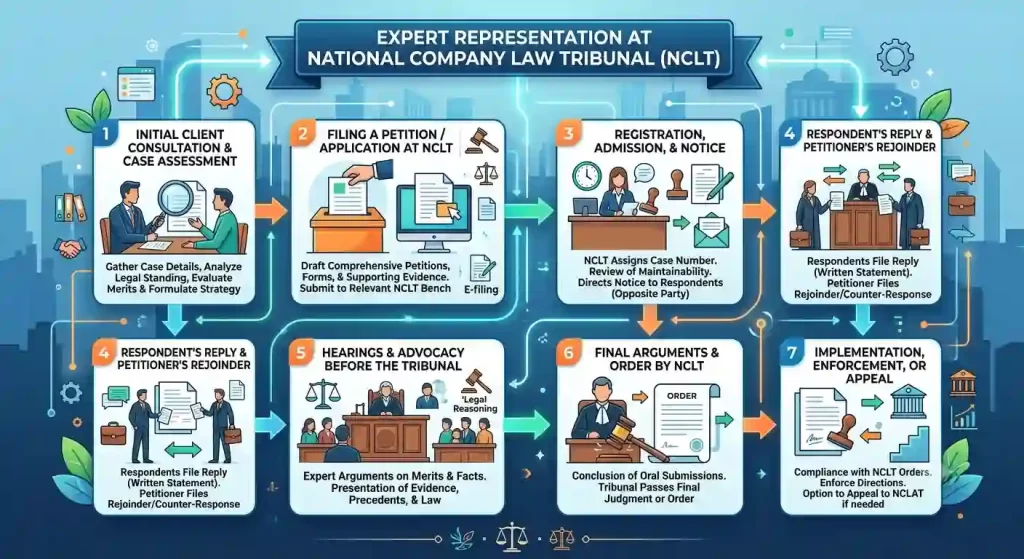
Effective NCLT representation begins with identifying the correct legal issue and statutory remedy. Rajendra Civil Law Firm offers comprehensive support from consultation through final orders and appeals. Our services can include petition drafting, document review, evidence preparation, filing coordination, and hearing representation. Furthermore, we assist with insolvency applications, shareholder disputes, corporate restructuring, restoration, and winding-up matters. We also advise directors, promoters, creditors, investors, and companies facing urgent corporate disputes. Every matter receives forum-specific analysis because NCLT jurisdiction differs from ordinary civil court jurisdiction. Lawyers also assess whether parallel proceedings require coordination or strategic restraint. Consequently, clients receive practical advice rather than fragmented litigation steps. Our approach considers commercial objectives alongside statutory rights and procedural requirements. Early consultation can help preserve evidence, avoid limitation problems, and select suitable legal remedies.
Below is a publication-ready, SEO/AEO-focused article for Rajendra Civil Law Firm. The legal framework reflects current NCLT information available in August 2026. The NCLT confirms jurisdiction under the Companies Act, 2013 and IBC, 2016, including CIRP, oppression, mismanagement, mergers, winding-up, and related proceedings. (National Company Law Tribunal)
Expert Representation at National Company Law Tribunal (NCLT)
NCLT Legal Representation for Corporate Disputes
Why Expert NCLT Representation Matters
Expert representation before the National Company Law Tribunal requires focused knowledge of corporate and insolvency laws. Rajendra Civil Law Firm assists companies, directors, shareholders, creditors, and stakeholders before appropriate NCLT Benches. The Tribunal handles company law matters under the Companies Act, 2013. It also acts as the adjudicating authority under the Insolvency and Bankruptcy Code, 2016. (National Company Law Tribunal) Therefore, each petition requires careful jurisdictional, procedural, and documentary assessment. Our legal support covers pleadings, applications, evidence, hearings, interim relief, and final orders. Additionally, lawyers assess limitation, maintainability, statutory notices, and supporting records before filing. Corporate insolvency matters demand strict attention to statutory timelines. Consequently, early legal advice can prevent avoidable procedural defects and financial exposure. We also coordinate with insolvency professionals when proceedings involve CIRP, liquidation, or creditor claims.
Companies Act Matters Before NCLT
NCLT proceedings cover several company disputes affecting shareholders, directors, creditors, and corporate management. The Tribunal addresses oppression and mismanagement petitions under applicable Companies Act provisions. It also considers class actions, share capital reduction, member register rectification, mergers, amalgamations, and company restoration matters. (National Company Law Tribunal) Therefore, legal representation must match the precise statutory remedy. Rajendra Civil Law Firm examines corporate records, shareholder agreements, board resolutions, financial statements, and statutory filings. We also identify conflicts involving directors, promoters, minority shareholders, and controlling groups. Furthermore, counsel can challenge unlawful corporate decisions through appropriate NCLT proceedings. Where necessary, we seek interim protection against prejudicial corporate actions. Legal strategy also considers possible appeals before the National Company Law Appellate Tribunal. Proper documentation strengthens the petition and helps present the dispute clearly.
Insolvency and Bankruptcy Code Representation
Corporate insolvency disputes require specialized representation because the IBC follows defined statutory processes. NCLT exercises jurisdiction over Corporate Insolvency Resolution Process proceedings as the adjudicating authority. (National Company Law Tribunal) Financial creditors, operational creditors, and corporate applicants may initiate appropriate proceedings. Lawyers must assess default, limitation, debt documentation, and statutory requirements before filing. Additionally, counsel assists creditors during admission hearings and subsequent CIRP stages. Representation can cover claims, resolution plans, avoidance applications, liquidation issues, and stakeholder disputes. Personal guarantor insolvency proceedings can also fall within NCLT jurisdiction. (National Company Law Tribunal) Therefore, parties need coordinated legal and commercial strategy throughout the process. Rajendra Civil Law Firm assists clients in protecting recovery rights and corporate interests. We also evaluate settlement opportunities when they offer legally sustainable outcomes.
NCLT Jurisdiction, Remedies and Litigation Support
Chennai NCLT Jurisdiction and Applicable Forums
NCLT Chennai Bench for Tamil Nadu Matters
The NCLT Chennai Bench exercises jurisdiction over Tamil Nadu and Puducherry. (National Company Law Tribunal) Its current address is Corporate Bhawan, UTI Building, Third Floor, No. 29 Rajaji Salai, Chennai. (National Company Law Tribunal) Companies registered within this territorial jurisdiction may face NCLT proceedings there. However, jurisdiction depends upon statutory requirements and the relevant corporate circumstances. Lawyers should verify the appropriate Bench before preparing petitions or applications. Rajendra Civil Law Firm provides representation for Chennai NCLT matters and related appellate proceedings. We assess whether the matter belongs before NCLT, NCLAT, High Court, or another forum. Furthermore, corporate disputes may involve ROC, MCA, IBBI, SEBI, GST authorities, or banks. Effective representation therefore requires coordinated forum selection. Early jurisdictional review reduces unnecessary objections and procedural delays.
NCLT Powers and Available Legal Remedies
NCLT provides statutory remedies across company law and insolvency proceedings. Available remedies depend upon the nature of the dispute and governing legislation. These remedies may include admission of insolvency applications, restoration of companies, and relief against oppression. They may also include directions concerning management, mergers, capital reduction, winding-up, and member records. (National Company Law Tribunal) Creditors can pursue remedies for qualifying financial or operational defaults under the IBC. Parties may also seek appropriate interim directions where statutory requirements support such relief. Additionally, aggrieved parties can consider appeals before NCLAT, subject to applicable law and limitation. The Civil Procedure Code does not automatically govern every NCLT proceeding like an ordinary civil suit. Therefore, specialized procedural rules and principles of natural justice require careful application. Lawyers also evaluate settlement, mediation, restructuring, and negotiated corporate solutions.
Oppression and Mismanagement Proceedings
Minority shareholders may seek relief when corporate affairs become oppressive or prejudicial. NCLT can adjudicate oppression and mismanagement disputes under the Companies Act. (National Company Law Tribunal) Such cases often involve unlawful board actions, exclusion from management, or misuse of corporate powers. Lawyers examine shareholding patterns, notices, minutes, resolutions, accounts, and correspondence. Additionally, counsel identifies whether statutory eligibility requirements apply to the proposed petition. Interim relief can become important when disputed actions threaten company assets or governance. Therefore, prompt legal assessment can protect shareholder rights before irreversible decisions occur. Rajendra Civil Law Firm prepares pleadings around statutory grounds and supporting evidence. We also challenge misleading records and procedural irregularities where legally justified. Proper presentation helps the Tribunal understand the commercial background and legal grievance.
Company Restoration and Winding-Up Matters
Companies may require legal assistance for restoration, winding-up, and related corporate proceedings. NCLT expressly handles restoration of company names and winding-up matters under applicable law. (National Company Law Tribunal) Restoration proceedings commonly require evidence explaining why the company should return to the register. Winding-up matters require careful assessment of debts, assets, creditor interests, and statutory grounds. Lawyers review ROC records, financial statements, tax records, contracts, and creditor claims. Furthermore, representation must address objections raised by regulators, creditors, shareholders, or other stakeholders. Appropriate orders may protect assets and clarify corporate obligations during proceedings. Rajendra Civil Law Firm provides drafting, filing, hearing, and compliance support for such cases. We also advise directors regarding consequences arising from corporate non-compliance. Timely representation can reduce risks created by incomplete statutory records.
Merger, Amalgamation and Corporate Restructuring
NCLT proceedings can facilitate statutory mergers, amalgamations, and corporate restructuring under the Companies Act. These transactions require detailed legal, financial, shareholder, and creditor analysis. Lawyers review schemes, valuation reports, corporate approvals, creditor positions, and regulatory requirements. Additionally, counsel coordinates procedural requirements involving the Tribunal and concerned authorities. Restructuring strategies may also address distressed businesses facing insolvency risks. Therefore, early legal review can identify regulatory objections before formal hearings. Rajendra Civil Law Firm assists businesses with petitions, affidavits, notices, hearings, and compliance requirements. We also consider tax, contractual, employment, intellectual property, and financing implications. Where multiple regulators become involved, coordinated submissions help maintain consistency. Properly structured advice supports efficient corporate restructuring while protecting stakeholder interests.
Appeals Before NCLAT and Higher Courts
An NCLT order may create significant consequences for companies, creditors, directors, or shareholders. Depending on the governing statute, an aggrieved party may pursue an appeal before NCLAT. Further judicial review may reach constitutional courts where legally permissible. Therefore, appellate strategy should begin immediately after receiving the challenged order. Lawyers examine findings, jurisdictional errors, procedural defects, evidence, limitation, and statutory interpretation. Additionally, counsel evaluates whether interim protection is necessary during the appeal. The Civil Procedure Code may assist by analogy in appropriate contexts, but NCLT proceedings remain specialized. Legal teams must therefore avoid treating every corporate dispute as an ordinary civil suit. Rajendra Civil Law Firm prepares appellate grounds based on the specific order and statutory framework. We also advise clients about realistic remedies, costs, timelines, and compliance obligations.
Evidence, Regulatory Issues and Corporate Criminal Concerns
Frequently Asked Questions
Documentary and Electronic Evidence
Corporate litigation increasingly depends on electronic records, financial data, emails, messages, and digital documents. Lawyers must preserve relevant evidence before disputes escalate. The Bharatiya Sakshya Adhiniyam, 2023 now forms the principal statutory framework for evidence. (India Code) However, evidence requirements depend upon the nature and forum of the proceeding. Corporate records can include board minutes, statutory registers, invoices, bank statements, emails, and digital communications. Therefore, proper preservation helps prevent disputes about authenticity and reliability. Rajendra Civil Law Firm reviews available documents before drafting pleadings or applications. We also identify inconsistencies that may affect corporate or insolvency claims. Where proceedings involve electronic evidence, counsel assesses applicable certification and admissibility requirements. Strong documentary preparation can improve clarity during contested NCLT hearings.
ROC, MCA, IBBI and Regulatory Coordination
NCLT disputes frequently intersect with regulatory authorities and statutory compliance departments. The Ministry of Corporate Affairs and Registrar of Companies maintain important corporate records. IBBI regulates insolvency professionals and the broader insolvency ecosystem. Additionally, SEBI, GST authorities, Income Tax authorities, and banks may become relevant. Lawyers must identify each authority’s role without confusing their respective statutory powers. Therefore, regulatory correspondence should remain consistent with pleadings filed before the Tribunal. Rajendra Civil Law Firm assists with legal responses involving corporate filings and regulatory concerns. We also examine notices, inspection reports, adjudication orders, and compliance records. Where necessary, counsel coordinates strategies across NCLT, NCLAT, High Court, and regulatory forums. This approach reduces contradictory positions and protects the client’s broader legal interests.
Criminal Complaints and Police Proceedings
Certain corporate disputes may also involve allegations of cheating, forgery, criminal breach, fraud, or dishonest conduct. Such allegations can trigger police complaints or criminal proceedings outside NCLT jurisdiction. The Bharatiya Nyaya Sanhita, 2023 replaced the Indian Penal Code framework from July 2024. (India Code) The Bharatiya Nagarik Suraksha Sanhita, 2023 governs criminal procedure under the new framework. (India Code) The Bharatiya Sakshya Adhiniyam, 2023 governs evidence questions in criminal proceedings. (India Code) Therefore, corporate and criminal strategies should remain legally coordinated. Nearby police authorities may receive complaints where alleged criminal conduct falls within police jurisdiction. For local reference, the Police station and Arcot Taluk police station serve areas around Arcot. Criminal complaints require separate assessment from NCLT remedies.
Strategic Legal Support for NCLT Litigation
Effective NCLT representation begins with identifying the correct legal issue and statutory remedy. Rajendra Civil Law Firm offers comprehensive support from consultation through final orders and appeals. Our services can include petition drafting, document review, evidence preparation, filing coordination, and hearing representation. Furthermore, we assist with insolvency applications, shareholder disputes, corporate restructuring, restoration, and winding-up matters. We also advise directors, promoters, creditors, investors, and companies facing urgent corporate disputes. Every matter receives forum-specific analysis because NCLT jurisdiction differs from ordinary civil court jurisdiction. Lawyers also assess whether parallel proceedings require coordination or strategic restraint. Consequently, clients receive practical advice rather than fragmented litigation steps. Our approach considers commercial objectives alongside statutory rights and procedural requirements. Early consultation can help preserve evidence, avoid limitation problems, and select suitable legal remedies.
FAQs
1. What matters does NCLT handle NCLT handles company law disputes, oppression, mismanagement, mergers, restoration, winding-up, and corporate insolvency matters under applicable statutes.
2. Can a creditor approach NCLT for unpaid debt Yes. A qualifying financial or operational creditor may initiate insolvency proceedings under the IBC, subject to statutory requirements.
3. Which NCLT Bench covers Tamil Nadu The NCLT Chennai Bench has territorial jurisdiction over Tamil Nadu and Puducherry. (National Company Law Tribunal)
4. Can NCLT orders be appealed Yes. Eligible NCLT orders can generally be challenged before NCLAT under the applicable statutory appeal provisions.
5. Does CPC directly govern NCLT proceedings NCLT proceedings are specialized. The CPC does not automatically apply like ordinary civil suits, so forum-specific procedure matters.
6. Can corporate fraud also involve police action Yes. Alleged cheating, forgery, fraud, or other offences may lead to separate criminal proceedings under the BNS and BNSS.
Read More
- Championing Motor Vehicle Accident Claims: Expert Legal Support
- Motor Accidents Claim Tribunal: Fighting for Your Rights
- Pursuing Medical Malpractice Claims: Expert Legal Representation
- Media Law and Disputes: Expert Legal Counsel You Can Count On
- Marriage Registration Made Simple: Expert Legal Assistance
- National Company Law Tribunal (NCLT)
This article is part of our guide: Winning Strategies for Business Litigation: Expert Legal Advice and Representation.