Motor Accidents Claim Tribunal: Fighting for Your Rights
In this article (6 sections)
- Common Legal Issues Before Motor Accidents Claim Tribunal
- Jurisdiction, Courts, Forums and Government Authorities Involved
- Tribunal Procedure From Petition to Award
- Insurance Company Defences and Legal Responses
- Important Evidence That Strengthens Compensation Claims
- Legal Remedies, Authorities and Support Available
Motor Accidents Claim Tribunal provides legal relief after road accidents across India. Every victim deserves timely compensation for injuries, disability, or death. Moreover, the tribunal follows the Motor Vehicles Act, 1988, as amended. Civil lawyers guide claimants through every legal stage confidently. Police stations register the First Information Report after serious accidents. Subsequently, investigators prepare records supporting compensation proceedings. Medical reports, eyewitness statements, insurance policies, and vehicle documents strengthen every claim. District tribunals examine evidence before determining compensation. Furthermore, appellate remedies remain available before the jurisdictional High Court. Relevant laws include Bharatiya Nagarik Suraksha Sanhita, 2023 (BNSS), Bharatiya Nyaya Sanhita, 2023 (BNS), Bharatiya Sakshya Adhiniyam, 2023 (BSA), and selected Code of Civil Procedure, 1908 (CPC) principles where applicable. Rajendra Civil Law Firm assists victims, legal heirs, pedestrians, passengers, cyclists, and motorists with comprehensive legal representation before tribunals, courts, insurance authorities, and related forums throughout India.
Motor Accidents Claim Tribunal: Fighting for Your Rights - Rajendra Civil Law Firm
Why Immediate Legal Action Improves Every Motor Accident Compensation Claim
Early legal action preserves valuable evidence and strengthens compensation claims before the tribunal. Therefore, victims should consult experienced advocates immediately after medical stabilization. Lawyers collect accident photographs, CCTV recordings, vehicle inspection reports, insurance documents, and hospital records. Prompt documentation reduces disputes regarding negligence and liability. Additionally, advocates coordinate with investigating officers and insurance companies for accurate records. Timely applications also prevent procedural complications during hearings. Courts appreciate consistent evidence supported by authentic documentation. Proper legal advice protects claimants from accepting inadequate settlements prematurely. Lawyers also evaluate permanent disability, medical expenses, future treatment, income loss, pain, suffering, and dependency compensation. Effective representation improves negotiation outcomes and courtroom success. Consequently, professional legal assistance safeguards every legal right throughout the compensation process. Strong preparation ultimately helps victims secure fair compensation while reducing unnecessary litigation delays before the Motor Accidents Claim Tribunal.
Legal Framework Governing Motor Accident Compensation in India
Motor accident compensation follows a structured legal framework protecting victims and dependents. The Motor Vehicles Act, 1988 establishes Motor Accidents Claim Tribunals across jurisdictions. Additionally, BNSS governs criminal investigation procedures after road accidents. BNS defines relevant criminal offences involving rash or negligent driving. BSA regulates admissibility and appreciation of evidence during proceedings. Insurance companies remain bound by statutory obligations under applicable insurance regulations. High Courts supervise tribunal decisions through appellate jurisdiction. Furthermore, the Supreme Court continues developing compensation principles through landmark judgments. District police, Regional Transport Offices, hospitals, forensic experts, and insurers collectively influence successful claims. Important legal issues include negligence, contributory negligence, permanent disability, wrongful death, insurance repudiation, delayed FIR registration, fake driving licences, uninsured vehicles, and quantum assessment. Experienced civil lawyers coordinate every legal requirement while protecting claimant interests before tribunals and appellate courts.
Common Legal Issues Before Motor Accidents Claim Tribunal
Motor accident litigation involves several factual and legal disputes requiring experienced representation. Negligence remains the most contested issue during tribunal proceedings. Furthermore, insurers often challenge policy coverage, driving licences, or accident circumstances. Lawyers carefully examine every document before presenting evidence. Frequent legal issues include:
- Rash and negligent driving
- Hit-and-run accident claims
- Permanent disability assessment
- Fatal accident dependency claims
- Insurance policy disputes
- Compensation calculation
- Contributory negligence
- Delay in filing claims
- Vehicle ownership disputes
- Commercial vehicle liability
Courts evaluate documentary evidence alongside witness testimony before determining liability. Medical experts also explain disability percentages affecting compensation calculations. Effective advocacy addresses procedural objections quickly while maintaining compliance with statutory requirements. Consequently, professional legal guidance significantly strengthens claimant positions before the Motor Accidents Claim Tribunal.
Jurisdiction, Courts, Forums and Government Authorities Involved
Motor accident compensation matters involve multiple authorities working under different statutory responsibilities. Tribunals decide compensation disputes arising from road accidents. Meanwhile, criminal courts independently determine criminal liability where offences exist. Relevant institutions include:
| Authority | Primary Role |
|---|---|
| Motor Accidents Claim Tribunal | Compensation adjudication |
| High Court | Appeals |
| Supreme Court | Constitutional and appellate remedies |
| Police Station | FIR and investigation |
| Regional Transport Office | Vehicle records |
| Insurance Company | Compensation liability |
| Government Hospital | Medical evidence |
| Forensic Experts | Scientific evidence |
Additionally, District Legal Services Authorities may provide legal aid to eligible victims. Consumer forums may also address limited insurance service disputes where appropriate. Coordination among authorities strengthens evidence and accelerates compensation proceedings. Experienced advocates ensure compliance with procedural requirements across every concerned forum.
Types of Compensation Available for Accident Victims
Motor accident compensation extends beyond immediate medical reimbursement. Tribunals consider every financial and personal loss arising from the accident. Therefore, claimants should present comprehensive supporting evidence. Compensation commonly includes:
- Medical expenses
- Future treatment costs
- Loss of income
- Future earning capacity
- Permanent disability
- Pain and suffering
- Attendant charges
- Transportation expenses
- Funeral expenses
- Loss of consortium
- Loss of estate
- Mental agony
Courts evaluate age, occupation, disability percentage, future prospects, and dependency before determining final compensation. Insurance companies frequently dispute higher claims. Accordingly, experienced advocates present medical evidence, expert opinions, employment records, and financial documents supporting appropriate compensation under applicable statutory provisions.
Essential Documents Required for Successful Tribunal Claims
Proper documentation strengthens every compensation claim before the tribunal. Missing records frequently delay proceedings unnecessarily. Therefore, victims should preserve every relevant document immediately after the accident. Important documents include:
- FIR copy
- Accident Information Report
- Charge sheet
- Medical records
- Disability certificate
- Insurance policy
- Driving licence
- Registration Certificate
- Hospital bills
- Salary records
- Identity proof
- Death certificate where applicable
Advocates verify document consistency before filing compensation petitions. Medical experts also certify disability whenever permanent injuries exist. Documentary evidence supported by credible witnesses increases claim reliability. Consequently, organized documentation significantly improves the likelihood of obtaining fair and timely compensation before the Motor Accidents Claim Tribunal.
How Rajendra Civil Law Firm Supports Accident Victims
Rajendra Civil Law Firm delivers comprehensive legal representation throughout motor accident compensation proceedings. Lawyers evaluate every case carefully before recommending appropriate legal strategies. Moreover, the firm coordinates with hospitals, investigators, insurance companies, and expert witnesses whenever necessary. Services include claim drafting, evidence collection, compensation assessment, tribunal appearances, settlement negotiations, appellate representation, execution proceedings, and legal consultation. Advocates also monitor statutory timelines while protecting client interests during every hearing. Practical legal advice helps clients understand procedural developments confidently. Transparent communication builds trust throughout litigation. Furthermore, experienced representation minimizes avoidable legal complications while maximizing lawful compensation opportunities. Every case receives careful attention based upon applicable laws, judicial precedents, factual evidence, and client objectives. Professional advocacy ultimately helps accident victims pursue justice efficiently before the Motor Accidents Claim Tribunal.
Filing a Motor Accident Claim Before the Tribunal
Motor accident compensation begins with proper claim preparation and accurate legal documentation. Victims or legal heirs should collect every supporting record before filing. Furthermore, advocates verify jurisdiction, limitation requirements, and maintainability before presenting the petition. Every application should clearly explain accident facts, negligence, injuries, treatment, and financial losses. Courts appreciate complete pleadings supported by reliable evidence. Insurance companies usually submit written objections challenging liability or compensation. Therefore, lawyers prepare strong replies using statutory provisions and judicial precedents. Witnesses, medical experts, employers, and investigating officers may support the claimant during hearings. Documentary evidence remains equally important throughout proceedings. Effective case preparation reduces unnecessary adjournments and procedural objections. Consequently, organized legal representation improves the chances of securing fair compensation from the Motor Accidents Claim Tribunal within a reasonable period while protecting every statutory and procedural right.
Tribunal Procedure From Petition to Award
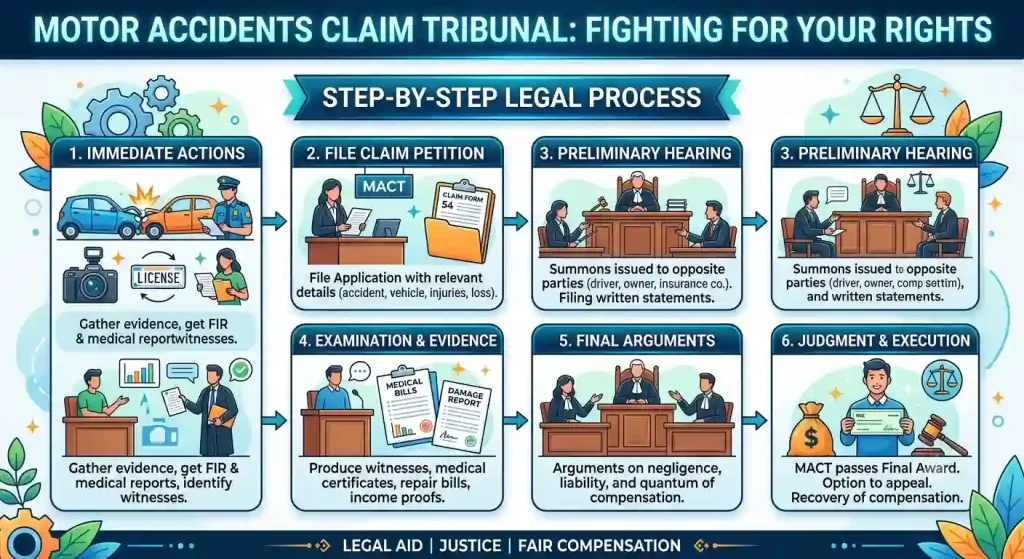
Motor Accidents Claim Tribunal follows a structured procedure ensuring fairness for every party. Initially, advocates file the compensation petition before the competent tribunal. Subsequently, notices reach the vehicle owner, driver, and insurer. Respondents submit written statements explaining their legal defence. Courts frame issues before recording documentary and oral evidence. Medical specialists often explain disability assessments during examination. Insurance representatives may dispute negligence, policy validity, or compensation calculations. Lawyers cross-examine witnesses carefully to establish relevant facts. After evidence concludes, parties present detailed legal arguments. The tribunal evaluates statutory provisions, precedents, and available records before delivering the award. Successful claimants may initiate execution proceedings if compensation remains unpaid. Appellate remedies also remain available before the jurisdictional High Court. Efficient legal strategy ensures every procedural stage supports the claimant’s legitimate interests effectively.
Insurance Company Defences and Legal Responses
Insurance companies frequently raise legal objections while contesting compensation petitions before tribunals. Common defences involve policy breaches, invalid driving licences, delayed reporting, contributory negligence, or fabricated evidence. Therefore, experienced advocates anticipate these arguments during case preparation. Medical records, police investigation reports, witness testimony, and expert opinions often rebut unsupported allegations. Lawyers also examine insurance contracts for exclusions and statutory obligations. Judicial precedents guide tribunals while interpreting disputed clauses. Additionally, advocates challenge arbitrary claim repudiation whenever insurers violate applicable legal standards. Accurate documentation strengthens claimant credibility during every hearing. Strong legal arguments frequently discourage unnecessary litigation tactics. Consequently, victims receive better opportunities to recover lawful compensation despite complex insurance disputes. Professional representation protects claimants against unfair settlement offers and procedural challenges throughout tribunal proceedings.
Important Evidence That Strengthens Compensation Claims
Reliable evidence forms the foundation of every successful compensation petition before the tribunal. Claimants should preserve original documents whenever possible. Moreover, digital evidence increasingly supports accident reconstruction and liability determination. Valuable evidence includes:
- CCTV footage
- Dash camera recordings
- Mobile photographs
- Scene sketches
- Vehicle inspection reports
- Medical certificates
- Disability assessment reports
- Salary slips
- Income tax returns
- Expert opinions
- Witness statements
- Police investigation records
Tribunals examine documentary and oral evidence collectively before determining negligence and compensation. Lawyers organize records chronologically for easier judicial appreciation. Medical experts clarify long-term physical limitations affecting future earnings. Accordingly, comprehensive evidence significantly improves the claimant’s position throughout litigation while reducing opportunities for unnecessary disputes raised by opposing parties.
Compensation Assessment and Judicial Principles
Tribunals calculate compensation using established legal principles and factual circumstances. Every case requires individualized assessment rather than mechanical calculations. Therefore, judges consider age, occupation, income, disability percentage, medical expenses, future prospects, and dependency. Courts also evaluate emotional suffering and diminished quality of life where supported by evidence. Relevant judicial principles promote fairness and consistency across compensation awards. Advocates rely upon authoritative precedents while presenting calculations. Economic losses receive careful scrutiny through documentary proof. Furthermore, future medical treatment and rehabilitation expenses deserve proper consideration whenever supported medically. Sound legal submissions assist tribunals during compensation assessment. Consequently, victims receive compensation reflecting actual financial losses and personal hardships instead of arbitrary estimates inconsistent with statutory objectives.
Legal Remedies Available After Tribunal Decisions
Tribunal awards do not always conclude every legal dispute permanently. Dissatisfied parties may exercise available statutory remedies within prescribed timelines. Common legal remedies include:
- Appeal before the High Court
- Review where legally maintainable
- Execution of compensation award
- Recovery proceedings
- Interest claim enforcement
- Settlement during appeal
- Interim compensation applications
- Legal aid assistance
Appellate courts review legal errors, procedural irregularities, and compensation assessments carefully. Lawyers prepare comprehensive appeal memoranda supported by statutory provisions and judicial precedents. Timely action protects valuable legal rights after the tribunal delivers its judgment. Accordingly, experienced legal representation remains essential even after obtaining a compensation award.
Latest Legal Developments Affecting Accident Claims
Motor accident litigation continues evolving through legislative reforms and judicial interpretation. The Motor Vehicles Act remains the principal compensation statute. Additionally, BNSS modernizes criminal investigation procedures following road accidents. BNS governs offences involving rash, negligent, and dangerous driving. BSA strengthens evidentiary evaluation before courts and tribunals. Electronic records now receive wider recognition under applicable evidentiary principles. Digital documentation improves investigation accuracy and case management. Courts increasingly encourage efficient adjudication while discouraging avoidable delays. Insurance compliance also receives closer judicial scrutiny across several jurisdictions. Furthermore, technology assists evidence collection through surveillance systems and electronic records. Lawyers who understand recent legal developments provide stronger representation before tribunals, appellate courts, and related judicial forums handling motor accident compensation matters.
Choosing Experienced Legal Representation for Tribunal Success
Selecting experienced legal representation significantly influences the outcome of motor accident compensation proceedings. Qualified advocates understand procedural rules, insurance practices, judicial precedents, and evidentiary requirements thoroughly. Moreover, they evaluate claim value realistically before commencing litigation. Professional representation includes legal consultation, documentation review, claim drafting, witness preparation, tribunal advocacy, settlement negotiation, appellate assistance, and award execution. Clients also receive practical guidance regarding timelines, legal costs, available remedies, and procedural developments. Strong communication encourages informed decision-making throughout litigation. Ethical advocacy remains essential while pursuing maximum lawful compensation. Every legal strategy should reflect statutory provisions and factual evidence. Consequently, Rajendra Civil Law Firm delivers comprehensive legal support before Motor Accidents Claim Tribunals, High Courts, and other competent judicial forums while protecting every client’s legal rights effectively.
Conclusion: Protect Your Legal Rights After Every Motor Accident
Motor accident claims demand prompt legal action and reliable professional guidance. Victims should preserve evidence immediately after every accident. Furthermore, timely medical treatment strengthens both recovery and compensation claims. Police investigations, medical records, insurance documents, and witness statements collectively establish liability before the Motor Accidents Claim Tribunal. Experienced advocates identify legal risks before they affect compensation. Courts, tribunals, and insurers expect accurate documentation throughout proceedings. Consequently, organized preparation improves the likelihood of obtaining fair compensation without avoidable delays. Rajendra Civil Law Firm represents accident victims, legal heirs, pedestrians, passengers, and vehicle owners across diverse compensation matters. The firm provides strategic legal support before Motor Accidents Claim Tribunals, High Courts, and other competent forums. Professional representation ultimately protects legal rights while pursuing lawful compensation under the Motor Vehicles Act, BNSS, BNS, BSA, applicable CPC principles, and prevailing judicial precedents.
Legal Remedies, Authorities and Support Available
Motor accident victims may pursue several legal remedies depending upon the circumstances. Appropriate legal strategy depends upon available evidence and statutory rights. Therefore, professional legal advice remains valuable from the beginning. Important remedies and authorities include:
| Legal Issue | Remedy / Authority |
|---|---|
| Compensation claim | Motor Accidents Claim Tribunal |
| Fatal accident claim | MACT by legal heirs |
| Insurance dispute | High Court / Appropriate Forum |
| Rash or negligent driving | Police Station and Criminal Court |
| Hit-and-run compensation | Claims under applicable Government Scheme |
| Award execution | Motor Accidents Claim Tribunal |
| Appeal | Jurisdictional High Court |
| Free legal aid | District Legal Services Authority |
| Vehicle records | Regional Transport Office (RTO) |
| Investigation | Jurisdictional Police Station |
Nearby police stations register FIRs according to the accident location. District MACTs exercise territorial jurisdiction over eligible compensation claims. Relevant authorities include State Transport Departments, Regional Transport Offices, Police Departments, Legal Services Authorities, Government Hospitals, Insurance Regulatory authorities, and competent appellate courts.
Frequently Asked Questions
FAQ 1: Who can file a Motor Accident Claim Tribunal case Victims, injured passengers, pedestrians, cyclists, vehicle owners, and legal heirs may file claims. Proper evidence, medical records, and accident documents strengthen compensation proceedings.
FAQ 2: What documents are essential for a compensation claim FIR, charge sheet, medical records, disability certificate, insurance policy, driving licence, registration certificate, hospital bills, income proof, photographs, and witness details support claims.
FAQ 3: Can compensation be claimed without a criminal conviction Yes. Tribunal proceedings independently determine compensation. Criminal prosecution and compensation proceedings generally follow separate legal standards and objectives.
FAQ 4: Can legal heirs claim compensation after a fatal accident Yes. Legal heirs may seek dependency compensation, funeral expenses, consortium, loss of estate, and other lawful benefits before the Motor Accidents Claim Tribunal.
FAQ 5: Can the tribunal award future medical expenses Yes. Courts may award future treatment expenses when reliable medical evidence establishes continuing healthcare needs arising from the accident injuries.
FAQ 6: Can a tribunal award be challenged Yes. Aggrieved parties may file an appeal before the jurisdictional High Court within the applicable limitation period, subject to statutory requirements and judicial procedures.
Read More
- Pursuing Medical Malpractice Claims: Expert Legal Representation
- Media Law and Disputes: Expert Legal Counsel You Can Count On
- Marriage Registration Made Simple: Expert Legal Assistance
- Resolving Marine Disputes: Expert Legal Guidance
- Pursuing Maintenance Cases: Legal Strategies for Success
- Ministry of Road Transport and Highways (MoRTH) – Motor Vehicles Act, 1988
This article is part of our guide: Consumer Complaints in Chennai: Find the Best Reliable Advocate.