
Pursuing Maintenance Cases: Legal Strategies for Success
In this article (5 sections)
Pursuing Maintenance Cases - Maintenance proceedings protect spouses, children, and parents facing financial hardship. Indian courts grant relief through several statutory provisions. Therefore, early legal planning improves recovery prospects and minimizes procedural delays. Rajendra Civil Law Firm assists clients before Family Courts, District Courts, High Courts, and the Supreme Court. Lawyers evaluate income records, liabilities, and supporting evidence before filing claims. Proper documentation strengthens every maintenance petition from the beginning. Moreover, applicants should preserve bank statements, salary slips, medical bills, school expenses, and property records. Courts examine genuine financial needs alongside the respondent’s earning capacity. BNSS, BSA, CPC, and personal laws influence procedural aspects depending upon jurisdiction. Legal Services Authorities also provide eligible litigants with free legal assistance. Nearby police stations may assist when court protection orders require enforcement.
Pursuing Maintenance Cases: Legal Strategies for Success - Rajendra Civil Law Firm
Key objectives include:
- Financial security
- Child welfare
- Interim maintenance
- Litigation support
- Execution of maintenance orders
Legal Framework Governing Maintenance Claims in India
Indian maintenance law combines secular and personal legal provisions. Section 144 BNSS now governs maintenance proceedings replacing the earlier criminal procedure provision. Additionally, the Hindu Marriage Act, Hindu Adoptions and Maintenance Act, Special Marriage Act, Muslim Women legislation, Protection of Women from Domestic Violence Act, and older citizen laws provide remedies. Courts interpret every statute according to factual circumstances. BSA governs admissibility and appreciation of evidence during contested proceedings. CPC principles apply wherever civil procedures become relevant before competent courts. High Courts regularly clarify maintenance principles through binding precedents. Important legal provisions include:
| Law | Primary Purpose |
|---|---|
| BNSS Section 144 | Maintenance proceedings |
| Hindu Marriage Act | Spousal maintenance |
| Hindu Adoptions and Maintenance Act | Family maintenance |
| Domestic Violence Act | Monetary relief |
| Older Citizens Act | Parent maintenance |
Proper statute selection significantly improves procedural efficiency.
Who Can Claim Maintenance Before Competent Courts
Several categories receive statutory protection under Indian maintenance laws. Accordingly, wives, divorced spouses, dependent children, adopted children, disabled adult children, and older parents may pursue maintenance. Courts examine dependency before granting relief. Financial incapacity remains an essential consideration during adjudication. Applicants should establish genuine expenses through reliable documentary evidence. Respondents frequently dispute income disclosures. Therefore, advocates collect employment records, business information, tax returns, property details, and digital evidence. Family Courts encourage mediation before contested hearings whenever appropriate. Legal aid remains available through District Legal Services Authorities for eligible applicants. Eligible claimants commonly include:
- Wife.
- Divorced wife.
- Minor children.
- Disabled dependents.
- Older citizen parents.
- Adopted children under applicable laws. Timely filing often prevents prolonged financial hardship.
Choosing the Correct Forum for Maintenance Proceedings
Forum selection affects litigation speed, jurisdiction, procedural compliance, and enforcement. Family Courts generally hear matrimonial maintenance disputes where established. Otherwise, competent Judicial Magistrates or civil courts exercise jurisdiction according to applicable legislation. High Courts supervise lower courts through constitutional and statutory powers. The Supreme Court settles substantial legal questions. Moreover, mediation centres, Lok Adalats, and court-annexed settlement mechanisms encourage negotiated resolutions. Petitioners should file cases where jurisdiction legally exists. Incorrect filing causes avoidable delays. Lawyers verify territorial jurisdiction before presenting pleadings. Jurisdiction depends upon:
- Residence of parties.
- Marriage location.
- Cause of action.
- Applicable statute.
- Competent court notification. Accurate jurisdiction strengthens procedural compliance and avoids unnecessary objections.
Preparing Strong Evidence Before Filing the Petition
Evidence determines the strength of every maintenance claim. Consequently, applicants should organize financial records before initiating proceedings. BSA emphasizes credible documentary and electronic evidence. Salary certificates, income tax returns, business accounts, digital payments, property documents, school invoices, medical expenses, rent agreements, insurance policies, and bank statements establish genuine requirements. Witness testimony further supports disputed facts. Lawyers also investigate concealed assets through lawful methods. Courts may direct financial disclosure from both parties. Honest disclosure enhances judicial confidence. Essential documents include:
- Identity proof.
- Marriage records.
- Birth certificates.
- Income documents.
- Medical records.
- Educational expenses.
- Property details.
- Banking transactions. Well-prepared evidence substantially increases the likelihood of obtaining fair maintenance orders.
Building a Winning Maintenance Case Through Effective Legal Strategy
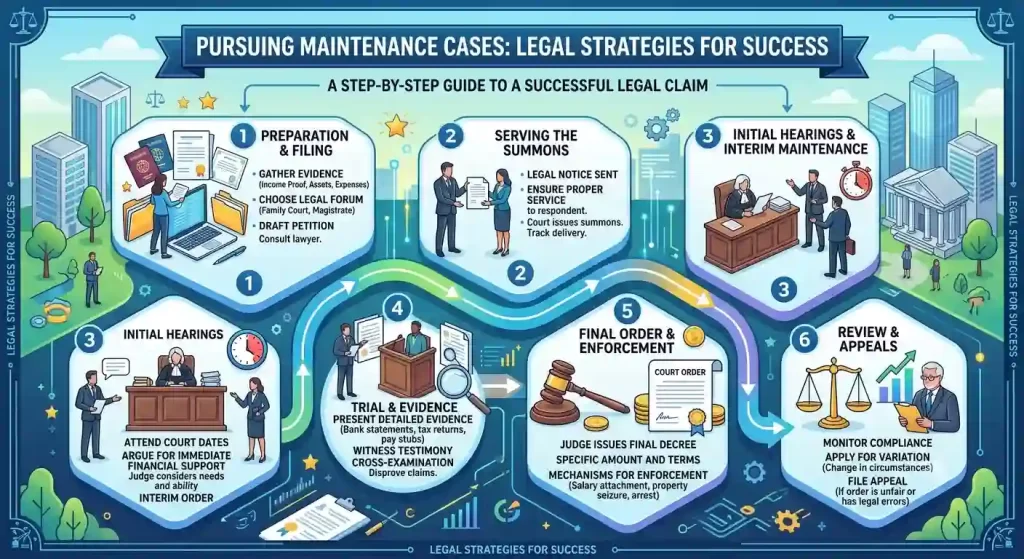
A successful maintenance case depends upon preparation, accuracy, and timely legal action. Therefore, applicants should disclose every material fact honestly before filing proceedings. Courts carefully examine income, liabilities, assets, qualifications, lifestyle, and earning capacity. Lawyers prepare pleadings with supporting documents and relevant judicial precedents. Respondents often understate earnings or conceal valuable assets. Accordingly, advocates gather admissible electronic records, employment details, business information, and property documents. BSA supports reliance upon legally obtained electronic evidence during trial. Courts also evaluate children’s education, healthcare, housing, and daily living expenses before fixing maintenance. Successful legal strategies include:
- Collect complete financial records.
- Preserve electronic communications.
- File accurate pleadings.
- Respond promptly to notices.
- Follow every court direction. Careful preparation improves credibility and strengthens the applicant’s position.
Interim Maintenance and Urgent Financial Relief
Interim maintenance protects dependents during lengthy litigation. Consequently, courts may grant temporary financial support before final adjudication. Applicants should request urgent relief with complete expense statements and supporting evidence. Family Courts and competent Magistrates consider immediate necessities, children’s welfare, medical expenses, and housing costs. Delay in seeking interim relief may increase financial hardship. Lawyers therefore present concise affidavits with verified documents. Respondents may challenge exaggerated claims through evidence and cross-examination. Courts balance fairness while determining reasonable interim amounts. Common urgent expenses include:
- School fees.
- Medical treatment.
- Monthly rent.
- Household expenses.
- Essential utilities.
- Food and transportation. Prompt interim applications reduce hardship and preserve financial stability throughout pending proceedings.
Defending False or Excessive Maintenance Claims
Every maintenance claim deserves judicial scrutiny based upon reliable evidence. Therefore, respondents should present truthful financial disclosures and lawful documentary proof. Courts reject unsupported allegations and evaluate genuine earning capacity instead of speculative assumptions. Lawyers examine employment records, income tax returns, loan liabilities, medical conditions, and dependent responsibilities. Cross-examination exposes contradictions whenever evidence lacks credibility. BSA governs admissibility and appreciation of documentary and electronic material. Applicants also remain accountable for accurate financial disclosures. Effective defence measures include:
- Produce authentic income records.
- Explain unavoidable liabilities.
- Challenge fabricated documents.
- Present independent witnesses.
- Preserve electronic evidence. A balanced defence promotes fair adjudication while protecting legitimate legal rights.
Enforcement of Maintenance Orders and Recovery Remedies
Obtaining a maintenance order marks only one stage of litigation. However, effective enforcement ensures actual financial recovery. Courts possess authority to compel compliance through lawful execution proceedings. Applicants may seek recovery of arrears, attachment of property, salary attachment, or other statutory remedies where permitted. Persistent non-compliance attracts serious legal consequences under applicable provisions. Lawyers monitor compliance and initiate execution without unnecessary delay. Nearby police stations may assist when courts issue enforceable directions requiring official support. Available enforcement remedies include:
| Remedy | Purpose |
|---|---|
| Execution Petition | Recover unpaid maintenance |
| Salary Attachment | Secure regular payments |
| Property Attachment | Recover outstanding dues |
| Court Directions | Ensure compliance |
| Appeal or Revision | Challenge erroneous orders |
Timely enforcement protects dependents from prolonged financial uncertainty.
Alternative Dispute Resolution and Settlement Options
Not every maintenance dispute requires prolonged courtroom litigation. Accordingly, mediation often provides practical and cost-effective solutions. Family Courts regularly encourage settlement discussions before contested trials. Mediators help parties negotiate maintenance amounts, payment schedules, educational expenses, and future obligations. Lok Adalats also resolve suitable disputes through voluntary compromise. Lawyers ensure every settlement protects statutory rights and remains legally enforceable. Courts generally record lawful settlements after verifying voluntary consent. Benefits of negotiated settlement include:
- Faster resolution.
- Lower litigation costs.
- Reduced emotional stress.
- Better compliance.
- Greater privacy. Constructive negotiations frequently preserve family relationships while securing dependable financial support for deserving dependents.
Appeals, Revision, and Modification of Maintenance Orders
Maintenance orders remain subject to judicial review whenever law permits. Therefore, an aggrieved party may file an appeal, revision, or modification petition before the competent forum. Courts examine substantial legal errors, procedural irregularities, fresh evidence, and material changes in circumstances. Increased income, unemployment, remarriage where legally relevant, serious illness, or educational expenses may justify modification. Lawyers should file proceedings within the prescribed limitation period. Delay may weaken available remedies. High Courts exercise supervisory jurisdiction in appropriate matters. The Supreme Court addresses substantial questions affecting legal interpretation. Important post-order remedies include:
- Appeal before the competent appellate court.
- Revision where legally maintainable.
- Modification based on changed circumstances.
- Execution for unpaid maintenance.
- Review where permitted by law. Timely legal advice protects valuable rights and improves procedural success.
Common Mistakes That Weaken Maintenance Cases
Many deserving parties lose valuable opportunities because of avoidable mistakes. Consequently, applicants and respondents should approach every proceeding with preparation and honesty. Incomplete financial disclosure often damages credibility before the court. Missing hearings also delays justice and increases litigation costs. Lawyers should verify every pleading before filing. Documentary evidence deserves careful preservation throughout the case. Digital records, emails, bank transactions, and mobile communications frequently strengthen disputed claims. Courts appreciate consistent conduct and truthful testimony during examination. Avoid these common mistakes:
- Hiding income or assets.
- Ignoring court notices.
- Filing incorrect documents.
- Delaying execution proceedings.
- Making false allegations.
- Destroying electronic evidence. Careful compliance with legal procedures significantly improves the likelihood of obtaining a fair outcome.
Why Choose Rajendra Civil Law Firm for Maintenance Litigation
Rajendra Civil Law Firm delivers strategic legal representation for maintenance disputes across India. The firm advises spouses, children, older citizens, and families through every litigation stage. Lawyers prepare legally compliant petitions supported by strong documentary evidence. They also represent clients before Family Courts, District Courts, High Courts, and the Supreme Court. Furthermore, the team assists with mediation, execution proceedings, appeals, interim maintenance applications, and settlement negotiations. Every strategy focuses upon protecting financial rights while reducing unnecessary delays. Clients receive practical guidance regarding BNSS, BSA, CPC, applicable personal laws, and judicial procedures. Professional representation improves legal preparedness and procedural compliance. Early consultation often strengthens evidence collection and increases the prospects of obtaining sustainable maintenance relief through lawful remedies.
Frequently Asked Questions
1. Which court hears a maintenance case in India Family Courts generally hear maintenance disputes. Otherwise, competent Magistrates or civil courts exercise jurisdiction under BNSS and applicable personal laws.
2. Can I claim interim maintenance before the final decision Yes. Courts may grant interim maintenance after examining immediate financial needs, income details, children’s expenses, and supporting evidence during pending proceedings.
3. What documents strengthen a maintenance petition Marriage records, identity proof, bank statements, salary slips, income tax returns, medical bills, school expenses, property documents, and electronic evidence improve claims.
4. Can maintenance amounts change after the court order Yes. Courts may modify maintenance when income, employment, health, dependency, or other material circumstances substantially change after the original order.
5. What happens if the respondent refuses to pay maintenance The applicant may initiate execution proceedings, seek attachment of salary or property, recover arrears, and pursue other lawful enforcement remedies ordered by the court.
6. Is free legal assistance available for maintenance cases Eligible applicants may obtain free legal aid through District Legal Services Authorities, helping them access representation and pursue lawful maintenance remedies effectively.
Read More
- Legal Separation Simplified: Expert Guidance You Can Trust
- Issuing Legal Notices: Expert Guidance for Effective Communication
- Expert Legal Representation for Labor Issues
- Protecting Intellectual Property: Expert Legal Counsel
- Insider’s Guide to Insolvency and Liquidation Proceedings
- National Legal Services Authority (NALSA) Services
This article is part of our guide: Resolving Real Estate Disputes: Expert Legal Guidance and Representation.