Issuing Legal Notices: Expert Guidance for Effective Communication
In this article (4 sections)
Issuing Legal Notices - A legal notice starts formal communication before litigation or settlement discussions. It informs another party about grievances and expected remedies. Moreover, a well-drafted notice prevents unnecessary disputes through clear legal demands. Many civil disputes conclude after effective legal communication. Businesses, individuals, landlords, tenants, employers, employees, consumers, and NRIs regularly use legal notices. Rajendra Civil Law Firm prepares notices with strong legal reasoning and supporting evidence. Proper drafting reduces ambiguity and strengthens future litigation. Every notice should mention facts, legal provisions, jurisdiction, deadlines, and available remedies. Courts often consider pre-litigation conduct during proceedings. Therefore, professional drafting protects legal rights and supports fair negotiations. Relevant matters include property disputes, breach of contract, recovery suits, consumer complaints, family disputes, employment issues, partnership conflicts, company matters, cheque dishonour, insurance claims, banking disputes, and commercial disagreements. Effective notices also improve settlement opportunities before approaching courts, tribunals, commissions, or other competent authorities.
Issuing Legal Notices: Expert Guidance for Effective Communication - Rajendra Civil Law Firm
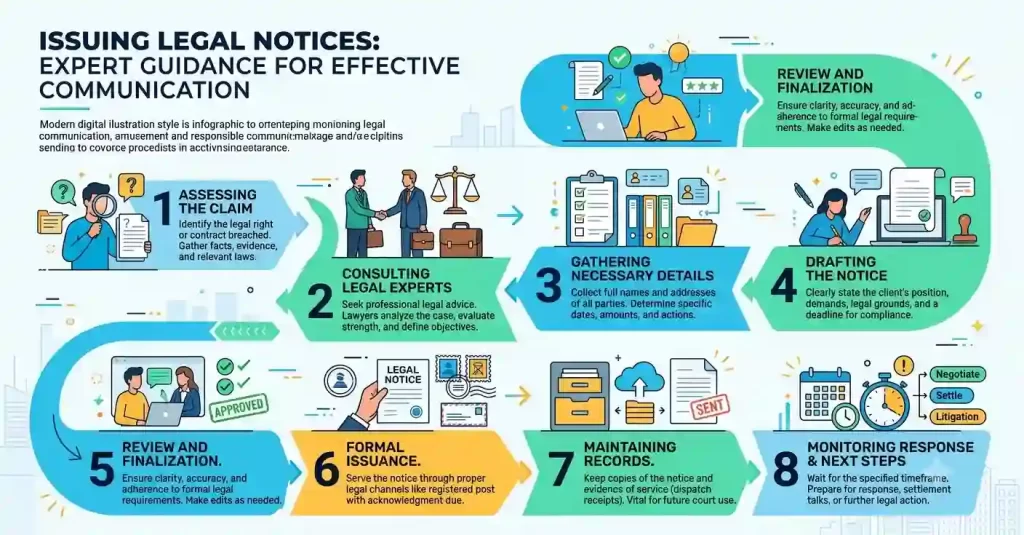
Essential Components of a Legally Strong Notice
Every legal notice requires complete factual accuracy and legal clarity. Additionally, proper documentation strengthens every allegation and claim. Essential contents generally include:
- Parties’ complete names and addresses.
- Chronological statement of facts.
- Relevant contractual obligations.
- Applicable legal provisions.
- Specific legal demands.
- Reasonable compliance period.
- Consequences of non-compliance.
- Advocate’s details and signature.
Supporting documents increase credibility during future proceedings. Jurisdiction should mention the appropriate civil court, commercial court, tribunal, consumer commission, family court, labour court, or arbitration forum. Notices may rely upon the Code of Civil Procedure, 1908, the Bharatiya Nyaya Sanhita, 2023, the Bharatiya Nagarik Suraksha Sanhita, 2023, the Bharatiya Sakshya Adhiniyam, 2023, contractual obligations, statutory rights, and judicial precedents. Proper drafting minimizes technical objections and improves legal enforceability during subsequent litigation or settlement discussions.
Common Situations Requiring Legal Notices
Legal notices apply across numerous civil and commercial disputes. Consequently, timely action preserves valuable legal rights. Common situations include the following table:
| Legal Issue | Concerned Forum | Possible Remedy |
|---|---|---|
| Property dispute | Civil Court | Declaration, injunction |
| Money recovery | Civil Court | Recovery suit |
| Cheque dishonour | Criminal Court | Statutory proceedings |
| Consumer complaint | Consumer Commission | Compensation |
| Employment dispute | Labour Court | Reinstatement or benefits |
| Contract breach | Commercial Court | Damages |
| Family property dispute | Civil Court | Partition |
| Insurance claim | Consumer Commission | Claim settlement |
Each notice should include supporting records, witness details, correspondence, invoices, agreements, photographs, electronic evidence, and payment records. Strong documentation creates persuasive legal communication before litigation begins.
Legal Framework, Jurisdiction, and Strategic Drafting
Latest Legal Framework Supporting Legal Notices
Legal notices derive strength from statutory provisions and judicial principles. Moreover, appropriate legal references increase credibility before courts and authorities. Civil disputes generally follow the Code of Civil Procedure, 1908. Criminal allegations may involve the Bharatiya Nyaya Sanhita, 2023, the Bharatiya Nagarik Suraksha Sanhita, 2023, and the Bharatiya Sakshya Adhiniyam, 2023 wherever applicable. Consumer disputes proceed before Consumer Commissions under consumer protection laws. Commercial disagreements may reach Commercial Courts or arbitration tribunals. Banking disputes sometimes involve the Banking Ombudsman or Debt Recovery Tribunal. Company matters may proceed before the National Company Law Tribunal. Revenue matters involve competent revenue authorities. Proper jurisdiction prevents unnecessary objections and delays. Professional drafting identifies applicable statutes, contractual obligations, limitation periods, available remedies, and competent forums before dispatching every legal notice. Such preparation significantly improves settlement prospects and future litigation strategy.
Choosing the Correct Jurisdiction and Forum
Selecting the proper jurisdiction remains essential before issuing any legal notice. Therefore, advocates examine territorial jurisdiction, pecuniary jurisdiction, contractual clauses, and statutory requirements. Suitable forums generally include:
- Civil Courts.
- Commercial Courts.
- Consumer Commissions.
- Family Courts.
- Labour Courts.
- Debt Recovery Tribunals.
- National Company Law Tribunal.
- Revenue Authorities.
- Arbitration Tribunals.
- High Courts.
Police stations may receive complaints where criminal offences accompany civil disputes. Jurisdiction depends upon the cause of action, property location, contract execution, business transactions, or defendant’s residence. Proper forum selection avoids unnecessary procedural objections. Accurate legal notices also identify relevant government departments whenever statutory authorities exercise regulatory powers. Strategic drafting ensures compliance with applicable procedural requirements before initiating formal legal proceedings.
Effective Drafting Techniques for Better Legal Results
A professionally drafted legal notice communicates facts with precision and confidence. Furthermore, persuasive drafting encourages early dispute resolution without prolonged litigation. Every notice should maintain respectful language while asserting enforceable legal rights. Consider these practical drafting principles:
- State facts chronologically.
- Avoid emotional allegations.
- Quote relevant statutory provisions.
- Mention documentary evidence.
- Specify monetary claims accurately.
- Provide reasonable compliance time.
- Preserve future legal remedies.
- Request written response.
Each statement should remain factually verifiable and legally sustainable. Clear language reduces misunderstanding during negotiations. Supporting documents strengthen every legal assertion before courts, tribunals, commissions, or regulatory authorities. Consequently, recipients often prefer negotiated settlements instead of lengthy legal proceedings.
Legal Remedies Available After Non-Compliance
Failure to comply with a legal notice creates several legal options. Accordingly, the next remedy depends upon applicable law and available evidence. Common remedies include:
| Nature of Dispute | Legal Remedy | Competent Authority |
|---|---|---|
| Contract breach | Civil Suit | Civil Court |
| Commercial dispute | Commercial Suit | Commercial Court |
| Consumer grievance | Compensation | Consumer Commission |
| Property dispute | Injunction or Declaration | Civil Court |
| Employment issue | Service Benefits | Labour Court |
| Company dispute | Corporate Relief | NCLT |
| Banking recovery | Recovery Proceedings | DRT |
| Criminal intimidation | Criminal Complaint | Police or Criminal Court |
Experienced advocates evaluate documents before selecting the most effective legal remedy. Early legal advice often saves litigation costs and valuable business relationships. Well-planned legal strategy enhances successful enforcement of legal rights while minimizing procedural complications.
Professional Legal Assistance for Effective Legal Notices
Why Rajendra Civil Law Firm Is the Right Choice
Professional legal drafting significantly improves dispute resolution opportunities before litigation begins. Moreover, experienced advocates identify legal risks before issuing notices. Rajendra Civil Law Firm assists individuals, businesses, startups, companies, landlords, tenants, employees, employers, older citizens, and NRIs across diverse civil matters. Services include legal notice drafting, contract review, document verification, recovery proceedings, property disputes, commercial litigation, arbitration support, consumer complaints, banking disputes, insurance claims, partnership conflicts, family property matters, and court representation. The firm also advises on limitation periods, jurisdiction, documentary evidence, settlement negotiations, and enforcement strategies. Clients receive practical legal guidance supported by applicable statutes and judicial precedents. Timely legal notices frequently encourage amicable settlements while preserving valuable legal rights. Therefore, professional legal assistance strengthens communication, reduces avoidable litigation, and protects long-term legal and commercial interests through strategic planning and effective representation before competent authorities.
Key Takeaways Before Sending a Legal Notice
Every legal notice should reflect legal accuracy and strategic planning. Furthermore, complete documentation enhances credibility during negotiations and litigation. Follow these important practices before issuing any notice:
- Verify all supporting documents.
- Confirm limitation periods.
- Select proper jurisdiction.
- Identify applicable statutes.
- Preserve electronic evidence.
- Mention precise legal relief.
- Keep communication professional.
- Retain dispatch proof.
- Monitor response deadlines.
- Consult experienced civil advocates.
Proper preparation minimizes procedural defects and strengthens future court proceedings. Notices should always align with the Code of Civil Procedure, Bharatiya Nyaya Sanhita, Bharatiya Nagarik Suraksha Sanhita, Bharatiya Sakshya Adhiniyam, contractual obligations, and other applicable laws. Professional legal guidance increases settlement possibilities while protecting valuable legal rights before courts, tribunals, commissions, police authorities, and regulatory departments.
Frequently Asked Questions
Q1. Is a legal notice compulsory before filing every civil case Answer: No. Some laws require prior notice, while others do not. However, sending a legal notice often encourages settlement and strengthens your litigation strategy.
Q2. Who can issue a legal notice Answer: A party may issue one personally. Nevertheless, an advocate prepares stronger notices with accurate legal provisions, evidence, jurisdiction, and remedies.
Q3. How much time should a legal notice provide for compliance Answer: Most notices allow 15 to 30 days. Still, the period depends upon contractual terms, statutory requirements, and the dispute’s urgency.
Q4. What happens if the recipient ignores the legal notice Answer: The sender may initiate proceedings before the appropriate court, tribunal, commission, or authority while relying upon the notice as supporting evidence.
Q5. Can emails and electronic records support a legal notice Answer: Yes. Electronic communications, invoices, messages, contracts, and digital records may support claims under applicable evidence laws and procedural rules.
Q6. What documents should accompany a legal notice Answer: Agreements, invoices, payment proofs, correspondence, photographs, electronic records, identity documents, and other relevant evidence strengthen the notice and future proceedings.
Read More
- Expert Legal Representation for Labor Issues
- Protecting Intellectual Property: Expert Legal Counsel
- Insider’s Guide to Insolvency and Liquidation Proceedings
- Industrial Accident Claims: Championing Your Legal Rights
- Income Tax Litigation: Protecting Your Financial Interests
- National Legal Services Authority (NALSA)
This article is part of our guide: Money suit: Find the Right Lawyers in Chennai.