Patent Registration Made Simple: Expert Legal Assistance in Chennai

In this article (12 sections)
- Novelty, Inventive Step and Industrial Application
- Ownership, Inventorship and Applicant Rights
- Provisional and Complete Specification Planning
- Online Filing, Examination and Patent Office Proceedings
- Identifying Patent Infringement
- Chennai Courts, Commercial Courts and High Court Proceedings
- Patent Remedies, Evidence and Enforcement Strategy
- Patent Filing Support, Opposition and Appeals
- Corporate Patent Strategy and Commercialisation
- Chennai Legal Forums and Connected Dispute Resolution
- Frequently Asked Questions About Patent Registration
- Legal Notice and Current-Law Disclaimer
Patent registration protects valuable inventions and creates a legally enforceable commercial asset in India. Rajendra Civil Law Firm assists inventors, startups, companies, researchers, and technology businesses with patent strategy and legal documentation. A patent application requires careful technical drafting, prior-art analysis, ownership verification, and procedural compliance. Therefore, early legal assistance can reduce avoidable objections and filing mistakes. Indian patent law primarily operates under the Patents Act, 1970 and the Patents Rules, 2003, including amendments introduced in 2024. The Indian Patent Office provides online filing facilities through its official systems. A provisional specification can secure an early filing date before the complete specification is filed. However, disclosure before filing can create serious novelty concerns. Patent registration also involves examination, publication, possible opposition, hearings, and grant procedures. After grant, enforcement may involve commercial courts and High Courts. Consequently, patent protection requires both registration planning and continuing legal supervision for effective commercial protection.
Understanding Patent Registration and Protectable Inventions
Patentability Requirements Under Indian Patent Law
Novelty, Inventive Step and Industrial Application
Checking Novelty Before Patent Filing
Indian patent registration begins by determining whether the proposed invention satisfies statutory patentability requirements. Section 2(1)(j) defines an invention as a new product or process involving inventive step and industrial application. Section 2(1)(ja) further explains the inventive step requirement through technical advance or economic significance. The invention must also avoid exclusions under Sections 3 and 4 of the Patents Act. Therefore, a professional patentability assessment should examine patents, publications, products, research papers, and public disclosures. Prior-art searches can identify documents that may challenge novelty or inventive step. Moreover, patent attorneys should examine whether the invention constitutes an excluded subject matter. Computer-related inventions require particular attention because Section 3(k) excludes computer programmes per se. A sound search strategy therefore combines technical analysis with statutory interpretation.
Excluded Subject Matter and Patent Strategy
Patent applicants must identify excluded subject matter before investing heavily in drafting and prosecution. Section 3 excludes several categories, including mathematical methods, business methods, computer programmes per se, and certain medical processes. Section 3 also addresses discoveries, traditional knowledge, mere arrangements, and certain biological subject matter. Therefore, describing technical functionality accurately can become critical during examination. A patent lawyer may restructure claims around genuine technical features without exceeding lawful disclosure boundaries. However, claim drafting cannot convert non-patentable subject matter into an invention through wording alone. The Patent Office examines statutory eligibility alongside novelty, inventive step, and industrial applicability. Consequently, inventors should preserve laboratory records, development notes, drawings, test results, and dated prototypes. These records can support inventorship, priority, ownership, and technical explanations. Rajendra Civil Law Firm can coordinate legal analysis with technical professionals when an invention requires specialised evidence.
Ownership, Inventorship and Applicant Rights
Identifying the True and First Inventor
Correctly identifying inventors prevents ownership disputes and procedural complications during patent registration. Section 6 permits applications by the true and first inventor, an assignee, or certain legal representatives. Section 7 requires the application to identify the person claiming to be the true and first inventor. Therefore, companies should document employment agreements, invention assignments, research collaborations, and development responsibilities. Joint inventions also require careful evaluation of each contributor’s inventive contribution. An employee’s involvement does not automatically resolve every ownership question without examining contractual arrangements. Universities and research institutions may apply separate intellectual property policies to faculty inventions. Similarly, startups should establish invention assignment clauses before fundraising or technology licensing. Assignment documents should clearly identify the invention, parties, consideration, and transferred rights. Proper ownership records can simplify later licensing, valuation, enforcement, mergers, acquisitions, and international filings.
Assignments, Licences and Patent Ownership Records
Patent ownership can change through assignments, transmissions, mortgages, licences, or other legally recognised interests. Section 69 provides a mechanism for registering such interests with the Controller. Section 68 also requires assignments and certain interests to satisfy prescribed writing and execution requirements. Therefore, businesses should update patent records after acquisitions, restructurings, licensing transactions, or founder exits. A missing ownership record can complicate enforcement and commercial negotiations. Patent due diligence should compare the register with contracts and corporate records. The process should also identify co-ownership arrangements and restrictions affecting commercial exploitation. A legal review can detect inconsistencies before a dispute reaches a civil court. For larger technology portfolios, a patent asset register can track application numbers, renewal dates, assignments, licences, and litigation. Consequently, patent registration should be treated as an ongoing intellectual property management process.
Patent Application Preparation and Filing
Provisional and Complete Specification Planning
Preparing a Strong Provisional Specification
A provisional specification can establish an early priority date while allowing additional development before complete specification filing. Indian Patent Office guidance states that a complete specification must follow within twelve months. No further extension exists after that prescribed provisional period expires. Therefore, applicants should treat the twelve-month period as a strategic development window. The provisional document should describe the invention sufficiently to support the claimed priority. Technical alternatives, preferred embodiments, drawings, operating principles, and experimental results should receive careful consideration. A weak provisional filing may create difficulties when later claims exceed its supported disclosure. Conversely, a well-planned filing can provide a useful foundation for subsequent claim drafting. Legal counsel should therefore review the invention before public demonstrations, investor presentations, publications, or commercial launches. The Indian Patent Office permits online filing, which also supports efficient submission and communication.
Drafting Claims and Complete Specifications
The complete specification defines the technical boundaries of the protection sought from an Indian patent. Section 10 requires detailed disclosure of the invention and its operation or use. The specification should disclose the best method known to the applicant for performing the invention. Claims then define the legal scope for which protection is requested. Therefore, patent claim drafting requires both technical precision and legal strategy. Independent claims generally establish core inventive features, while dependent claims provide narrower alternatives. Drawings can clarify structures, processes, interfaces, components, or technical relationships where appropriate. An abstract provides technical information but does not replace properly drafted claims. A patent lawyer should also examine support between the description and every proposed claim. This approach can reduce objections concerning clarity, support, enablement, unity, and inventive step.
Online Filing, Examination and Patent Office Proceedings
Filing Documents and Requesting Examination
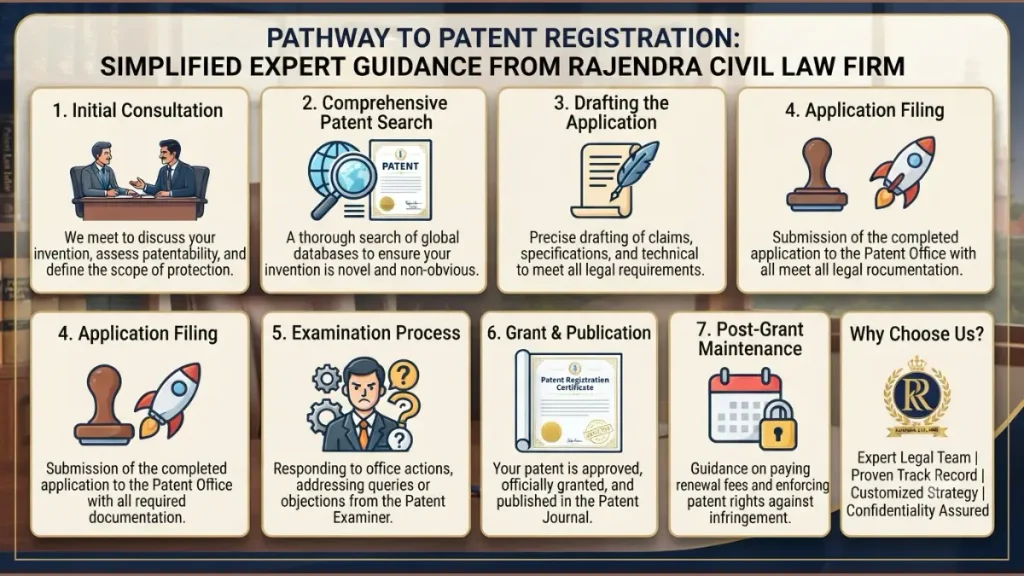
Patent registration involves more than uploading a specification and paying the prescribed government fee. Applicants must select appropriate forms, applicant categories, priority details, inventor information, specifications, drawings, and supporting documents. The Indian Patent Office provides a comprehensive online filing system for patent applications. Examination begins after the prescribed request for examination is properly submitted. Section 12 requires the Controller to refer the application and related documents to an examiner. The examination considers statutory compliance, objections, and investigation results. Therefore, applicants should monitor deadlines carefully after filing. Professional docket management can prevent missed responses and unnecessary abandonment risks. The Patent Office also communicates electronically through its systems. Applicants should preserve filing receipts, acknowledgement records, correspondence, hearing notices, and submitted responses.
Responding to First Examination Reports
A First Examination Report can raise objections involving novelty, inventive step, clarity, support, unity, enablement, formal requirements, or excluded subject matter. The applicant should analyse every objection against the specification, cited prior art, and applicable statutory provisions. A response should address objections precisely rather than merely repeating the invention’s commercial advantages. Amendments may narrow claims where legally and technically justified. However, amendments cannot introduce unsupported new matter beyond the original disclosure. Hearings may arise when written submissions do not resolve outstanding objections. Patent prosecution therefore benefits from coordinated technical and legal preparation. Rajendra Civil Law Firm can assist with objection analysis, written responses, hearing preparation, claim strategy, and procedural compliance. Section 21 also provides consequences where prescribed requirements remain unfulfilled within applicable periods. Consequently, docket monitoring becomes an essential component of patent legal assistance.
2024 Patent Rules and Current Compliance Changes
Current patent practice must account for amendments to the Patents Rules, including the 2024 amendments. The Patents Office identifies the Patents Rules, 2003 as incorporating amendments through March 2024. The Second Amendment Rules, 2024 introduced a framework concerning adjudication of penalties and related appeals. The Jan Vishwas reforms also changed certain penalty provisions under patent law from August 2024. Therefore, applicants should avoid relying on outdated articles, forms, or procedural checklists. Legal professionals should verify current forms, fees, deadlines, and electronic filing requirements before every filing. This matters particularly for startups, foreign applicants, educational institutions, and small entities. Patent prosecution can involve several procedural events across multiple years. A current compliance calendar helps track examination requests, responses, hearings, renewals, assignments, and post-grant proceedings.
Patent Litigation, Jurisdiction and Civil Remedies
Patent Infringement and Commercial Disputes
Identifying Patent Infringement
Product and Process Patent Infringement
Patent infringement arises when protected rights are allegedly violated without lawful consent or applicable statutory protection. Section 48 grants specific exclusive rights for patented products and processes. Product patents can restrict unauthorised making, using, offering for sale, selling, or importing. Process patents can restrict unauthorised use of the patented process and certain directly obtained products. Therefore, infringement analysis must compare the accused activity with the patent claims. A technical claim chart often helps identify corresponding elements and disputed limitations. Section 107 permits statutory grounds for revocation to operate as defences in infringement litigation. Section 107A also recognises specified acts that do not constitute infringement. Consequently, infringement disputes require careful technical, contractual, and statutory analysis. Early legal review can determine whether negotiation, licensing, notice, opposition, revocation, or litigation provides an appropriate procedural route.
Patent Validity, Revocation and Counterclaims
Patent enforcement may involve a direct validity challenge or a counterclaim for revocation. Section 64 identifies statutory grounds upon which a patent may be revoked by the High Court. Such grounds can include lack of novelty, insufficient entitlement, wrongful obtaining, or other statutory defects. Section 104 also addresses jurisdiction in patent infringement proceedings. When a defendant makes a counterclaim for revocation, the infringement suit and counterclaim move to the High Court. Therefore, litigation strategy must anticipate validity issues from the beginning. Prior-art evidence, prosecution history, technical expert evidence, and ownership documents may become important. Courts can also consider statutory defences available under the Patents Act. A patent lawyer should assess both infringement and validity rather than treating registration as conclusive proof of enforceability.
Chennai Courts, Commercial Courts and High Court Proceedings
Commercial Court and City Civil Court Considerations
Patent disputes require jurisdictional analysis before any infringement suit is instituted. Section 104 prevents filing below the level of a competent district court for specified patent proceedings. The Commercial Courts Act treats intellectual property disputes, including patent disputes, as commercial disputes. Commercial Courts can exercise jurisdiction over commercial disputes meeting applicable statutory requirements. The Act also provides for Commercial Divisions of High Courts exercising ordinary original civil jurisdiction. Therefore, Chennai patent litigation may involve the Madras High Court and appropriate commercial judicial forums. A City Civil Court may handle other connected civil disputes when statutory jurisdiction permits. However, patent infringement jurisdiction cannot be assumed merely because a party operates in Chennai. Territorial jurisdiction requires analysis under the Patents Act and applicable civil procedure.
Madras High Court Intellectual Property Proceedings
The Madras High Court remains an important forum for patent appeals and intellectual property litigation involving Chennai. Recent patent matters demonstrate the continuing role of the High Court in reviewing Controller decisions. In Amazon Technologies Inc. v. Controller of Patents and Designs, the Madras High Court considered a patent appeal concerning inventive step objections. In Maya Appliances Pvt. Ltd. v. Deputy Controller of Patents and Designs, the Court considered another patent appeal in 2025. The Court has also decided patent infringement suits involving substantive commercial remedies. These decisions illustrate why patent litigation requires specialised procedural preparation. The Tribunals Reforms Act, 2021 transferred appellate jurisdiction from the former IPAB framework to High Courts. Consequently, outdated references to the Intellectual Property Appellate Board should not guide current practice.
Patent Remedies, Evidence and Enforcement Strategy
Injunctions, Damages and Account of Profits
Section 108 identifies major remedies available in patent infringement proceedings. Courts may grant injunctions and, where appropriate, damages or an account of profits. Courts may also order seizure, forfeiture, or destruction of infringing goods and relevant materials. Therefore, an infringement strategy should identify the commercial harm and evidence supporting each requested remedy. The Code of Civil Procedure, 1908 also provides procedural mechanisms concerning pleadings, evidence, interim relief, and enforcement. Temporary injunction applications can become critical where ongoing sales threaten continuing losses. However, applicants must establish the legal basis and factual circumstances supporting interim protection. Courts can impose conditions on injunctions depending on case circumstances. Consequently, litigation preparation should combine patent claim analysis with financial, technical, and market evidence.
Evidence, Digital Records and Expert Assistance
Patent disputes increasingly involve emails, source files, laboratory records, websites, invoices, product samples, and digital communications. The Bharatiya Sakshya Adhiniyam, 2023 governs evidence law after its enforcement from July 2024. Digital evidence should therefore receive careful preservation and authentication treatment. Technical experts may assist courts in understanding complex inventions, processes, testing results, and claim limitations. Section 115 of the Patents Act also permits courts to appoint independent scientific advisers. Consequently, parties should preserve original technical documents and reliable digital records from the earliest dispute stage. A structured evidence repository can include product photographs, purchase records, technical manuals, correspondence, test reports, and metadata. This approach helps lawyers prepare claim charts and factual chronologies.
Patent Dispute Remedies and Procedural Options
Groundless Threats and Defensive Patent Relief
Patent disputes can also arise when a person receives allegedly unjustified threats of infringement proceedings. Section 106 provides a statutory route for relief against groundless threats. The aggrieved person may seek a declaration, injunction against continuing threats, and damages where legally available. Therefore, businesses should not ignore threatening legal communications involving patents. Counsel should examine whether the communication identifies a valid patent, relevant claims, and an alleged infringing activity. A careful response may preserve commercial relationships while protecting legal rights. In some situations, negotiation can clarify licensing expectations before formal litigation begins. Other cases may require urgent defensive proceedings when business operations face significant disruption. A complete review should also examine Section 107 defences and Section 107A statutory exceptions.
Patent Litigation Evidence Checklist
Consumer, Police and Regulatory Issues Around Patent Disputes
Patent infringement remains primarily a civil intellectual property issue, but connected misconduct can create additional legal concerns. Counterfeit goods, fraudulent representations, cheating, document fabrication, or dishonest transactions may require separate legal analysis. The Bharatiya Nyaya Sanhita, 2023 now forms part of India’s principal criminal law framework. The Bharatiya Nagarik Suraksha Sanhita, 2023 governs criminal procedure from July 2024. Therefore, a complaint at a Chennai police station should identify a cognisable criminal allegation rather than merely describe patent infringement. Mogappair or Ambattur police stations may become relevant when separate criminal facts arise within their territorial areas. Consumer complaints can also arise where defective or misrepresented patented products affect consumers. The Consumer Protection Act, 2019 provides consumer dispute mechanisms, subject to statutory jurisdiction and facts.
Expert Patent Registration Support and 24/7 Legal Assistance
End-to-End Patent Legal Assistance for Chennai Clients
Patent Filing Support, Opposition and Appeals
Pre-Grant and Post-Grant Opposition Assistance
Patent opposition provides an important mechanism for challenging a patent application or granted patent under prescribed statutory grounds. Section 25 permits pre-grant representation after publication and before grant. It also provides post-grant opposition within the prescribed statutory period after publication of grant. Therefore, applicants and competitors should monitor patent publications relevant to their technology sectors. A pre-grant opposition may raise issues involving prior publication, prior use, wrongful obtaining, or other statutory grounds. Post-grant proceedings require a separate procedural strategy and evidentiary record. Legal counsel can analyse prior-art documents, prosecution history, technical evidence, and statutory objections. Businesses should also consider commercial settlement where litigation costs outweigh practical objectives. However, settlement should protect confidentiality, licensing rights, and future commercial use.
Appeals Against Controller Decisions
Patent applicants may challenge eligible Controller decisions through the appellate mechanisms currently provided under the Patents Act. The Tribunals Reforms Act, 2021 replaced references to the former Appellate Board with High Court appellate jurisdiction. Section 117A now provides for specified appeals to the High Court. The amended provision also contemplates filing within the prescribed period, subject to applicable extension powers. Therefore, lawyers should calculate limitation from the relevant order and examine the correct appellate forum. Recent Madras High Court patent matters show active appellate scrutiny of Controller decisions. Amazon Technologies and Amgen represent recent examples involving patent prosecution disputes before the Madras High Court. Consequently, a rejected application does not necessarily end every available legal avenue. However, appellate success depends on statutory grounds, procedural history, technical evidence, and the impugned order’s reasoning.
Corporate Patent Strategy and Commercialisation
Patent Licensing, Assignment and Technology Transactions
A registered patent can become an important commercial asset through licensing, assignment, technology transfer, or strategic investment. Businesses should conduct intellectual property due diligence before transferring or licensing patent rights. Key issues include ownership, territorial scope, duration, royalty structures, sublicensing, improvements, confidentiality, and enforcement responsibility. Assignment documents should satisfy statutory requirements and support registration of the transferred interest. License agreements should clearly distinguish exclusive, non-exclusive, field-specific, and territorial rights. Technology development agreements should also address ownership of future inventions and improvements. The Commercial Courts Act expressly includes intellectual property disputes within commercial dispute categories. Therefore, contract drafting should anticipate possible commercial litigation in addition to ordinary contract enforcement. Rajendra Civil Law Firm can assist businesses with patent transactions, contractual risk analysis, dispute prevention, and enforcement strategy.
Patent Portfolio Management for Businesses
Patent portfolio management helps businesses convert individual registrations into a coordinated intellectual property strategy. A portfolio should track applications, grants, priority dates, renewal payments, assignments, licences, oppositions, and litigation. Companies should periodically review whether patents support current products and future research programs. Unused patents may still have licensing or defensive value, while weak patents may require strategic review. Patent landscapes can identify competitor filings and emerging technology areas. Freedom-to-operate analysis can separately evaluate third-party patent risks before commercial launch. Therefore, registration should not be treated as the final stage of intellectual property planning. A legal team can coordinate patent agents, engineers, business leaders, investors, and technical experts. This integrated approach supports stronger commercial decisions and reduces avoidable disputes. The Indian Patent Office reported substantial patent activity and a large number of patents in force during 2024-25.
Local Civil Litigation and 24/7 Legal Support
Chennai Legal Forums and Connected Dispute Resolution
Choosing the Appropriate Forum and Remedy
Patent-related disputes can intersect with contracts, consumer complaints, commercial transactions, technology agreements, and criminal allegations. Each issue requires separate jurisdictional analysis rather than automatically filing every dispute before one forum. Patent infringement may proceed before a competent district-level or High Court forum under applicable statutory provisions. Commercial disputes meeting specified requirements may fall within the Commercial Courts framework. Consumer disputes may involve District Consumer Disputes Redressal Commissions, State Commissions, or the NCDRC when statutory jurisdiction applies. Civil contract disputes may involve competent civil courts, including appropriate City Civil Court jurisdiction. Criminal allegations may require police or magistrate procedures under current criminal laws. Therefore, forum selection should follow the legal cause of action and statutory jurisdiction. Rajendra Civil Law Firm can evaluate interconnected disputes and recommend a procedurally appropriate litigation structure without duplicating proceedings unnecessarily.
Consumer Protection and Patent-Related Product Disputes
Patent rights and consumer rights address different legal interests, although one product can create issues under both frameworks. Consumers may pursue remedies for defective goods, deficient services, unfair trade practices, or misleading representations under the Consumer Protection Act, 2019. The appropriate Consumer Commission depends on the statutory pecuniary and territorial rules applicable when the complaint is filed. Government consumer guidance currently lists District, State, and National Commission structures under the Act. However, a consumer complaint does not automatically decide patent validity or infringement questions. Those issues may require proceedings under the Patents Act before competent courts or authorities. Therefore, legal counsel should identify each independent cause of action before selecting a forum. Product documentation, invoices, advertisements, technical claims, warranties, and expert reports may become important evidence.
Police Complaints and Criminal Misconduct Connected With IP
Patent registration itself does not convert every infringement allegation into a criminal offence. However, connected conduct may create separate criminal allegations under applicable laws. Examples can include cheating, criminal breach of trust, forgery, document fabrication, or other conduct supported by evidence. The Bharatiya Nyaya Sanhita, 2023 and Bharatiya Nagarik Suraksha Sanhita, 2023 now govern relevant substantive and procedural criminal matters. Digital records can also require consideration under the Bharatiya Sakshya Adhiniyam, 2023. Therefore, a complaint to a Chennai police station should clearly identify the alleged criminal conduct and supporting evidence. Mogappair and Ambattur police stations may be relevant depending on territorial facts. Legal counsel can assist with complaint drafting, document preservation, representations to senior police officers, and appropriate court remedies. A patent infringement suit should remain distinct from unsupported criminal allegations.
Practical Patent Registration Roadmap
Why Expert Patent Assistance Matters
Patent registration combines technology, statutory interpretation, drafting, evidence, commercial planning, and procedural deadlines. A filing may protect an invention for twenty years from the relevant application date, subject to statutory conditions and renewal requirements. Therefore, mistakes at the beginning can affect valuable rights for many years. Expert legal assistance can coordinate patentability review, specification drafting, ownership documentation, examination responses, hearings, opposition, licensing, and enforcement. The Indian Patent Office confirms that patent applications may be filed online and that provisional applications require timely complete specifications. Current rules also require attention to recent amendments and procedural developments. Consequently, inventors should obtain legal advice before public disclosure whenever possible. Rajendra Civil Law Firm provides civil litigation support alongside intellectual property dispute assistance for Chennai clients.
24/7 Legal Support for Patent and Civil Disputes
Patent problems can arise unexpectedly through competitor launches, examination notices, cease-and-desist letters, licensing disagreements, or urgent commercial threats. Prompt legal assessment can help preserve documents and prevent avoidable procedural mistakes. Rajendra Civil Law Firm offers legal assistance for patent registration, patent disputes, civil litigation, commercial disagreements, contractual claims, and connected legal issues. Support may include preliminary consultation, document review, patent dispute assessment, civil remedy planning, injunction strategy, evidence organisation, and court representation. Clients may also require coordination with patent agents, technical experts, corporate advisers, or forensic professionals. For urgent matters, legal teams should first identify limitation periods, response deadlines, jurisdiction, and immediate evidence preservation needs. Consequently, 24/7 legal support should focus on prompt triage rather than promising an automatic legal remedy. Every patent dispute remains fact-specific and depends upon statutory requirements, evidence, and the jurisdiction of the competent forum.
Patent Registration Assistance by Rajendra Civil Law Firm
Rajendra Civil Law Firm | Civil Advocates can assist clients seeking practical legal guidance for patent registration and related civil disputes. Our approach can cover invention assessment, ownership review, patent documentation, filing coordination, examination responses, opposition strategy, licensing concerns, and infringement litigation. Chennai clients may also require advice concerning commercial courts, the Madras High Court, civil courts, consumer commissions, tribunals, and connected regulatory authorities. Each forum has separate jurisdictional requirements, procedural rules, and available remedies. Therefore, the first consultation should identify the invention, applicant, filing status, dispute history, commercial objective, and urgent deadlines. Clients should bring available patent documents, technical descriptions, assignments, correspondence, product materials, and relevant agreements. Early legal review can help organise the dispute and identify the appropriate statutory pathway. The objective remains practical protection of intellectual property rights while maintaining compliance with current Indian patent and civil law.
Frequently Asked Questions About Patent Registration
How long does an Indian patent last?
An Indian patent generally lasts twenty years from the application date, subject to statutory requirements and timely renewal fees.
Can I file a provisional patent application?
Yes. A provisional specification can establish an early priority date, followed by a complete specification within twelve months.
Where are patent infringement suits filed?
Patent infringement suits require a competent district-level forum or applicable High Court jurisdiction under the Patents Act.
Can a patent be challenged after grant?
Yes. Post-grant opposition and High Court revocation proceedings may apply under statutory conditions and prescribed procedures.
Does patent registration protect an invention worldwide?
No. Indian patent protection operates within India. International protection requires appropriate foreign or international filing strategies.
Can lawyers help with patent objections?
Yes. Legal professionals can analyse examination reports, prepare responses, amend claims, handle hearings, and advise on appeals.
Legal Notice and Current-Law Disclaimer
This article provides general legal information about Indian patent registration, patent litigation, civil remedies, and connected legal procedures. Patent law changes through statutory amendments, rules, notifications, judicial decisions, and administrative practice. Therefore, readers should verify the law applicable to their specific filing or dispute before taking action. The article references the Patents Act, 1970, Patents Rules, 2003, Commercial Courts Act, 2015, Code of Civil Procedure, 1908, Consumer Protection Act, 2019, and current criminal and evidence laws. The Indian Patent Office confirms that the patent framework includes amendments introduced through 2024. Recent Madras High Court decisions also demonstrate continuing developments in patent appeals and litigation. Consequently, individual matters require review of their documents, facts, deadlines, jurisdiction, and applicable remedies. Rajendra Civil Law Firm can provide case-specific legal assistance after examining the relevant circumstances and records.
Read More
This article is part of our guide: Winning Strategies for Business Litigation: Expert Legal Advice and Representation.