
Protecting Your Intellectual Property: Expert Patent Litigation

In this article (10 sections)
- Patent Infringement and Claim Construction
- Patent Ownership, Licensing, and Commercial Rights
- Patent Defences and Revocation Counterclaims
- District Courts and Commercial Patent Litigation
- Consumer Forums, Police Authorities, and Connected Proceedings
- Patent Remedies, Injunctions, Damages, and Account of Profits
- Evidence, CPC, BSA, BNSS, and BNS in Patent Disputes
- Emergency Evidence Preservation
- Building a Complete Intellectual Property Enforcement Strategy
- Frequently Asked Questions About Patent Litigation
Patent litigation protects valuable inventions when unauthorized commercial use threatens intellectual property rights. Indian patent law gives patentees important civil remedies against qualifying infringement. The Patents Act, 1970 governs infringement, defences, jurisdiction, and available reliefs. Section 104 requires infringement suits to begin before a competent District Court. A revocation counterclaim transfers the suit to the High Court. Therefore, careful forum selection remains essential for Chennai businesses. Patent disputes may involve manufacturers, distributors, technology companies, research institutions, and licensing partners. Furthermore, technical evidence often determines whether infringement actually occurred. A civil advocate must therefore understand both procedural law and technical claim interpretation. Rajendra Civil Law Firm | Civil Advocates provides support for patent disputes and connected civil proceedings. Our approach considers evidence, jurisdiction, remedies, commercial objectives, and procedural requirements. Accordingly, businesses should seek advice before issuing demands or filing urgent proceedings.
Core patent litigation keywords: patent infringement lawyer Chennai, patent litigation advocate, intellectual property lawyer, patent dispute lawyer, patent infringement suit, patent validity challenge, patent revocation, patent injunction, patent damages, patent licensing dispute, Madras High Court patent lawyer, commercial court patent dispute, Patent Office appeal, civil remedies for patent infringement, Chennai intellectual property litigation, and urgent patent legal support. These terms reflect common search intents around patent enforcement and defence. Moreover, AEO content should answer practical questions directly. Businesses often ask which court handles patent infringement. They also ask whether injunctions, damages, or revocation proceedings remain available. Search users may additionally ask about Patent Office appeals and commercial courts. Therefore, this article addresses those questions with structured legal information. It also discusses consumer forums, police complaints, tribunals, and connected civil remedies. However, each dispute requires fact-specific legal analysis before filing.
Understanding Patent Rights and Infringement in India
Patent Rights, Claims, and Commercial Protection
A patent protects an invention within the scope of its legally enforceable claims. Patent rights can cover qualifying products, processes, machines, compositions, or technical improvements. However, registration alone does not resolve every commercial dispute. Patent owners must understand claim boundaries before alleging infringement. Each independent claim contains technical limitations that define protected subject matter. Dependent claims introduce additional limitations and require separate comparison. Therefore, lawyers often prepare detailed claim charts before filing litigation. Technical experts can compare patent elements against accused products or processes. Furthermore, prosecution records may assist interpretation when specific issues arise. Businesses should preserve specifications, drawings, laboratory reports, licences, invoices, and product samples. Such records can support both infringement allegations and defensive arguments. The Patents Act separately identifies infringement suits, defences, and statutory remedies. Consequently, effective patent enforcement requires legal, technical, commercial, and evidentiary preparation from the beginning.
Patent Infringement and Claim Construction
Patent infringement analysis begins with the language of the asserted patent claims. Lawyers must identify each limitation before comparing the accused technology. Courts do not decide infringement merely from commercial similarity between products. Instead, the legal analysis focuses on claim scope and relevant statutory principles. Therefore, technical comparison should follow a structured claim-by-claim method. A claim chart can place patent limitations beside corresponding accused features. Engineers can explain technical operation through diagrams, testing, and product documentation. Meanwhile, advocates address statutory interpretation, pleadings, evidence, and relief. This division of responsibilities improves clarity during complex hearings. Additionally, patent owners should examine potential validity challenges before seeking urgent injunctions. Defendants can challenge infringement by demonstrating missing claim elements. They may also raise statutory validity grounds under Section 107. The Patents Act makes revocation grounds available as infringement defences. Hence, claim construction remains central to both prosecution and litigation strategy.
Claim Charts and Technical Comparison
A claim chart translates complex patent language into an understandable comparison. First, counsel identifies every limitation within the asserted independent claim. Next, technical experts locate corresponding features within the accused product. Then, the team records supporting evidence for each alleged correspondence. This process exposes gaps before lawyers make infringement allegations. Moreover, charts can assist pleadings, expert reports, cross-examination, and settlement discussions. Product manuals can support technical assertions when they accurately describe actual operation. Laboratory testing may provide stronger evidence where product literature remains incomplete. Photographs can also document physical structures and manufacturing characteristics. However, lawyers must preserve the provenance of technical evidence. Digital files should retain relevant metadata whenever practicable. The Bharatiya Sakshya Adhiniyam, 2023 provides India’s current evidence framework. Therefore, electronic records require appropriate attention during litigation preparation. A disciplined claim chart can improve communication between patent advocates and engineering experts.
Patent Validity and Prior-Art Investigation
Patent validity can become equally important as infringement during contentious proceedings. Defendants may investigate prior publications, earlier use, obviousness, insufficiency, and patentability issues. Section 107 permits revocation grounds as defences in infringement proceedings. Section 64 separately identifies statutory grounds for patent revocation. Therefore, validity review should begin before filing major infringement applications. Prior-art searches can identify documents that affect novelty or inventive step. Technical experts can compare earlier disclosures with the challenged patent claims. Patent prosecution records may also reveal amendments and responses concerning cited prior art. Furthermore, ownership records can expose entitlement questions. Lawyers should distinguish genuine validity issues from speculative objections. Courts examine evidence within the applicable statutory and procedural framework. Consequently, a structured validity memorandum can assist settlement and litigation decisions. Rajendra Civil Law Firm can coordinate civil advocacy with patent agents and technical professionals.
Process Patents and Burden of Proof
Process patent disputes can create distinctive evidentiary challenges for both parties. Manufacturing processes often remain confidential inside industrial facilities. Section 104A addresses the burden of proof for specified process patent cases. The court may direct a defendant to establish a different process under statutory conditions. However, the patentee must first satisfy the requirements described within Section 104A. The provision also protects manufacturing and commercial secrets from unreasonable disclosure. Therefore, process patent litigation needs careful technical and confidentiality planning. Lawyers should identify what evidence can establish product identity. Engineers can then explain why the relevant manufacturing process appears likely. Defendants should preserve process records that demonstrate independent methods. Protective arrangements may become important where confidential technology enters evidence. Courts can balance evidentiary needs against legitimate commercial secrecy. Accordingly, process patent cases require early coordination between advocates and technical experts.
Patent Ownership, Licensing, and Commercial Rights
Patent disputes frequently involve ownership questions alongside infringement allegations. Employers, inventors, universities, startups, and investors may hold competing contractual interests. Therefore, lawyers should examine employment agreements and invention assignment documents. Licensing agreements also require detailed review before litigation begins. An exclusive licensee can possess statutory enforcement rights under Section 109. However, the exact licence terms can affect parties, territories, products, and remedies. Non-exclusive arrangements may create different enforcement considerations. Royalty disputes can also generate commercial litigation independent of infringement. Furthermore, sublicensing provisions may affect whether particular conduct received authorization. Parties should preserve executed agreements, amendments, payment records, and correspondence. Courts may need to interpret contractual rights alongside statutory patent provisions. Consequently, patent litigation should include an ownership and licensing audit. This audit can identify necessary parties and reduce procedural objections.
Exclusive Licensee Enforcement Rights
An exclusive licensee may possess significant rights concerning patent infringement proceedings. Section 109 permits an exclusive licensee to institute specified infringement proceedings. The provision also addresses the patentee’s role in such proceedings. Therefore, counsel should inspect the licence before drafting a patent plaint. The agreement should establish exclusivity clearly and identify the licensed patent. Territorial and commercial limitations also require careful consideration. Royalty provisions can provide evidence concerning commercial value and potential losses. Furthermore, termination clauses may affect standing when litigation begins. A licensee should therefore maintain complete records of licence execution and performance. Defendants should request relevant documents where authorization becomes disputed. Courts may examine the contractual relationship while considering available remedies. Accordingly, licensing documents can become central evidence in patent litigation. Early review helps identify whether the patentee, licensee, or both should participate.
Licensing Disputes and Royalty Claims
Patent licensing disputes can involve unpaid royalties, territorial breaches, unauthorized sublicensing, and reporting failures. Such disputes may also include allegations of contract termination or misuse. Therefore, counsel should examine the licence wording before alleging contractual default. Payment records can establish royalty calculations and disputed amounts. Sales reports may reveal whether licensees exceeded agreed commercial limits. Moreover, audit rights can provide contractual mechanisms for verifying royalty obligations. Parties should preserve notices, invoices, correspondence, and accounting records. A negotiated amendment may resolve technical or commercial disagreements without prolonged litigation. However, urgent injunctions may become necessary when unauthorized use continues. Patent rights and contractual rights should then receive separate legal analysis. Courts may grant remedies based on the applicable statutory and contractual framework. Consequently, patent litigation strategy should avoid combining unrelated causes without proper pleadings. Clear issue separation can improve procedural efficiency.
Patent Defences and Revocation Counterclaims
Defendants can raise infringement and validity arguments when responding to patent litigation. Section 107 expressly makes revocation grounds available as infringement defences. A defendant may therefore examine novelty, inventive step, insufficiency, and other statutory grounds. Non-infringement arguments can separately demonstrate missing claim limitations. Section 107A also identifies certain acts that do not constitute infringement. Consequently, counsel should evaluate statutory exceptions before drafting defensive pleadings. A defendant should also examine licences and authorization documents. Prior commercial conduct may affect factual disputes surrounding alleged infringement. Furthermore, Section 104 contains an important jurisdictional consequence for revocation counterclaims. The infringement suit and counterclaim move to the High Court. This consequence makes early forum analysis especially important. Technical experts should support substantial validity allegations with credible evidence. A carefully structured defence can address infringement, validity, jurisdiction, evidence, and remedies together.
Grounds for Challenging Patent Validity
Patent validity challenges require evidence linked to statutory revocation grounds. Prior publication can raise questions concerning novelty. Earlier public use can also affect validity under applicable provisions. Obviousness arguments require technical analysis of the claimed invention and relevant prior art. Insufficiency arguments may concern whether the specification adequately teaches the invention. Other statutory grounds can involve entitlement, patentability exclusions, or procedural defects. Therefore, a defendant should identify the precise ground before gathering supporting material. Broad allegations can create avoidable evidentiary difficulties during trial. Patent databases can assist preliminary prior-art research. However, technical interpretation often requires qualified experts. Lawyers should also review the complete patent prosecution history. Consistency matters because previous statements can become relevant during litigation. Accordingly, a validity challenge should combine statutory analysis with technical evidence. This method creates a clearer basis for revocation counterclaims and infringement defences.
Non-Infringement and Statutory Exceptions
A defendant may prevail on non-infringement arguments when the accused conduct falls outside patent claim boundaries. Each asserted claim should receive separate technical comparison. Furthermore, Section 107A identifies specified acts that do not constitute infringement. The provision includes certain regulatory-development activities and authorized imports. Therefore, defendants should examine statutory exceptions before assuming commercial exposure. Evidence should establish exactly what activity occurred and why the statutory exception applies. Regulatory records can become useful when pharmaceutical or regulated products are involved. Import documentation can similarly assist cases involving authorized international distribution. However, exceptions depend on their statutory conditions. Lawyers should avoid broad claims without supporting evidence. Technical and regulatory experts may help explain the factual circumstances. Accordingly, a defence should connect each exception with precise documents. This approach helps courts assess whether the alleged activity falls within statutory protection.
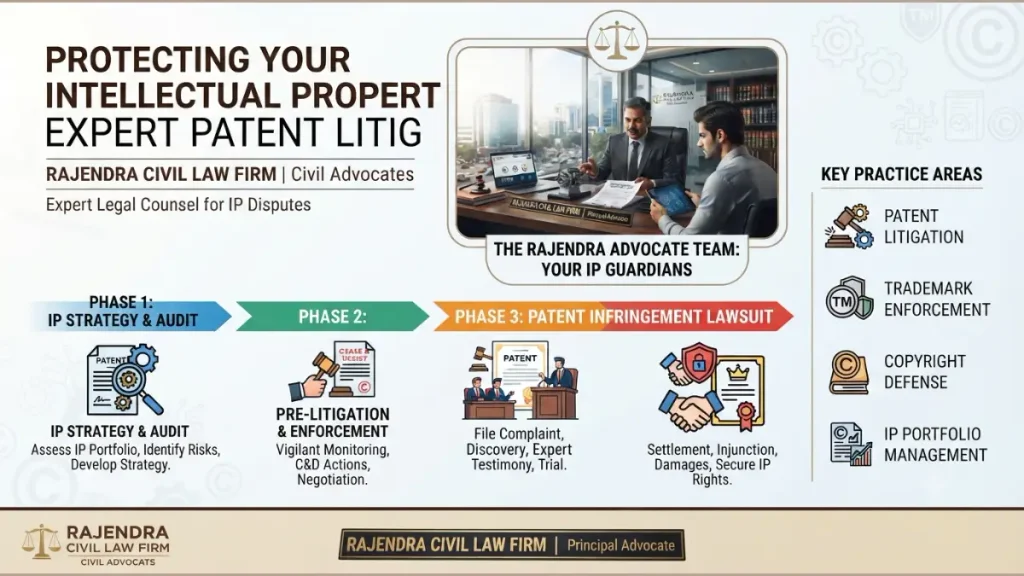
Chennai Patent Litigation, Courts, Tribunals, and Remedies
Jurisdiction, Commercial Courts, and Madras High Court
Chennai patent disputes require careful consideration of statutory and territorial jurisdiction. Section 104 prohibits infringement suits below a competent District Court. A revocation counterclaim transfers the proceeding to the High Court. Commercial intellectual property disputes can also fall within the Commercial Courts framework. Therefore, lawyers should assess jurisdiction before preparing pleadings and court fees. The Madras High Court has a dedicated Intellectual Property Rights Division framework. Recent Madras High Court patent decisions demonstrate active appellate consideration of Patent Office orders. For example, the Court decided patent appeals involving Controllers during 2025. These decisions show why statutory appellate routes require careful verification. A City Civil Court does not automatically replace the jurisdiction prescribed by patent legislation. Likewise, consumer forums address consumer causes rather than ordinary patent infringement. Accordingly, Chennai litigants should identify the precise cause of action before selecting a forum.
District Courts and Commercial Patent Litigation
Patent infringement suits generally require a competent District Court or higher forum. Section 104 establishes this important jurisdictional threshold. Commercial Courts may handle qualifying intellectual property disputes under applicable legislation. Therefore, Chennai businesses should evaluate commercial jurisdiction alongside ordinary civil jurisdiction. The Code of Civil Procedure continues to govern civil procedure, subject to commercial court modifications. Pleadings should identify patent ownership, infringement acts, jurisdiction, valuation, limitation, and requested relief. Evidence should support each material allegation. Furthermore, commercial procedure can impose demanding disclosure and case-management requirements. Lawyers should therefore prepare documents before filing rather than collecting everything later. A City Civil Court may have civil jurisdiction over many disputes. However, patent litigation requires compliance with the Patents Act’s specific forum rules. Accordingly, forum selection should follow statutory analysis rather than convenience alone. Rajendra Civil Law Firm can assist with Chennai jurisdiction assessment and civil patent proceedings.
Madras High Court Intellectual Property Division
The Madras High Court Intellectual Property Rights Division handles qualifying intellectual property proceedings. Patent appeals can arise from decisions of the Patent Office. Recent cases demonstrate continuing patent appellate activity before the Court. In Amgen Inc. v. Assistant Controller of Patents, the Court decided a patent appeal in 2025. Amazon Technologies also pursued a patent appeal before the Madras High Court in 2025. Tekelec similarly appeared in a patent appeal concerning the Controller. These authorities illustrate the practical importance of correct appellate procedure. However, each judgment depends upon its own facts and statutory provisions. Lawyers should therefore examine the complete order before relying upon any precedent. The Madras High Court IP Division provides an important Chennai forum for qualifying patent matters. Proper filing classification remains essential for appellate and original proceedings. Consequently, specialist civil advocacy can help coordinate technical and procedural requirements.
Patent Office and Controller Proceedings
The Indian Patent Office remains central to patent examination, opposition, prosecution, and administrative decisions. Chennai hosts the Patent Office at the Intellectual Property Office Building in Guindy. Recent Madras High Court cases identify the Chennai Patent Office in appellate proceedings. Therefore, patent applicants and litigants should maintain complete prosecution records. Controller decisions can later become relevant during infringement or validity proceedings. Patent Office orders may also create statutory appeal rights under applicable provisions. However, not every administrative order necessarily carries the same appellate route. The precise statutory provision must therefore be checked before filing. Recent Madras High Court authority demonstrates this procedural issue. In Caleb Suresh Motupalli, the Court considered the scope of Section 117A appeals. Consequently, lawyers should identify the challenged order and its statutory source. Accurate classification can prevent avoidable maintainability disputes.
Consumer Forums, Police Authorities, and Connected Proceedings
Patent disputes can sometimes overlap with consumer, criminal, or contractual issues. However, each cause of action requires separate jurisdictional analysis. The Consumer Protection Act, 2019 governs qualifying consumer disputes. District Consumer Disputes Redressal Commissions handle matters within their statutory jurisdiction. State Commissions and NCDRC handle matters according to the Act and applicable thresholds. Therefore, consumer forums do not automatically decide patent infringement claims. A consumer complaint may instead concern defective patented goods or deficient services. Similarly, police involvement requires facts disclosing an independent criminal offence. The BNS now provides India’s substantive criminal law framework. The BNSS provides the current criminal procedure framework. The BSA governs evidence under the new evidence regime. Consequently, civil patent claims should remain distinct from criminal allegations. Chennai businesses may require assistance involving Mogappair or Ambattur police stations when relevant facts arise. Lawyers should coordinate proceedings without creating inconsistent factual positions.
Consumer Protection Act and Patent-Related Product Disputes
A patented product can generate consumer complaints without creating a patent infringement cause. Consumers may allege defective goods, deficient services, unfair trade practices, or other statutory violations. The Consumer Protection Act, 2019 governs qualifying consumer disputes. Therefore, the appropriate Consumer Commission depends upon statutory jurisdiction and applicable thresholds. District Consumer Disputes Redressal Commissions handle qualifying district-level matters. State Commissions and NCDRC exercise jurisdiction under their respective statutory provisions. However, consumer proceedings do not substitute for patent infringement litigation. Patent ownership and infringement remain governed primarily by the Patents Act. Businesses should therefore identify the actual cause of action before filing. Furthermore, the same product may create separate contractual and consumer disputes. Lawyers should avoid combining unrelated causes without proper jurisdictional analysis. Accordingly, a patent dispute involving consumers may require coordinated civil and consumer-law advice. Rajendra Civil Law Firm can assess connected proceedings and appropriate civil remedies.
Police Complaints and BNS-Related Issues
Some intellectual property disputes include allegations of conduct beyond patent infringement. Such conduct may involve forged records, deception, counterfeit goods, or unauthorized access. The BNS provides the current substantive criminal law framework. The BNSS governs criminal procedure for applicable offences. Therefore, police action depends on the actual facts and statutory ingredients. A patent dispute alone does not automatically establish criminal liability. Chennai businesses may approach the appropriate police authority when an independent offence appears disclosed. Mogappair or Ambattur police stations may become relevant based on the incident location. Lawyers should prepare factual complaints supported by relevant documentary evidence. Electronic evidence requires consideration under the BSA. Furthermore, civil litigation and criminal proceedings should maintain consistent factual positions. A criminal complaint should not replace a required patent infringement suit. Accordingly, clients should obtain advice about both civil remedies and any genuinely connected criminal issues.
Patent Remedies, Injunctions, Damages, and Account of Profits
Patent owners can seek several remedies when infringement satisfies the statutory requirements. Section 108 identifies injunctions and monetary remedies among available reliefs. The court may also order seizure, forfeiture, or destruction of infringing goods. Therefore, remedy selection should reflect the commercial harm and available evidence. An interim injunction can address urgent continuing conduct. A permanent injunction can follow final adjudication where appropriate. Damages can compensate legally established loss. An account of profits can address profits attributable to infringement. Section 111 contains restrictions concerning damages and accounts of profits. Consequently, parties should preserve sales, licensing, and financial records. Evidence should support both liability and quantum. Courts assess relief according to statutory requirements and case circumstances. Lawyers should therefore avoid seeking every remedy without factual justification. A focused remedy strategy can improve pleading clarity and evidentiary consistency.
| Patent Legal Issue | Relevant Forum | Possible Legal Remedy |
|---|---|---|
| Patent infringement | Competent District Court or High Court | Injunction, damages, account of profits |
| Patent revocation | High Court | Revocation or defensive relief |
| Controller appeal | High Court IP Division | Statutory appellate relief |
| Consumer product dispute | District Commission, State Commission, or NCDRC | Consumer-law remedies |
| Related criminal conduct | Police and criminal courts | Investigation and criminal remedies |
| Licensing dispute | Competent civil or commercial forum | Contractual and statutory relief |
Interim and Permanent Injunctions
Injunctions remain important remedies when alleged infringement threatens continuing commercial activity. Section 108 expressly includes injunctions among patent infringement reliefs. An interim application requires careful evidence concerning the patent and accused conduct. Lawyers should present claim charts, technical documents, product evidence, and relevant commercial facts. Courts apply established principles when considering interim relief. Therefore, applicants should address the factual basis clearly and accurately. Defendants may contest infringement, validity, delay, jurisdiction, authorization, or other issues. Evidence preservation becomes particularly important when products can disappear from markets quickly. Courts may consider the parties’ conduct and surrounding circumstances. Accordingly, counsel should prepare both the interim application and anticipated defence. A permanent injunction depends upon final adjudication and applicable law. Effective litigation strategy should therefore connect interim relief with the final remedies requested.
Damages and Account of Profits
Patent owners may seek damages or an account of profits under Section 108. However, monetary recovery requires appropriate evidence and statutory compliance. Section 111 limits damages or accounts in specified circumstances involving knowledge and patent marking. Therefore, owners should maintain commercial records from the earliest infringement concerns. Sales invoices can help establish lost revenue or infringing sales. Licensing agreements can provide useful commercial benchmarks. Accounting evidence may also assist profit calculations. Defendants can challenge causation, quantum, attribution, and statutory eligibility. Furthermore, evidence should distinguish profits arising from patented features. A product may contain many non-patented components. Consequently, financial experts may assist where complex revenue allocation becomes necessary. Courts will determine the appropriate relief based on evidence and applicable law. Lawyers should therefore plead monetary remedies with specific supporting facts.
Seizure, Forfeiture, and Destruction Orders
Patent courts can address infringing goods through statutory orders concerning seizure, forfeiture, or destruction. Section 108 recognizes these remedies alongside injunctions and monetary relief. Such relief can matter where continued circulation creates recurring commercial harm. However, applications should identify the goods and materials precisely. Evidence should establish their connection with the alleged infringement. Photographs, invoices, inspection records, and product samples can assist this process. Lawyers should also consider storage and custody issues after seizure. Courts may require practical directions for handling disputed goods. Therefore, applicants should avoid overly broad requests without evidentiary support. Defendants can challenge whether particular goods actually infringe asserted claims. They may also dispute the necessity or scope of destruction. Accordingly, targeted relief can provide greater procedural clarity. Technical evidence remains important even when the requested remedy concerns physical goods.
Evidence, CPC, BSA, BNSS, and BNS in Patent Disputes
Patent litigation operates within a broader Indian procedural and evidentiary framework. The Code of Civil Procedure, 1908 remains central to civil court procedure. The Bharatiya Sakshya Adhiniyam, 2023 provides the current general evidence framework. The BNSS governs criminal procedure for separate criminal proceedings. The BNS provides the current substantive criminal law. Therefore, lawyers should distinguish civil patent claims from collateral criminal allegations. Electronic evidence may require careful authentication and preservation under the BSA. Civil pleadings must also satisfy CPC requirements and applicable commercial procedure. Furthermore, patent-specific provisions can modify or supplement general civil principles. Section 77 gives the Controller specified civil-court powers for patent proceedings. The correct legal framework therefore depends upon the proceeding involved. Lawyers should identify the statutory source for every requested remedy. This approach prevents confusion between patent law, civil procedure, evidence law, and criminal law.
Electronic Evidence Under the BSA
Modern patent disputes often involve websites, emails, software, product databases, and digital manufacturing records. The Bharatiya Sakshya Adhiniyam, 2023 governs evidence in the current legal framework. Therefore, parties should preserve original electronic material whenever legally accessible. Screenshots may provide useful context but may require supporting evidence. Metadata can help establish source, timing, and continuity. Emails can demonstrate licensing discussions or admissions when properly proved. Website captures can document public product descriptions and technical claims. Manufacturing logs can assist process patent disputes. However, parties must respect privacy, confidentiality, and access restrictions. Unauthorized access can create separate legal complications. Accordingly, lawyers should use lawful collection and preservation methods. Technical forensic professionals can assist when electronic authenticity becomes disputed. A clear evidence register can connect digital records with specific pleaded facts.
CPC Procedure and Commercial Litigation
The Code of Civil Procedure provides essential procedural rules for patent-related civil litigation. Commercial courts may apply additional procedures to qualifying commercial disputes. Therefore, patent lawyers must consider pleadings, disclosure, documents, interim relief, evidence, and case management. Jurisdiction should receive attention before filing the plaint. Valuation and court fees should also receive appropriate review. Furthermore, limitation issues can affect the timing and structure of claims. Lawyers should maintain a chronology of infringement events and communications. This chronology can support procedural and factual arguments. Commercial litigation may require extensive document disclosure between parties. Accordingly, businesses should preserve relevant records before commencing proceedings. The CPC also supports mechanisms relevant to interim and procedural relief. Patent-specific provisions remain important throughout the case. A coordinated approach can prevent conflicts between general procedure and specialized patent legislation.
BNS and BNSS Issues Connected With IP Disputes
The BNS and BNSS may become relevant when patent disputes involve independent criminal allegations. The BNS provides substantive offences, while the BNSS regulates criminal procedure. Therefore, lawyers should identify the precise alleged conduct before recommending police action. Patent infringement itself primarily arises under the Patents Act’s civil framework. Criminal proceedings require separate statutory ingredients. Fraudulent documentation, deception, or counterfeiting may raise additional issues depending upon facts. Police complaints should therefore contain accurate factual descriptions and supporting documents. Electronic records should receive appropriate evidentiary treatment under the BSA. Furthermore, civil pleadings should remain consistent with any criminal complaint. In Chennai, local police stations such as Mogappair or Ambattur may become relevant geographically. However, the appropriate authority depends upon jurisdiction and alleged conduct. Accordingly, clients should obtain fact-specific advice before initiating parallel proceedings.
24/7 Patent Legal Support for Urgent Chennai Disputes
Patent disputes can become urgent when product launches, manufacturing, imports, or online sales occur quickly. Businesses may need immediate assistance with evidence preservation and infringement assessment. A 24/7 legal support model can provide emergency consultation and preliminary issue identification. Such support may include patent document review, claim analysis, notice drafting, injunction preparation, and procedural guidance. Lawyers can also coordinate technical experts when product comparison requires specialist knowledge. Furthermore, counsel can evaluate whether mediation or licensing discussions remain practical. Urgent support should not replace formal court procedure. Instead, it helps organize the steps required for timely legal action. A useful emergency sequence includes evidence preservation, claim identification, technical comparison, jurisdiction review, and remedy selection. Police coordination may become relevant only when independent criminal facts arise. Consumer forums may become relevant only for separate consumer causes. Therefore, rapid advice should remain legally precise and forum-specific.
Emergency Evidence Preservation
Evidence can disappear quickly when accused products change, websites update, or manufacturing records become unavailable. Therefore, preservation should begin as soon as a serious dispute emerges. Businesses should retain patent documents, product samples, invoices, emails, licences, and technical records. Publicly available online material should also receive lawful preservation where appropriate. Screenshots should retain dates and relevant source information whenever possible. Furthermore, original digital files should remain protected from unnecessary alteration. Internal employees should receive clear instructions concerning document preservation. Counsel can then organize evidence according to each pleaded issue. Technical experts may examine products before substantial changes occur. This preparation can support injunction applications and later trial evidence. However, evidence collection must respect confidentiality and applicable access laws. Accordingly, emergency preservation should combine legal instructions with technical controls. Rajendra Civil Law Firm can assist businesses in organizing urgent civil litigation preparation.
Patent Notice and Settlement Strategy
A patent notice can create an opportunity to resolve disputes before full litigation begins. The notice should identify the patent, relevant claims, accused conduct, and requested response. Lawyers should avoid unsupported statements that could complicate later proceedings. Furthermore, technical allegations should match the evidence available at that stage. Settlement discussions may consider licences, royalties, product modifications, territories, and future conduct. Confidentiality provisions can protect sensitive technical information exchanged during negotiations. Pre-litigation mediation may also apply to qualifying commercial disputes, subject to statutory exceptions. Therefore, counsel should examine whether mediation requirements affect the proposed litigation timetable. Urgent interim relief can require different procedural treatment. Parties should also document any agreed settlement terms precisely. A settlement should identify patent numbers, products, obligations, deadlines, and consequences. Accordingly, informed negotiation can coexist with appropriate litigation preparation. Businesses should preserve evidence even while settlement discussions continue.
24/7 Legal Assistance for Businesses and Inventors
Inventors, companies, research institutions, and licensing partners may require legal support outside ordinary working hours. A 24/7 patent support model can address urgent questions before evidence disappears. Services may include emergency consultation, infringement screening, document preservation, legal notice review, and injunction preparation. Additional assistance can cover Patent Office orders, appeals, licensing disputes, and commercial litigation. Chennai clients may also require coordination with technical experts and patent agents. Furthermore, related civil, consumer, or criminal issues can receive separate jurisdictional assessment. Such support should prioritize accurate facts rather than immediate assumptions. Lawyers should identify the patent, claims, accused conduct, location, and requested remedy. Then, the team can determine the appropriate legal pathway. Courts and statutory authorities retain responsibility for formal adjudication. Accordingly, 24/7 legal support provides rapid preparation rather than guaranteed outcomes. Rajendra Civil Law Firm can assist with urgent civil advocacy and connected patent disputes.
Patent Litigation Checklist for Chennai Businesses
Businesses can prepare for patent disputes by maintaining organized intellectual property records. First, preserve the patent certificate and complete specification. Second, maintain prosecution records and relevant Patent Office communications. Third, preserve licences, assignments, and royalty records. Fourth, maintain technical development records and product specifications. Fifth, monitor competitor products through lawful sources. Sixth, document suspected infringement with reliable evidence. Seventh, obtain preliminary technical claim analysis. Eighth, identify territorial and statutory jurisdiction. Ninth, assess injunction, damages, declaration, or revocation issues. Tenth, obtain legal advice before issuing major public allegations. This structured approach supports both patent owners and accused businesses. Moreover, consistent documentation can reduce avoidable evidentiary disputes. Chennai companies should also identify appropriate civil courts and the Madras High Court IP Division. Therefore, a litigation checklist should become part of broader intellectual property governance.
- Preserve patents, licences, technical records, and digital evidence.
- Identify asserted claims and prepare a technical comparison.
- Review validity, ownership, licensing, and jurisdiction issues.
- Assess injunctions, damages, accounts, declarations, or revocation.
- Check commercial court and mediation requirements.
- Coordinate advocates, patent agents, and technical experts.
Building a Complete Intellectual Property Enforcement Strategy
Patent enforcement should form part of a broader intellectual property protection programme. Businesses may hold patents alongside trademarks, copyrights, designs, and confidential information. Therefore, one dispute can involve several intellectual property rights simultaneously. A patented software product may also contain copyright and trade secret elements. A branded machine may involve patents, trademarks, and industrial designs. Consequently, lawyers should conduct an intellectual property audit before major enforcement action. Ownership documents should cover employees, consultants, contractors, and research partners. Confidentiality agreements should protect sensitive technical information before disclosure. Licensing agreements should define enforcement responsibility clearly. Furthermore, businesses should maintain renewal and registration calendars. Online monitoring can identify potentially infringing commercial activity. Civil remedies should then match the particular right allegedly violated. Rajendra Civil Law Firm can assist with connected civil disputes and intellectual property enforcement planning. A coordinated strategy can reduce duplicated proceedings and inconsistent legal positions.
Patent Audit and Preventive Legal Review
A patent audit helps businesses understand the scope and condition of their intellectual property portfolio. Lawyers can review ownership, assignments, licences, renewals, prosecution history, and commercial use. Technical professionals can assess whether current products correspond with registered patent claims. Furthermore, audits can identify patents approaching expiration or requiring maintenance action. Licensing agreements should receive periodic review for compliance and territorial restrictions. Businesses should also examine employee invention arrangements and confidentiality obligations. Competitor monitoring can identify emerging infringement risks. Early identification can support negotiation before disputes become expensive. Moreover, preventive review can reveal inconsistencies between patent records and commercial operations. Such inconsistencies may affect enforcement strategy. Therefore, patent audits should become part of corporate intellectual property governance. Rajendra Civil Law Firm can support legal review of patent-related civil risks. Regular assessment can help businesses prepare evidence before disputes arise.
Consult Rajendra Civil Law Firm for Patent Litigation
Patent litigation requires precise coordination between intellectual property law, civil procedure, evidence, and technical analysis. The Patents Act provides specific provisions for jurisdiction, defences, infringement remedies, and non-infringement declarations. Section 104 establishes important jurisdictional requirements for infringement proceedings. Section 108 identifies injunctions, damages, accounts, and destruction-related relief. Recent Madras High Court decisions demonstrate continuing judicial consideration of patent appeals. Therefore, Chennai patent disputes require careful procedural planning. Related consumer complaints should remain within the Consumer Protection Act framework. Connected criminal issues require separate BNS and BNSS analysis. Evidence requires attention to the BSA and applicable procedural rules. Rajendra Civil Law Firm | Civil Advocates can assist with patent infringement disputes, civil remedies, commercial proceedings, Patent Office matters, injunction preparation, licensing conflicts, and urgent legal support. Early advice can help preserve evidence and identify the appropriate legal pathway.
Frequently Asked Questions About Patent Litigation
What is patent litigation in India
-
Patent litigation involves disputes over patent infringement, validity, ownership, licensing, and statutory remedies. Indian proceedings primarily rely on the Patents Act, 1970 and civil procedure.Which court handles a patent infringement suit
-
Section 104 generally requires infringement suits before a competent District Court or higher forum. A revocation counterclaim can transfer proceedings to the High Court.Can a patent owner obtain an injunction
-
Yes. Section 108 identifies injunctions among patent infringement remedies. Courts examine claims, evidence, statutory requirements, and applicable principles before granting relief.Can an accused infringer challenge patent validity
-
Yes. Section 107 allows applicable revocation grounds as infringement defences. A revocation counterclaim can require High Court consideration under Section 104.Do consumer forums decide patent infringement
-
Consumer Commissions address qualifying consumer disputes under the Consumer Protection Act, 2019. Patent infringement normally requires proceedings under the Patents Act framework.Can Chennai lawyers provide urgent patent support
-
Yes. Urgent support can cover evidence preservation, claim analysis, legal notices, injunction preparation, Patent Office appeals, mediation, and related civil proceedings.
Legal information notice: This article provides general educational information. Patent disputes depend on specific claims, evidence, statutory provisions, and procedural circumstances. Current law and judicial developments should receive professional verification before action.
Read More
This article is part of our guide: Winning Strategies for Business Litigation: Expert Legal Advice and Representation.