Summary Suit under Order 37 CPC: Procedure and Defence
In this article (11 sections)
- What is a summary suit under Order 37 CPC
- Which suits can be filed under Order 37
- Who can use it
- Step-by-step procedure
- Leave to defend: the key battleground
- Pre-institution mediation for commercial disputes
- Interest and costs
- Limitation
- Setting aside an ex parte decree
- Advantages and risks
- Frequently Asked Questions
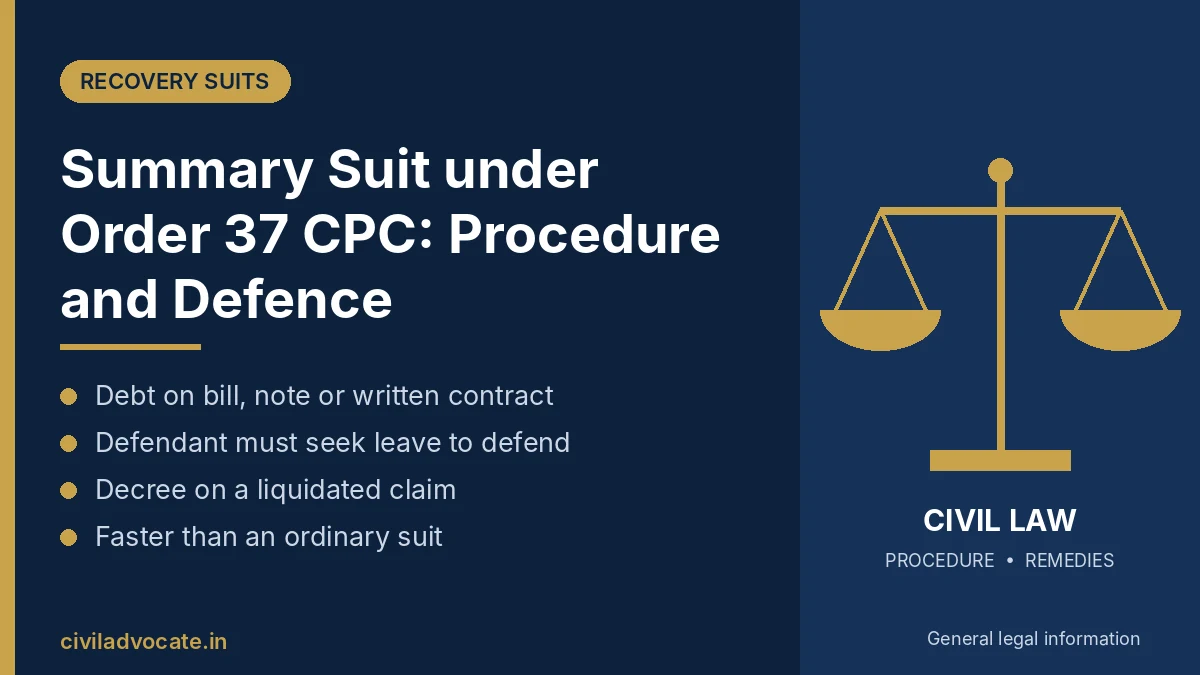
When a debt is based on a written document such as a cheque, promissory note or written contract, waiting years for an ordinary trial is painful. A summary suit under Order 37 CPC (the Code of Civil Procedure, 1908) offers a faster route to a decree. This article explains when it can be used and how the procedure works.
What is a summary suit under Order 37 CPC
A summary suit is a special procedure in which the defendant does not have an automatic right to defend. He must first obtain leave to defend from the court by showing a triable issue. If leave is refused, the plaintiff gets a judgment without a full trial.
Which suits can be filed under Order 37
Order 37 Rule 1 applies to the High Courts, City Civil Courts and Courts of Small Causes, and to other courts notified by the High Court. It covers suits where the plaintiff seeks to recover a debt or liquidated demand in money, arising on:
- a bill of exchange, hundi or promissory note (which includes a dishonoured cheque dealt with civilly),
- a written contract where the sum is a fixed amount or arises from a fixed formula,
- a guarantee, where the claim is against the principal debtor or surety for a debt, or
- the enforcement of a statute where the sum is a fixed debt, other than a penalty.
The suit should be based on a written instrument. A claim for damages, unliquidated amounts, or specific performance does not qualify.
Who can use it
Lenders, suppliers, businesses that issued invoices backed by written terms, and holders of dishonoured cheques commonly use this route. A cheque bounce can lead to both a criminal complaint under Section 138 of the Negotiable Instruments Act and a civil summary suit, and the two proceedings can run in parallel.
Step-by-step procedure
- Step 1: Plaint. The plaint must state that the suit is filed under Order 37, and that no relief other than that falling within the Order is claimed. The prescribed inscription appears under the title of the suit.
- Step 2: Summons for appearance. The court issues summons in the prescribed form, and the defendant must enter appearance within ten days of service. The defendant’s address for service is filed with the appearance.
- Step 3: Summons for judgment. After the defendant appears, the plaintiff serves the summons for judgment with the plaint and affidavit.
- Step 4: Application for leave to defend. The defendant has to apply for leave to defend within ten days of service of the summons for judgment, supported by an affidavit showing facts that disclose a defence.
- Step 5: Decision on leave. The court may refuse leave, grant it unconditionally, or grant it on conditions such as depositing the amount or furnishing security.
- Step 6: Decree or trial. If leave is refused, or the defendant does not apply, the plaintiff is entitled to a decree. Where leave is granted, the suit proceeds to trial.
Leave to defend: the key battleground
The Supreme Court in IDBI Trusteeship Services Ltd. v. Hubtown Ltd. (2017) summarised the principles. In broad terms:
- If the defendant shows a good defence on merits, leave should be granted unconditionally.
- If the defence raises a triable issue but appears doubtful, the court may grant leave on a condition of deposit.
- If the defence is sham or illusory, leave may be refused, or granted only with a full deposit.
- A defence that is plainly moonshine should not be allowed to delay the plaintiff.
Plaintiffs should therefore anticipate the defence and annex all documents showing the debt, acknowledgements and demand notices.
Pre-institution mediation for commercial disputes
If the dispute is a commercial dispute under the Commercial Courts Act, 2015 and no urgent interim relief is sought, Section 12A requires pre-institution mediation. The Supreme Court in Patil Automation Pvt. Ltd. v. Rakheja Engineers Pvt. Ltd. (2022) held it to be mandatory. Check this before filing, since a plaint filed without it may be rejected.
Interest and costs
The decree can include principal, contractual interest, and interest from the date of suit till realisation as the court directs, along with costs. Claim the interest rate agreed in the document, or a reasonable rate where the contract is silent.
Limitation
Suits for money due on a promissory note, bill or written contract are generally subject to a three-year period from the date the debt became due, subject to acknowledgement and part payment rules. Check the limitation article that applies to your claim before filing.
Setting aside an ex parte decree
If the defendant does not appear or apply for leave, a decree can be passed. Under Order 37 Rule 4, the court may set aside the decree and give leave to defend on special circumstances, on such terms as it thinks fit. The grounds are narrow, so the defendant should not delay.
Advantages and risks
- Advantages: Faster disposal, pressure on the debtor, and lower litigation cost.
- Risks: If the plaintiff’s documents have gaps, the court will grant leave, and the suit becomes a regular trial. Courts also take a strict view of suits wrongly framed under Order 37.
To protect assets or possession while a suit is pending, see our guide on temporary injunction under Order 39. The text of the Code is available on India Code.
Frequently Asked Questions
What is the purpose of a summary suit?
To allow quick recovery of a liquidated debt based on a written document, without a full trial where the defendant has no genuine defence.
Can a cheque bounce claim be filed as a summary suit?
Yes. A dishonoured cheque is a bill of exchange, and a recovery claim based on it can be filed under Order 37 in an eligible court, separately from the criminal complaint under Section 138.
How many days does the defendant have to appear?
Ten days from service of summons, and then ten days from service of the summons for judgment to apply for leave to defend.
What happens if leave to defend is granted?
Once leave to defend is granted, the defendant files a written statement and the suit proceeds like an ordinary suit with issues, evidence and arguments. The court may impose a condition such as depositing the claimed amount or furnishing security.
Can a summary suit be filed for damages?
No. Order 37 applies only to a debt or liquidated demand in money, based on the kinds of documents the Order lists. Claims for damages, specific performance or injunction must be filed as ordinary suits.
Is pre-institution mediation required?
In commercial disputes, Section 12A of the Commercial Courts Act requires pre-institution mediation unless urgent interim relief is sought, and the Supreme Court has held it mandatory. A non-commercial money claim does not need it.
Can an ex parte decree be set aside?
Yes. Under Order 37 Rule 4, if the defendant shows special circumstances, the court can set the decree aside, stay or set aside execution, and allow leave to defend, usually on terms such as a deposit.
Read More
- Temporary Injunction in a Civil Suit: Order 39 CPC Guide for Chennai
- SET-ASIDE and EX-PARTE decree: Expert Legal advice
- Expert Attorneys in Chennai for Comprehensive Legal Services
- Civil Case Filing Procedure in Chennai City Civil Court
- Get Legal Protection: How to Obtain a Stay Order for Your Case
This article is general legal information and not a substitute for advice on your specific case. Consult an advocate before acting.
This article is part of our guide: How to file a civil case in Chennai ?.