Temporary Injunction in a Civil Suit: Order 39 CPC Guide for Chennai
In this article (13 sections)
- Temporary and Perpetual Injunctions: The Basic Difference
- When Can You Seek an Injunction
- The Three-Part Test Every Court Applies
- Documents You Need to Support the Application
- Step-by-Step Procedure in a Tamil Nadu Civil Court
- Ex Parte Orders Without Notice
- Mandatory Injunctions
- Injunction Versus Declaration: Choosing the Right Suit
- When Courts Refuse an Injunction
- Disobeying an Injunction: Order XXXIX Rule 2A
- Duration, Review and Appeal
- Court Fees, Costs and Timeline
- Practical Tips for Property Owners in Chennai
A temporary injunction is a court order that freezes a situation until the civil suit is decided. It stops a neighbour from raising a wall on your land, a seller from selling a property already agreed to be sold, or a relative from dispossessing you of a house. In a property dispute it is often the most valuable order in the whole case, because by the time the final judgment arrives the damage may already be done.
This guide explains how injunctions work under Order XXXIX of the Code of Civil Procedure, 1908 (CPC) and Sections 36 to 42 of the Specific Relief Act, 1963. It covers the three-part test, how to apply, what happens if the order is disobeyed and the mistakes that make courts refuse relief. It is meant for property owners, tenants, businesses and families in Chennai and across Tamil Nadu.
Temporary and Perpetual Injunctions: The Basic Difference
Section 37 of the Specific Relief Act separates two kinds of injunction. A temporary injunction lasts until a specified time or until further orders of the court. It is granted during the pendency of the suit under Order XXXIX of the CPC. A perpetual injunction is granted at the end of the suit, by a decree, after the court has examined the evidence and decided the rights of the parties.
The two serve different purposes. The temporary order preserves the status quo and protects the plaintiff from harm while the case is pending. The perpetual order permanently restrains the defendant from interfering with the right the court has found to exist. A plaintiff usually asks for both in the same suit, with the temporary order sought by a separate application filed with the plaint.
| Feature | Temporary injunction | Perpetual injunction |
|---|---|---|
| Governing law | Order XXXIX Rules 1 and 2 CPC; Section 37(1) SRA | Sections 37(2) and 38 SRA |
| When granted | During the suit, on an interim application | By decree at the end of the suit |
| Based on | Prima facie case, balance of convenience, irreparable injury | Final findings on evidence and rights |
| Duration | Till disposal of the suit or further orders | Permanent, subject to appeal |
| Typical use | Stop sale, construction, dispossession during trial | Permanently restrain interference with title or possession |
When Can You Seek an Injunction
Order XXXIX Rule 1 allows a temporary injunction where the property in dispute is in danger of being wasted, damaged or alienated by a party to the suit, wrongfully sold in execution of a decree, or where the defendant threatens to remove or dispose of property to defraud creditors, or to dispossess the plaintiff or otherwise cause injury in relation to the property. Rule 2 extends this to cases where the defendant is about to commit a breach of contract or other injury.
In everyday terms, an injunction is the right tool when a threatened act would be hard or impossible to undo. Common situations include:
- Threatened sale or encumbrance. A co-owner or seller is about to alienate or mortgage the disputed property. This often accompanies a specific performance of an agreement to sell or a partition suit.
- Interference with possession. Someone is attempting to enter, build on or take over land that the plaintiff possesses.
- Illegal construction or encroachment. A neighbour is raising a structure on the plaintiff’s land or blocking a right of way.
- Eviction without due process. A landlord or relative is trying to throw out an occupier without a court order. See also our guide on eviction.
- Business and contract disputes. Breach of a non-compete, misuse of confidential information or termination in breach of an agreement, where damages would not repair the harm.
The Three-Part Test Every Court Applies
Temporary injunction: the three tests
1
Prima facie case
2
Balance of convenience
3
Irreparable injury
4
Prompt, honest conduct
Order XXXIX CPC and Sections 36-42, Specific Relief Act, 1963. General information only.
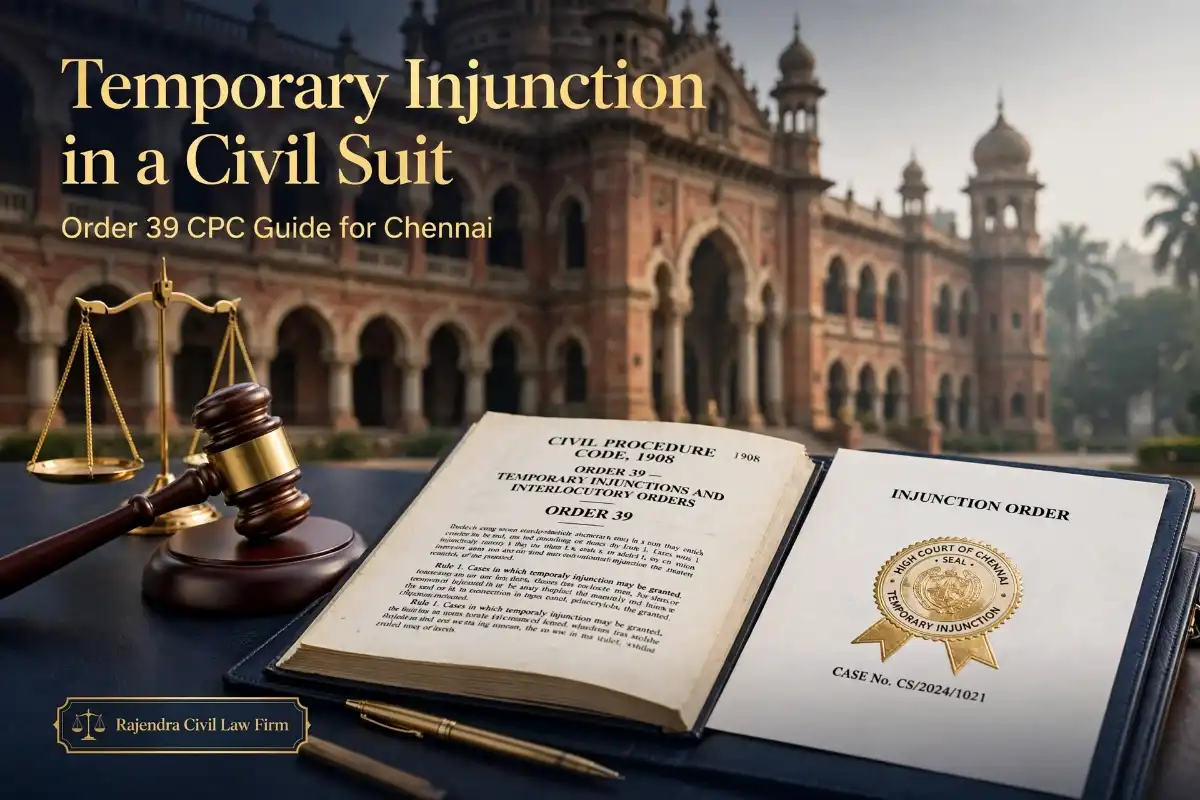
Courts across India apply three conditions before granting a temporary injunction. The principle is well settled, and the Supreme Court restated it in Dalpat Kumar v. Prahlad Singh (1992). The plaintiff must satisfy all three, not merely one.
- Prima facie case. There must be a serious question to be tried. The plaintiff does not need to prove the case at this stage, but must show a real right, such as title documents, possession records or an agreement, that deserves protection.
- Balance of convenience. The court asks who will suffer more if the order is granted or refused. If refusing the order causes the plaintiff greater harm than granting it causes the defendant, the balance favours the plaintiff.
- Irreparable injury. The harm must be of a kind that cannot be adequately compensated in money. Loss of a home, demolition of a building or alienation of unique property qualifies more easily than a loss that can be calculated.
The court also considers conduct. A plaintiff who knew of the defendant’s acts for months and did nothing will find it hard to prove urgency. A plaintiff who conceals facts or approaches the court with unclean hands can have the order vacated.
Documents You Need to Support the Application
Preparation matters more than argument. A well-supported application normally includes the following papers:
- Title documents such as sale deed, settlement deed, will or partition deed, with patta, chitta and encumbrance certificate.
- Proof of possession: tax receipts, electricity and water bills, photographs, survey sketch, and any earlier court orders.
- The agreement or notice relevant to the dispute, if the suit is contractual.
- Evidence of the threatened act, such as messages, police complaint, photographs of construction, or the notice received.
- A supporting affidavit stating the facts and, where relevant, why the plaintiff could not act earlier.
Step-by-Step Procedure in a Tamil Nadu Civil Court
- Choose the court. The suit is filed where the property is situated or where the defendant resides, depending on the nature of the claim.
- File the plaint with the injunction prayer. The main suit seeks the final relief, for example a declaration or perpetual injunction. See the explainer on the declaration suit where title itself is in question.
- File the application under Order XXXIX Rules 1 and 2 with an affidavit. The application sets out the facts and the three conditions in numbered paragraphs.
- Seek interim orders. Where the matter is urgent, ask for an interim order of status quo until the hearing. The court may pass such an order, usually until the next date.
- Serve notice on the defendant. Under Rule 3 the court should ordinarily hear the other side before granting the order.
- Hearing. The defendant files a counter affidavit and the court hears both sides on the three conditions.
- Order. The court grants, refuses or modifies the injunction, sometimes with conditions such as depositing money or giving an undertaking.
Ex Parte Orders Without Notice
Courts may in exceptional cases grant an injunction before hearing the defendant, where the delay in giving notice would defeat the purpose of the order. The proviso to Order XXXIX Rule 3 requires the court to record reasons for doing so, and the plaintiff must send the application, affidavit and documents to the defendant immediately after the order. If the plaintiff fails to comply, the order is liable to be vacated.
An ex parte order is not a final win. The defendant can apply under Rule 4 to discharge, vary or set it aside, and the court will then hear both sides. A person who has filed a caveat under Section 148A of the CPC is entitled to notice before such an order is made, which is a reason for property owners who anticipate litigation to consider filing one.
Mandatory Injunctions
Most injunctions are prohibitory: they tell someone not to do something. A mandatory injunction, covered by Section 39 of the Specific Relief Act, directs a party to do something, such as removing an unauthorised construction or restoring a blocked passage. Courts are more careful here, because the order changes the situation rather than preserving it. Interim mandatory injunctions are granted only in clear cases where the plaintiff shows a strong prima facie case and serious prejudice, and especially where the defendant has acted in haste to defeat the suit.
Injunction Versus Declaration: Choosing the Right Suit
A frequent mistake is to file a bare suit for injunction when title itself is genuinely disputed. The Supreme Court in Anathula Sudhakar v. P. Buchi Reddy (2008) explained that where the plaintiff is in settled possession and no serious cloud on title exists, a suit for injunction simply based on possession is enough. Where the defendant denies the plaintiff’s title or the plaintiff’s possession is not clear, a suit for declaration of title with consequential injunction, or for recovery of possession, is the proper course.
Choosing wrongly can waste years. A plaintiff who loses a bare injunction suit because title is in doubt may be told to sue again for declaration, and may then face a limitation or res judicata objection. A careful advocate decides the type of suit before filing, based on the title documents and the facts of possession. For wider context on land and building conflicts see our guides on property disputes and real estate disputes.
When Courts Refuse an Injunction
Section 41 of the Specific Relief Act lists cases where an injunction cannot be granted. Among them are orders to stay a judicial proceeding in another court, to restrain proceedings in a criminal matter, to prevent a breach of a contract that cannot be specifically enforced, to prevent a nuisance when it is not clear that it is actually a nuisance, and where equally efficacious relief can be obtained by another usual mode of proceeding. Courts also refuse relief where the plaintiff has acted in bad faith, has delayed unreasonably or has no personal interest in the matter.
- Where damages would be an adequate remedy and the property is not unique.
- Where the plaintiff is a trespasser seeking to protect an unlawful possession against the true owner. Possession must be lawful to attract protection.
- Where the plaintiff has suppressed material facts or filed false documents.
- Where the order would stop a public utility project that the law protects.
Disobeying an Injunction: Order XXXIX Rule 2A
Once an injunction is granted, it must be obeyed. If a party disobeys it, or breaks any undertaking given to the court, Rule 2A allows the court to attach the property of the person guilty of disobedience and to order detention in civil prison for up to three months. The attachment can last for up to one year, after which the property may be sold if the disobedience continues and compensation awarded. A buyer who purchases property with notice of an injunction does not obtain protection simply because the sale deed is registered, and transactions in the teeth of the order can be treated as invalid.
The applicant should file the contempt application promptly, with photographs and proof of service of the order. Where the order is not served on the opposite party, the court may refuse to find wilful disobedience, so serve it properly and keep an acknowledgement.
Duration, Review and Appeal
A temporary injunction continues until the suit ends, unless the court modifies or vacates it. It may be vacated if the plaintiff does not take steps in the suit or if circumstances change. Orders granting or refusing injunctions are appealable under Order XLIII Rule 1(r) of the CPC. The Supreme Court in Wander Ltd. v. Antox India (1990) held that an appellate court should not ordinarily substitute its own discretion for that of the trial court, unless the order was arbitrary, capricious or perverse.
Many plaintiffs make the mistake of not pursuing the main suit once an interim order is in hand. Courts expect the trial to move forward, and long inaction can lead to the order being discharged. Where the suit succeeds, the temporary order merges in the decree and the final order can be enforced through execution of decrees.
Court Fees, Costs and Timeline
The court fee on the plaint depends on the relief claimed and the value of the property. The application for temporary injunction carries a modest fee. Timelines vary with the court and the docket, but a well-prepared application, with notice served, is often heard within a few weeks, and an urgent status quo order can sometimes be obtained on the first day. Parties should plan for the main suit to run for years and should treat the interim order as the period in which their strategy is most visible to the court.
Practical Tips for Property Owners in Chennai
- Act the moment you see a threat. Photographs with dates and a police complaint help prove urgency.
- Check that your name appears in the revenue records and that your title papers are complete before filing.
- File a caveat if you expect the other side to run to court first.
- Never suppress a prior case or order. Disclose it in the affidavit.
- Comply scrupulously with any condition imposed by the court. A single lapse can cost the order.
- Take legal advice before taking the law into your own hands. Self-help eviction or demolition invites criminal and civil consequences.
Conclusion
A temporary injunction is a practical tool to protect property and rights while a civil case runs its course. Courts grant it where the plaintiff shows a prima facie case, a favourable balance of convenience and the risk of irreparable injury, and where the plaintiff has come to court promptly and honestly. The best applications are built on clear title and possession records, timely action and the right choice of main suit. If you face a threatened sale, construction or dispossession, document the threat and speak to a civil lawyer before the status quo changes.
This article is for general information only and is not legal advice. Statutory provisions and judgments should be verified against current official sources before reliance.
Frequently Asked Questions
What is the difference between a temporary and a perpetual injunction?
A temporary injunction is passed during the suit under Order XXXIX CPC to preserve the position until the case ends. A perpetual injunction is granted by the final decree after the court decides the rights of the parties.
What three things must I prove to get a temporary injunction?
You must show a prima facie case, that the balance of convenience lies in your favour, and that you will suffer irreparable injury if the order is refused.
Can a court grant an injunction without hearing the other side?
Yes, in urgent cases, but the court must record its reasons and the plaintiff must serve the papers on the defendant immediately. The defendant can apply to set the order aside.
What happens if someone disobeys an injunction?
Under Order XXXIX Rule 2A the court can attach the offender’s property and order civil detention for up to three months.
Should I file a suit for injunction or for declaration?
If your possession is settled and your title is not seriously disputed, an injunction suit may be enough. If title is denied or unclear, a declaration of title with consequential injunction is the safer course.
Can I appeal if the court refuses my injunction application?
Yes. Orders granting or refusing a temporary injunction are appealable under Order XLIII Rule 1(r) of the CPC, though appellate courts interfere only where the trial court acted arbitrarily or perversely.
Read More
- File a Suit for Injunction: Expert Civil Lawyers to Protect Your Rights
- Expert Legal Representation for Property Disputes: Protecting Your Rights
- Specific Performance of Contract in India: Specific Relief Act Guide
- SET-ASIDE and EX-PARTE decree: Expert Legal advice
- Get Legal Protection: How to Obtain a Stay Order for Your Case
This article is part of our guide: How to file a civil case in Chennai ?.