Temporary Injunction under Order 39 CPC: Grounds, Process
In this article (9 sections)
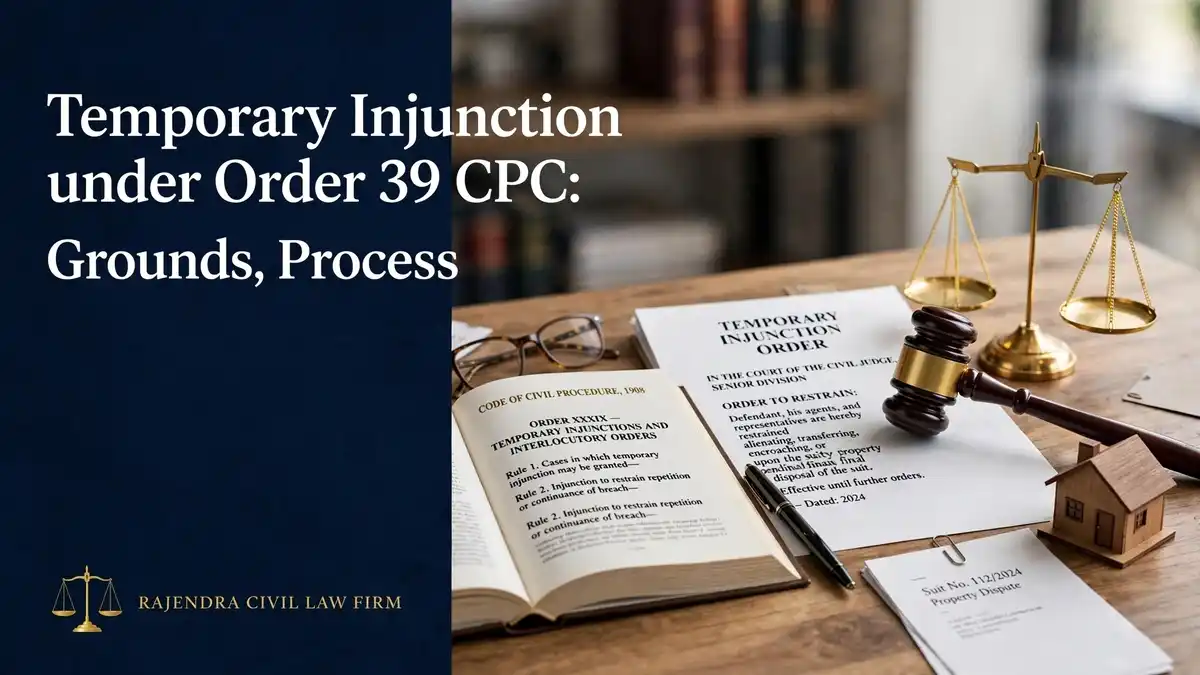
A temporary injunction is an interim order of a civil court that restrains a party from doing something, or directs a party to maintain the existing position, until the suit is decided. It is governed by Order 39 Rules 1 and 2 of the Code of Civil Procedure, 1908 (CPC) and Section 94 and Section 151 CPC. It is often the most important relief in a property, business or contract dispute, because the final decree may come years later. This guide explains the test, the procedure and the practical points.
How to Obtain a Temporary Injunction: A Complete Guide to Order 39 CPC
When can a court grant a temporary injunction
Order 39 Rule 1 allows the court to grant a temporary injunction where:
- Any property in dispute is in danger of being wasted, damaged or alienated by any party to the suit, or wrongfully sold in execution of a decree.
- The defendant threatens or intends to remove or dispose of his property with a view to defrauding his creditors.
- The defendant threatens to dispossess the plaintiff or otherwise cause injury to him in relation to any property in dispute.
Rule 2 covers cases where the defendant is about to commit a breach of contract or other injury of any kind.
The three-part test
The Supreme Court in *Dalpat Kumar v. Prahlad Singh* (1992) and *Wander Ltd. v. Antox India* (1990) has set out the principles. The plaintiff must show:
- A prima facie case, meaning a serious question to be tried, not a certainty of success.
- The balance of convenience in his favour, meaning greater inconvenience will be caused to him if the injunction is refused than to the defendant if it is granted.
- Irreparable injury, meaning loss that cannot be adequately compensated in money.
All three must be satisfied. Courts also look at the conduct of the plaintiff, such as delay or concealment of facts. A plaintiff who seeks equity must come with clean hands.
Temporary injunction and permanent injunction
A temporary injunction lasts until the disposal of the suit or until further orders. A permanent injunction is granted in the final decree under the Specific Relief Act, 1963, after trial. A suit for a declaration of title and injunction usually combines both. To understand the title suit, read our guide on suit for declaration of title under Section 34.
How to apply
- File the plaint and then an application under Order 39 Rules 1 and 2 read with Section 151 CPC, supported by an affidavit.
- Annex the documents on which the claim depends: title deeds, agreements, patta, tax receipts, photographs and correspondence.
- Serve a copy on the opposite party. The court usually calls for objections and hears both sides.
- The court may appoint a commissioner to inspect the property where the physical position is disputed.
Ex parte (interim) injunction
In urgent cases, the court may grant an injunction before hearing the other side. Order 39 Rule 3 requires the court to record reasons for believing that delay would defeat the object of the injunction. The applicant must, immediately after the order, send the application, the plaint and the documents to the other side. The Rule also requires the court to try to dispose of an ex parte injunction application within thirty days of the grant. If the plaintiff conceals material facts, the order is liable to be vacated.
Disobedience of an injunction
Under Order 39 Rule 2A, if a party disobeys the order, the court can attach his property and order him to be detained in civil prison for up to three months. The property attachment cannot last longer than one year, after which the court may sell it and compensate the injured party.
Vacating, varying or setting aside
The party against whom the injunction is granted can apply under Order 39 Rule 4 to discharge, vary or set aside the order. An appeal also lies against an order granting or refusing injunction under Order 43 Rule 1(r) CPC.
Practical tips
- Move quickly. Delay weakens the claim of irreparable injury.
- Be honest about all earlier proceedings, since concealment can be fatal.
- Check limitation before filing. See our guide on limitation period for civil suits in India.
- If a money claim is what you seek, consider a summary suit under Order 37 CPC.
- The Code is available on India Code.
Frequently Asked Questions
What is a temporary injunction?
It is an interim order from a civil court under Order 39 CPC that restrains a party from an act, or preserves the existing position, until the suit is decided.
What must be proved to get a temporary injunction?
A prima facie case, balance of convenience in your favour and irreparable injury if the injunction is refused. All three are required.
Can a court grant an injunction without hearing the other side?
Yes, in urgent cases under Order 39 Rule 3, but it must record reasons, and the applicant must serve the papers immediately. The court should try to dispose of the application within thirty days.
What happens if someone breaks an injunction?
Under Order 39 Rule 2A, the court can attach the property of the disobedient party and detain him in civil prison for up to three months.
Can a temporary injunction be challenged?
Yes. The affected party can apply to vacate or vary it under Order 39 Rule 4, and file an appeal under Order 43 Rule 1(r).
Is a temporary injunction the same as a stay order?
Not exactly. A stay usually suspends an order or proceeding, while a temporary injunction restrains a party from an act or maintains the status of property. In practice, both are interim reliefs.
How long does a temporary injunction last?
Until the disposal of the suit or until further orders of the court, unless it is vacated earlier.
Read More
-
Temporary Injunction in a Civil Suit: Order 39 CPC Guide for Chennai
-
File a Suit for Injunction: Expert Civil Lawyers to Protect Your Rights
-
Expert Legal Representation for Property Disputes: Protecting Your Rights
-
Cases Related to Pollution and Conservation: Legal Advocacy for Environmental Issues
This article is general legal information and not a substitute for advice on your specific case. Consult an advocate before acting.
This article is part of our guide: How to file a civil case in Chennai ?.