Rejection of Plaint under Order 7 Rule 11 CPC: Grounds
In this article (10 sections)
A weak or defective suit can be stopped at the very start. Rejection of plaint under Order 7 Rule 11 of the Code of Civil Procedure, 1908 (CPC) allows a court to throw out a suit without a trial when the plaint itself shows a fatal defect. This guide explains the grounds, how courts approach the question, and what happens next.
Rejection of Plaint Under CPC: Grounds and Procedure Under Order 7 Rule 11
What is a plaint, and what does rejection mean
A plaint represents the written statement of claim that starts a civil suit. Specifically, the law requires every plaint to meet certain basic legal requirements to be valid. Consequently, when a plaint fails to meet those requirements, the court rejects it and ends the suit at the threshold itself. Moreover, the court treats such a rejection as a decree under the CPC. Therefore, the aggrieved party can challenge the order by filing an appeal. Ultimately, this provision helps courts filter out defective or baseless suits at the very beginning.
The six grounds under Order 7 Rule 11
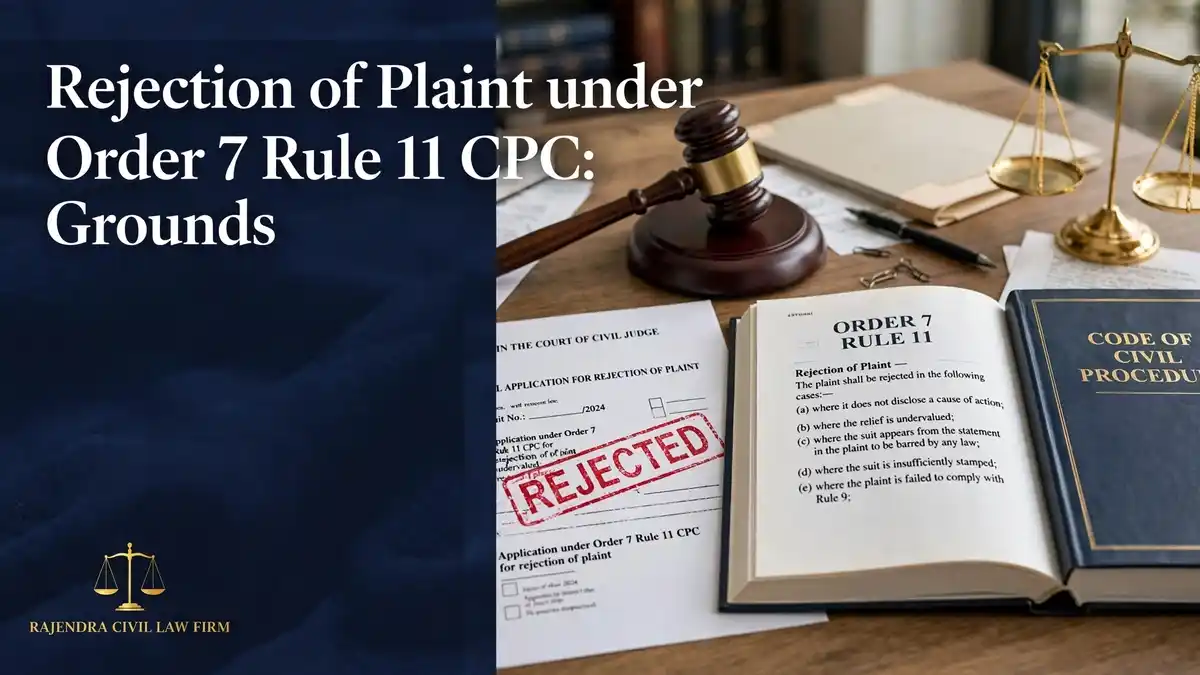
The court shall reject a plaint in these cases:
- (a) It does not disclose a cause of action.
- (b) The relief claimed is undervalued, and the plaintiff does not correct the valuation within the time fixed by the court.
- (c) The relief is properly valued but the plaint is written on insufficiently stamped paper, and the plaintiff does not supply the stamp paper within the time fixed.
- (d) The suit appears from the statement in the plaint to be barred by any law, including limitation.
- (e) It is not filed in duplicate.
- (f) The plaintiff fails to comply with the provisions of Rule 9, which require filing of copies for service.
Grounds (a) and (d) are the most litigated in practice.
How do courts decide an application
The Supreme Court has made the approach clear:
- In T. Arivandandam v. T.V. Satyapal (1977), the Court said that if a plaint, read meaningfully, shows a clever drafting that creates an illusion of a cause of action, it should be nipped in the bud.
- In Dahiben v. Arvindbhai Kalyanji Bhanusali (2020), the Court held that the court must look only at the plaint and the documents filed with it, and not at the defence in the written statement. The averments in the plaint are taken as true at this stage.
- Courts should not hold a mini-trial, and disputed facts must be decided at trial.
- A plaint cannot be rejected in part. The Supreme Court has explained that rejection under Rule 11 is of the plaint as a whole, so if some reliefs survive, the plaint stays, though the court may separately strike out claims that are barred.
Limitation as a ground
A plaint can be rejected under clause (d) only if the plaint itself shows that the suit is time-barred. Where limitation depends on facts, such as the date of knowledge, acknowledgement or fraud, it becomes a mixed question of fact and law for trial. See our guide on the limitation period for civil suits.
No cause of action
A cause of action means the bundle of facts that the plaintiff must prove to get relief. A plaint that does not state these facts, or that discloses only a bare right without any act of the defendant, can be rejected. For a title claim, check that the plaint meets the requirements discussed in our guide on a suit for declaration of title.
Procedure for the application
- The defendant can apply at any stage, even before filing a written statement.
- The court can also reject a plaint on its own motion.
- The application is decided after hearing both sides on the plaint.
- If the plaint is rejected for undervaluation or short stamp, the court usually gives a time to correct the defect first.
Rejection of plaint: effect and remedies
- Under Rule 13, rejection does not stop the plaintiff from presenting a fresh plaint on the same cause of action, unless the suit is barred by limitation or law.
- The plaintiff can appeal against the order of rejection as it is a decree, under Order 41, and seek the appellate court’s reconsideration.
- If the defendant’s application is rejected, the order is generally an interim order. The defendant can raise the same points at trial and in appeal.
Rule 11 and Order 7 Rule 10
Where the plaint is filed in a court that lacks territorial or pecuniary jurisdiction, the court generally returns the plaint under Order 7 Rule 10 instead of rejecting it, so that the plaintiff can file it in the correct court.
Practical tips
- Defendants should read the plaint carefully and apply early where the defect is clear, since it saves cost.
- Plaintiffs should state all material facts of the cause of action, the date of knowledge, and the facts for any extension of limitation.
- Value the suit properly and pay the court fee correctly.
- Do not draft by formula. A plaint with vague or cut-and-paste allegations invites an application.
- The Code is available on India Code.
Frequently Asked Questions
What is rejection of plaint?
It is an order under Order 7 Rule 11 CPC by which a court throws out a plaint at the threshold because it has a fatal defect, such as no cause of action or a bar by law.
Can the court look at the defendant’s written statement?
No. For Rule 11, the court considers only the plaint and the documents filed with it, as held by the Supreme Court in Dahiben (2020).
Can a plaint be rejected because the suit is time-barred?
Yes, if the plaint itself shows the suit is barred by limitation. If limitation depends on disputed facts, it is decided at trial.
Can the plaintiff file a fresh suit after rejection?
Yes, under Rule 13, unless the fresh suit is barred by limitation or law.
Can the plaintiff appeal against rejection of a plaint?
Yes. The rejection of a plaint is a decree, and a first appeal lies to the appellate court.
When is a plaint returned instead of rejected?
When the court lacks jurisdiction, the plaint is returned under Order 7 Rule 10 so that it can be presented to the proper court.
Who can apply for rejection of a plaint?
The defendant at any stage, and the court can also do so on its own motion if the defect is apparent.
Read More
- Navigating Munsiff Courts: Essential Legal Guidance for Your Case
- Temporary Injunction in a Civil Suit: Order 39 CPC Guide for Chennai
- Supreme Court Matters: Expert Legal Representation for Complex Cases
- SET-ASIDE and EX-PARTE decree: Expert Legal advice
- Specific Performance of Contract in India: Specific Relief Act Guide
This article is general legal information and not a substitute for advice on your specific case. Consult an advocate before acting.
This article is part of our guide: How to file a civil case in Chennai ?.