Suit for Declaration of Title: Section 34 Explained
In this article (10 sections)
When someone challenges your ownership, or puts a cloud over your title by a false document, a suit for declaration of title can clear the position. It is among the most important property remedies in civil courts. This guide explains the law and the practical steps.
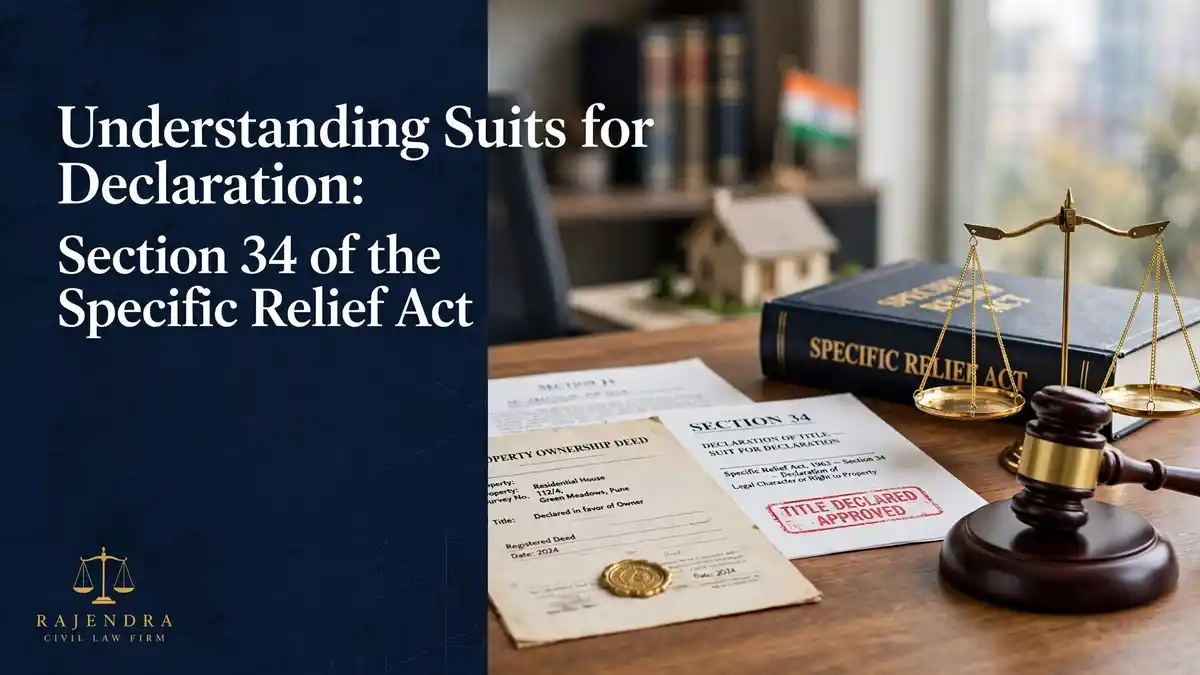
Understanding Suits for Declaration: Section 34 of the Specific Relief Act
What is a declaratory suit
Under Section 34 of the Specific Relief Act, 1963, a person entitled to any legal character, or to any right as to any property, may sue for a declaration that he is so entitled, where another denies or is interested in denying that title. The court may, in its discretion, grant the declaration. The Act is available on India Code.
When should you file one
- Someone claims ownership of your property by a forged or invalid document.
- A sale deed, gift or settlement is being relied on to deny your title.
- Revenue records, such as patta or chitta, are made in the wrong person’s name and you want your ownership declared.
- There is a threat to dispossess you, and the cloud on title must be removed first.
- You want a declaration that a decree, deed or order is not binding on you.
The proviso: ask for the further relief
The proviso to Section 34 says that the court shall not make a declaration where the plaintiff, being able to seek further relief than a mere declaration of title, omits to do so. If you are out of possession, you must also ask for recovery of possession. If you are in possession but threatened, you should usually also seek a permanent injunction. A suit for a bare declaration where a consequential relief is available is liable to fail.
Burden of proof in a suit for declaration of title
In a title suit, the plaintiff must succeed on the strength of his own title, not on the weakness of the defendant’s case. The Supreme Court laid down the principles in Anathula Sudhakar v. P. Buchi Reddy (2008), distinguishing between suits for title and possession, suits for injunction, and suits where title is in issue. In Union of India v. Ibrahim Uddin (2012), the Court stressed that a declaration of title requires proof of title and cannot be granted merely because the defendant fails to prove his own.
Documents to prepare
- Title deeds: sale deed, gift deed, settlement deed, partition deed or will, along with the chain of earlier documents.
- Encumbrance certificate for the relevant period.
- Patta, chitta, FMB sketch, and tax receipts for property tax and electricity.
- Survey records and village accounts.
- Proof of possession: utility bills, photographs, witnesses.
- The disputed documents and any correspondence or legal notices.
Note that revenue entries and mutation do not by themselves confer title. The Supreme Court held in Suraj Bhan v. Financial Commissioner (2007) that mutation is for fiscal purposes and creates no title, though it can be relevant evidence.
Step-by-step procedure
- Step 1: Legal notice. Often useful to document the dispute and demand withdrawal of the false claim.
- Step 2: Choose the court. A suit for declaration relating to immovable property is filed where the property is situated (Section 16 CPC), before the court having pecuniary jurisdiction.
- Step 3: Draft the plaint. State the facts, the cause of action, the chain of title, the denial by the defendant, the valuation and court fee, and the reliefs: declaration, possession and injunction where applicable.
- Step 4: Interim relief. Apply under Order 39 for a temporary injunction to protect possession and prevent alienation during the suit (see our guide on temporary injunction under Order 39).
- Step 5: Written statement and issues. The defendant responds, the court frames issues.
- Step 6: Evidence and arguments. Both sides lead oral and documentary evidence.
- Step 7: Judgment and decree. The court decides, and the decree can be registered and used to correct records.
Court fee and valuation
Court fee and valuation depend on the relief claimed and the applicable State law. In Tamil Nadu they are governed by the Tamil Nadu Court Fees and Suits Valuation Act, 1955, and the fee depends on whether consequential relief is claimed. Confirm the valuation with an advocate to avoid objections.
Limitation
A declaration suit is generally subject to three years under Article 58 from when the right to sue first accrues, while a suit for possession based on title has twelve years under Article 65. See our article on the limitation period for civil suits.
Common reasons for failure
- Not seeking the consequential relief of possession or injunction.
- Weak documents or a broken chain of title.
- Suit filed beyond the limitation period.
- Non-joinder of necessary parties such as co-owners or subsequent purchasers.
- Relying on revenue records alone.
Frequently Asked Questions
What is a suit for declaration of title?
It is a civil suit asking the court to declare that the plaintiff is the owner of a property, where the defendant disputes or clouds that title.
Which section governs declaratory relief?
Declaratory relief is governed by Section 34 of the Specific Relief Act, 1963. It allows a person entitled to a legal character or a right to property to seek a declaration, subject to the proviso that further relief must be sought where it is available.
Do I need to ask for possession as well?
If you are out of possession, yes. The proviso to Section 34 can bar a bare declaration where further relief is available but not claimed.
Who has to prove title in such a suit?
The plaintiff. He must prove his own title and cannot rely merely on weaknesses in the defendant’s case. The Supreme Court has repeatedly stressed this rule, so the plaintiff should place the full chain of title documents and evidence of possession before the court.
Does patta or mutation prove ownership?
No. They are revenue records and can support possession, but they do not by themselves confer title. Courts treat them as relevant evidence of possession and enjoyment, while title flows from valid documents such as a sale deed, gift, will or partition.
What is the limitation for a declaratory suit?
Three years under Article 58 from when the right to sue first accrues, while a suit for possession on title has twelve years.
Can I get an interim injunction in a title suit?
Yes. You can apply under Order 39 CPC along with the suit. The court looks for a prima facie case, balance of convenience and irreparable injury, and may grant an interim order to protect possession until judgment.
Read More
- Expert Legal Representation for Property Disputes: Protecting Your Rights
- Civil Court Fees and Advocate Fees in Chennai: Expert Advice
- Championing Partition Suit Cases: Expert Legal Advice
- Temporary Injunction in a Civil Suit: Order 39 CPC Guide for Chennai
- Legal Fees: Expert Advice on Insurance Claim Disputes in India
This article is general legal information and not a substitute for advice on your specific case. Consult an advocate before acting.
This article is part of our guide: Resolving Real Estate Disputes: Expert Legal Guidance and Representation.