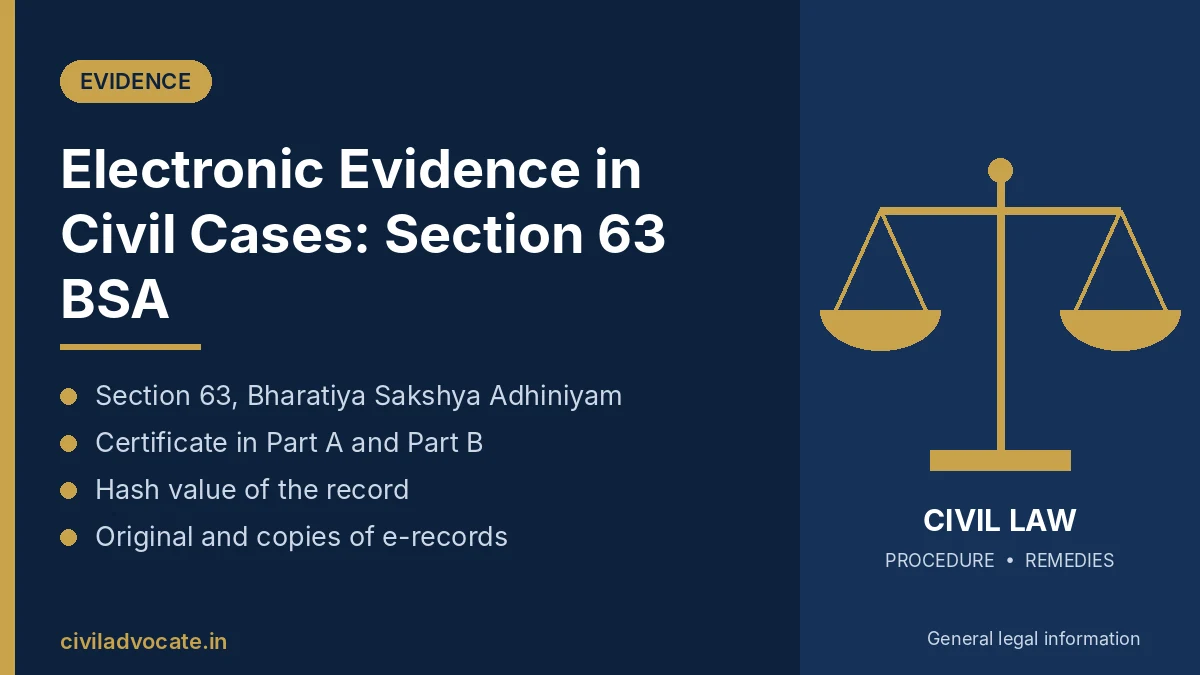
Electronic Evidence in Civil Cases: Section 63 BSA
In this article (8 sections)
First, electronic evidence in civil cases encompasses diverse formats, including emails, WhatsApp chats, call recordings, CCTV footage, photographs, bank statements, and digital documents. Subsequently, the Bharatiya Sakshya Adhiniyam, 2023 (BSA) took effect on 1 July 2024 to replace the Indian Evidence Act, 1872, and it now regulates this digital proof. Furthermore, the updated legislation streamlines the legal handling of modern data. Specifically, Section 63 of the BSA supersedes Section 65B of the old Act as the primary governing provision. Consequently, legal practitioners must carefully navigate these new standards to establish the authenticity of electronic records. Ultimately, this guide details the precise methods required to prove electronic evidence in a civil case.
Electronic evidence in civil cases: electronic records as documents
Under the BSA, a document includes an electronic or digital record. Section 61 says that the admissibility of an electronic record cannot be denied merely because it is in electronic form. It has the same legal effect, validity and enforceability as any other document. An electronic record produced for inspection of the court is a document, and the court has to be satisfied about its authenticity.
Section 63 certificate
First, Section 63 establishes that any information contained in an electronic record qualifies as an official document. Furthermore, the law considers outputs printed on paper, stored on optical media, or produced by a computer admissible without requiring the original. Specifically, the provision requires that the computer or device operated regularly for that purpose. In addition, personnel must have fed the information into the system in the ordinary course of business. Moreover, the hardware and software must have functioned properly during the process. Finally, the resulting output must accurately reproduce the data originally fed into it.
The most important requirement is the certificate under Section 63(4), in the form given in the Schedule to the Act. The certificate has two parts:
- Part A: Signed by the party or the person in charge of the computer or communication device. It identifies the electronic record, describes how it was produced, the device details, and discloses the hash value of the record.
- Part B: Signed by an expert, who certifies the record and its hash value.
A hash value is a unique digital fingerprint of a file, generated by an algorithm such as SHA-256. If even one character of the file changes, the hash value changes. It helps to show that the record produced in court is identical to the original.
The Supreme Court is reported to have upheld the validity of Section 63(4) in 2026 (*Pune Bar Association v. Union of India*) and to have described the hash value as an electronic fingerprint. Who may sign the expert part (Part B) is still being worked out by the courts, so check the latest rulings before filing.
Earlier rulings that still guide courts
- In *Anvar P.V. v. P.K. Basheer* (2014), the Supreme Court held that electronic evidence is admissible only if the certificate under Section 65B(4) is produced.
- In *Arjun Panditrao Khotkar v. Kailash Kushanrao Gorantyal* (2020), the Supreme Court affirmed that the certificate is mandatory for secondary electronic evidence, but that it can be produced at a later stage with the court’s permission, and that a certificate is not needed when the original device itself is produced and proved in the witness box.
These rulings help courts interpret Section 63 as well.
Which proceedings does the BSA apply to
The BSA applies to evidence in proceedings from 1 July 2024. For cases pending before that date, the savings clause of the BSA and the principles on pending proceedings should be considered, so that the old Evidence Act may continue to apply in some situations. Take legal advice on which law applies to your case.
Practical steps to prepare electronic evidence
- Preserve the original device and do not delete messages. Avoid editing or forwarding in a way that changes the metadata.
- Take a forensic copy or export of chats, with the date, time, sender and phone number visible.
- Generate the hash value at the time of copying and record it in a document.
- Obtain the certificate from the person in charge of the device and from an expert as required.
- Keep a chain of custody log: who handled the device, when, and what was done.
- Identify the persons whose voice or image appears, and be ready to prove their identity.
- Secure records from third parties, such as service providers, banks or platforms, through requests or court orders.
Common types of evidence
- Emails: Produce headers, server details and the certificate.
- WhatsApp or SMS: Show the phone number, profile and chat export, with the certificate.
- Call recordings: Prove the voice, the date and the device, and have the transcript.
- CCTV: Produce the footage with the DVR details, time settings and the certificate.
- Digital agreements and bank statements: Prove with the certificate and a bank official’s certificate where applicable.
Use in different civil suits
Electronic evidence is useful in suits for recovery, specific performance, defamation and family disputes. For a suit for money, see summary suit under Order 37 CPC. For a contract dispute, see specific performance of contract. Documents should be filed with the pleadings, as discussed in written statement and counterclaim under Order 8 CPC. In criminal matters, see our guide on cybercrime and online fraud. The Act is available on India Code.
Frequently Asked Questions
Which law governs electronic evidence now?
The Bharatiya Sakshya Adhiniyam, 2023, which came into force on 1 July 2024. Section 63 deals with the admissibility of electronic records.
What is the Section 63 certificate?
It is a certificate in the form given in the Schedule to the BSA, signed by the person in charge of the device and by an expert, which identifies the record and discloses its hash value.
What is a hash value?
It is a unique digital fingerprint of a file, produced by an algorithm. It shows whether the file has been changed after creation.
Is a WhatsApp chat admissible in a civil case?
Yes, if it is properly proved with the certificate and other evidence, such as proof of the phone number and the parties. Print-outs without the certificate may be rejected.
Can the certificate be filed later?
The Supreme Court allowed it at a later stage with the court’s permission under the earlier law. Do not rely on this and file it with the documents.
Do I need an expert for the certificate?
The BSA certificate has a part to be signed by an expert. The exact qualifications of the expert are being clarified by the courts, so seek legal advice.
Is a call recording valid evidence?
Yes, if it is relevant, the voice is identified, and the certificate and other requirements are satisfied. Courts also consider whether it was obtained lawfully and whether it is tampered.
Read More
- Marriage Registration Services: Simplifying the Process
- Civil Court Fees and Advocate Fees in Chennai: Expert Advice
- Temporary Injunction in a Civil Suit: Order 39 CPC Guide for Chennai
- Patent Registration Made Simple: Expert Legal Assistance in Chennai
This article is general legal information and not a substitute for advice on your specific case. Consult an advocate before acting.
This article is part of our guide: How to file a civil case in Chennai ?.