Specific Performance of Contract in India: Specific Relief Act Guide

In this article (17 sections)
- What Specific Performance Means in Indian Law
- Key Provisions of the Specific Relief Act at a Glance
- When a Court Will Order Specific Performance
- Readiness and Willingness: The Heart of the Case
- Limitation: Article 54 and the Three-Year Rule
- Is Time the Essence of the Contract
- Common Defences Raised by the Seller
- Step-by-Step Procedure for the Buyer
- Remedies Available Beyond the Sale Deed
- The Role of the Advance Money
- Specific Performance in Property Development and Business Contracts
- Specific Performance and Third-Party Rights
- Role of the Court in Tamil Nadu
- Declaration, Injunction and Specific Performance Together
- Common Mistakes That Cost Buyers the Case
- Practical Checklist Before You Sign an Agreement to Sell
- Frequently Asked Questions
Specific performance is the remedy by which a civil court orders a defaulting party to actually carry out a contract, instead of merely paying money for the breach. It is most often sought by a buyer under an agreement to sell immovable property, where the seller has taken an advance and then refuses to execute the sale deed. The remedy is governed by the Specific Relief Act, 1963, as substantially amended in 2018, and it now operates as the rule rather than the exception.
This guide explains when a suit for specific performance succeeds, what the plaintiff must prove, which defences commonly work, how limitation is counted and how the court treats the advance money. It is written for property buyers, sellers, developers and business owners in Tamil Nadu who hold or face an unperformed agreement. It is general information and not a substitute for advice on a specific document.
What Specific Performance Means in Indian Law
A breach of contract normally gives the innocent party a claim for damages. Damages are a poor remedy where the subject matter is unique, such as a particular plot, flat or shop, because no amount of money buys the same property. Specific performance fills that gap. The court directs the defendant to do what the contract promised, for example to receive the balance price and execute and register the sale deed within a fixed time.
The remedy sits in the Specific Relief Act, 1963. Section 10, after the 2018 amendment, says that the specific performance of a contract shall be enforced by the court, subject to the exceptions in Sections 11(2), 14 and 16. Before 2018 the Act spoke of the court’s discretion. That discretion was removed, so a plaintiff who proves a valid contract and his own readiness and willingness now stands on firmer ground than before.
Specific performance is an equitable remedy, which means conduct still matters. A buyer who sleeps over his rights, misrepresents facts or never had the money ready will find the court unwilling to help, even without the old discretion. The practical question is therefore always the same: did the plaintiff do everything the contract required of him, and is the contract capable of being enforced
Key Provisions of the Specific Relief Act at a Glance
Specific performance suit: five checkpoints
1
Valid written agreement
2
Readiness and willingness proved
3
Legal notice and Sub-Registrar visit
4
Suit within 3 years (Article 54)
5
Alternative refund prayer
Specific Relief Act, 1963 (as amended in 2018). General information only.
| Provision | What it deals with | Why it matters |
|---|---|---|
| Section 10 | Cases where specific performance is enforced | Makes the remedy the general rule after 2018 |
| Section 14 | Contracts that cannot be specifically enforced | Bars relief for personal service, determinable contracts and contracts needing continuous supervision |
| Section 16 | Persons barred from relief | Contains the readiness and willingness requirement in clause (c) |
| Section 20 | Substituted performance | Lets the plaintiff engage a third party at the defaulter’s cost, after notice |
| Section 21 | Compensation with or instead of performance | Allows damages to be claimed in the same suit |
| Section 22 | Possession, partition and refund of money | Allows consequential relief to be sought in the same plaint |
| Section 28 | Rescission after a decree | Lets the seller seek rescission if the buyer fails to pay within the time fixed |
When a Court Will Order Specific Performance
Courts look for a handful of conditions. If one is missing, the suit usually fails, however unfair the seller’s conduct may look.
- A valid and enforceable contract. The agreement must be concluded, certain in its terms and supported by lawful consideration. An unsigned draft or a vague understanding to sell “some portion” of a property is hard to enforce.
- Readiness and willingness. The plaintiff must plead and prove that he was and always has been ready and willing to perform his part. This covers both the capacity to pay and the intention to complete.
- Clear title and a seller able to perform. The defendant should be the owner or have authority to sell. Where title is defective or a third party holds an interest, relief may be refused or limited.
- No statutory bar. The contract must not fall within Section 14, for example a contract that is by nature determinable or depends on personal qualifications.
- A suit filed in time. Limitation under Article 54 of the Limitation Act, 1963 must be satisfied, as explained below.
Readiness and Willingness: The Heart of the Case
Section 16(c) requires the plaintiff to aver and prove that he has performed or has always been ready and willing to perform the essential terms of the contract that are to be performed by him. Courts treat this as a continuing obligation from the date of the agreement up to the date of the decree, not a formality to be recited in the plaint.
Evidence that normally supports the plea includes bank statements showing funds available at the relevant time, a loan sanction letter, a demand draft or cheque tendered, legal notices calling upon the seller to execute the deed, and proof that the plaintiff attended the Sub-Registrar’s office on the agreed date. Silence for years, followed by a sudden suit, weakens the plea. So does a plaintiff who admits he could not arrange the money.
The Supreme Court has repeatedly held that readiness and willingness must be seen from the entire conduct of the plaintiff and not from isolated statements. It is also settled that a plaintiff need not keep the entire price lying idle in the bank, but he must show the means to raise it when required. Where the agreement fixes the time for payment and the plaintiff fails to pay on that date, he must explain why.
What the plaint should contain
A properly drafted plaint pleads the agreement, the advance paid, the date fixed for completion, the plaintiff’s repeated readiness, the defendant’s refusal or evasion, the notice sent and the reply received. It should also plead the relief claimed in the alternative, such as refund of the advance with interest. Omitting an alternative relief can force the plaintiff to start a second round of litigation.
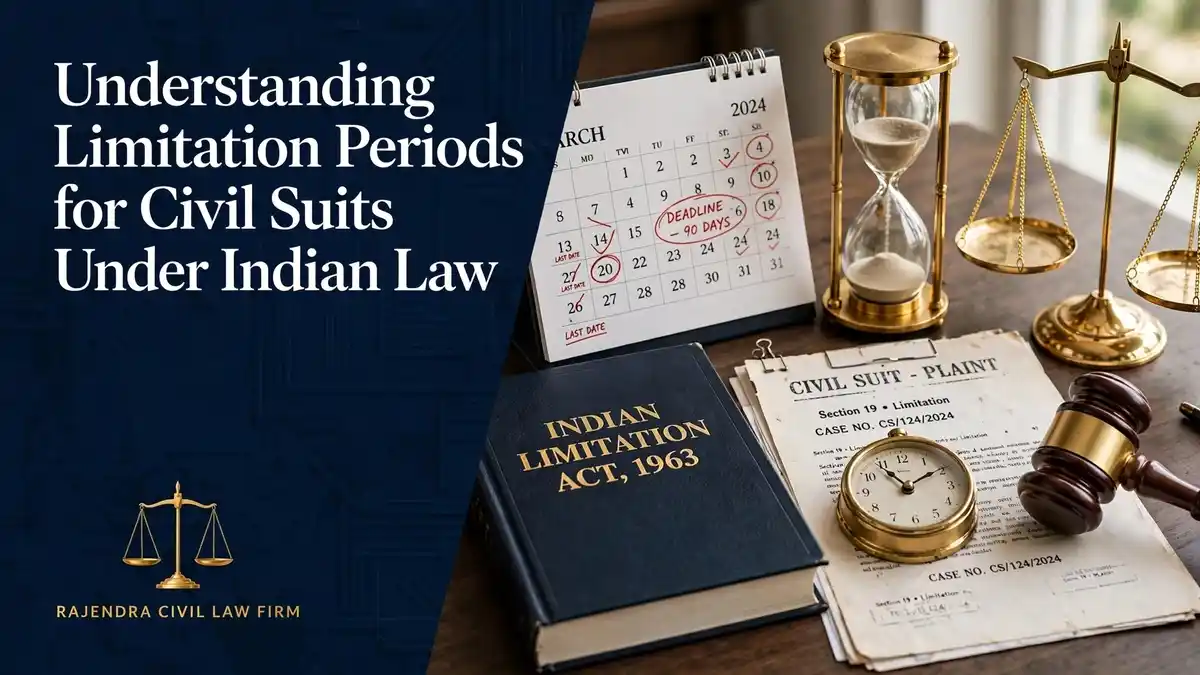
Limitation: Article 54 and the Three-Year Rule
A suit for specific performance must be filed within three years from the date fixed for performance. If no such date is fixed, the period runs from the date on which the plaintiff has notice that performance is refused. This distinction is frequently litigated. Where the agreement says the sale deed is to be executed “within six months”, time starts to run when those six months end, and the plaintiff cannot extend it by sending repeated reminders.
Firstly, Where a date is fixed, courts generally refuse to treat later correspondence as a fresh start. Where no date is fixed, the question becomes when the refusal was communicated, which depends on the facts: a reply notice, a conveyance of the property to a third party, or an unambiguous statement that the seller will not sell. A suit filed after the period is liable to be dismissed as barred, though the plaintiff may still recover the advance within its own limitation period if the claim is separately pleaded.
Is Time the Essence of the Contract
In contracts for the sale of immovable property, time is not ordinarily regarded as the essence of the contract unless the parties expressly say so or the circumstances clearly show it. A buyer who is a few weeks late with the balance payment is therefore not automatically disentitled. Courts do, however, expect the buyer to act within a reasonable time and not to delay for years.
Commercial properties, rapidly rising land markets and contracts with strict payment schedules can alter the position. A seller who intends to rely on time being of the essence should issue a clear notice making it so, and a buyer should respond promptly and in writing. The notices exchanged before suit often decide how the court reads the parties’ own understanding of the deadline.
Common Defences Raised by the Seller
- Plaintiff was not ready and willing. The most common defence. The seller shows that the buyer lacked funds, failed to pay by the date or never asked for the deed to be executed.
- Agreement is not genuine or was cancelled. The seller alleges forgery, absence of consideration or a later oral or written cancellation, and relies on the circumstances in which the advance was paid.
- Defective title or lack of authority. The seller argues that the property is joint, mortgaged, subject to a stay or not fully owned.
- Limitation. The suit is said to be filed beyond three years, with an effort to fix an earlier date of refusal.
- Hardship. Under Section 20 as it stood before 2018 hardship could defeat the decree. Under the amended law the argument is much narrower, but courts may still consider extreme prejudice when moulding relief.
- Subsequent purchaser without notice. A buyer who paid for the property in good faith without knowing of the earlier agreement may resist the decree under Section 19.
Step-by-Step Procedure for the Buyer
- Collect the documents. The agreement, receipts, bank entries, correspondence, title documents and proof of the buyer’s financial capacity.
- Send a legal notice. Call upon the seller to execute the sale deed on a stated date, offering to pay the balance. Keep proof of delivery and the reply.
- Attend the Sub-Registrar’s office. Where the agreement fixes a date, attend with the balance consideration, stamp paper and witnesses, and record the seller’s absence or refusal.
- File the suit. The suit is filed in the civil court having jurisdiction over the property, with an alternative prayer for refund and interest. Court fee follows the relief claimed.
- Seek interim protection. An application for temporary injunction can restrain the seller from alienating or encumbering the property while the suit is pending. Registering a lis pendens notice where permitted also alerts later buyers.
- Prove readiness at trial. Deposit the balance if the court so directs and lead evidence of financial capacity.
- Seek execution after the decree. If the seller does not comply, the court can execute the sale deed on his behalf. See our note on execution of the decree for how decrees are enforced.
Remedies Available Beyond the Sale Deed
A plaintiff is not confined to one remedy. Section 21 allows a claim for compensation either in addition to or in substitution for specific performance. Section 22 permits a claim for possession or partition and separate possession, and for refund of the earnest money or deposit, to be joined in the same suit. Where specific performance is refused, a decree for refund with interest and, in suitable cases, damages is often the fallback. For the money side of the dispute, see our guide on the damages suit.
Section 20, introduced in 2018, also lets the plaintiff, after giving the defaulting party a notice of at least thirty days, have the contract performed by a third party or by his own agency and recover the cost from the defaulter. This is of particular use in works contracts, though it does not generally apply to a straightforward conveyance of land.
The Role of the Advance Money
The advance paid under the agreement is not forfeited automatically. Where the seller wrongly refuses to perform, the buyer can claim the advance back with interest and, where appropriate, compensation. Where the buyer is the defaulter, the seller may retain the advance only if the agreement validly provides for forfeiture and the amount is a reasonable estimate of the loss, as Section 74 of the Indian Contract Act, 1872 allows reasonable compensation and not a penalty.
Practical tip: pay the advance by cheque or bank transfer and have it clearly mentioned in the agreement. Cash payments without receipts are the most common cause of evidential trouble in these suits.
Specific Performance in Property Development and Business Contracts
The remedy is not limited to individual plot sales. Joint development agreements, share purchase agreements, lease renewals and options to purchase can all be enforced where the terms are certain and damages would not be adequate. Contracts that are in their nature determinable, those requiring continuous duties the court cannot supervise and those depending on personal skill fall outside Section 14.
Where a builder delays delivery or fails to register the flat, the buyer may combine a claim for specific performance with other remedies, depending on the forum chosen. Readers dealing with delayed projects may also want to read about construction liability claims and the wider topic of contract disputes. Co-owners who need separate possession of their share may find the discussion of partition suits relevant.
Specific Performance and Third-Party Rights
Many cases fail or succeed on what happened after the agreement. If the seller sells the property to a third party, the original buyer can implead that purchaser. The question then is whether the later buyer paid value in good faith and without notice of the earlier agreement. A purchaser who knew of the agreement, or who had notice from an obvious possession or a registered lis pendens, cannot easily claim protection.
Buyers should therefore take possession where the agreement permits it, pay stamp duty properly, and consider asking the court for interim protection early. A delay of even a few months between refusal and filing can allow a third-party sale that complicates the suit for years.
Role of the Court in Tamil Nadu
Suits for specific performance of immovable property are filed in the civil court within whose local limits the property lies. Depending on the value, this is the Subordinate Court or the District Court, and in Chennai the City Civil Court or the High Court in its original jurisdiction where the pecuniary limit is met. Appeals lie under the Code of Civil Procedure, and the Madras High Court regularly applies the readiness and willingness test strictly. Parties should be ready for a trial that can take several years, which makes early interim relief especially valuable.
Declaration, Injunction and Specific Performance Together
Often the plaintiff needs more than a decree to execute the deed. A buyer whose possession is threatened may add a prayer for permanent injunction. Where the seller disputes the existence of the agreement itself, a declaration may be needed as well. The court fee, jurisdiction and limitation for each relief must be checked before the plaint is drafted. Our explainer on the declaration suit shows when a declaration is the right companion relief.
Common Mistakes That Cost Buyers the Case
- Failing to send a notice and attend the Sub-Registrar’s office on the agreed date, leaving no proof of readiness.
- Waiting beyond three years from the fixed date, assuming that correspondence extends the period.
- Paying a large part of the price in cash without receipts.
- Not checking the seller’s title before signing, then discovering a prior mortgage or family claim.
- Omitting the alternative prayer for refund of the advance.
- Not seeking an injunction, allowing the property to be sold to someone else while the suit is pending.
- Treating the 2018 amendment as automatic relief and neglecting evidence of financial capacity.
Practical Checklist Before You Sign an Agreement to Sell
Prevention is cheaper than litigation. Before signing, obtain the title deeds, encumbrance certificate for at least thirty years, patta and tax receipts, and approvals for the layout or building. Fix a clear date for completion, state who bears the stamp duty and registration charges, and spell out the consequence of default by either side. Insert a clause on what happens to the advance on failure. Keep every payment traceable. A short, precise agreement reviewed by an advocate before signing is the best insurance against a long specific performance suit.
If you hold an unperformed agreement or have received a notice or summons in a specific performance suit, preserve the documents and get the dates in order at once. The limitation clock and the interim protection decisions in the first weeks often shape the whole case.
Conclusion
Specific performance is a powerful remedy that, after 2018, favours the genuine buyer who has acted promptly and can prove his readiness. It is not automatic, and it does not rescue a plaintiff who delays or cannot show funds. The strongest cases rest on a clear agreement, early notices, documented capacity to pay and a suit filed within the three-year limit, with alternative reliefs pleaded properly. A careful reading of the agreement and a quick legal opinion usually decide whether to sue, negotiate or claim a refund.
This article is for general information only and is not legal advice. Statutory provisions and judgments should be verified against current official sources before reliance.
Frequently Asked Questions
What is specific performance of a contract?
It is a court order directing a party to carry out the contract as agreed, for example to execute a sale deed, instead of paying only damages. It is governed by the Specific Relief Act, 1963.
Is specific performance now a right after the 2018 amendment?
Specific performance is now the general rule under Section 10, subject to the exceptions in Sections 11(2), 14 and 16. The court no longer has the wide discretion it had earlier, but the plaintiff must still prove a valid contract and his readiness and willingness.
What is the limitation period for a suit for specific performance?
Under Article 54 of the Limitation Act, 1963 the suit must be filed within three years from the date fixed for performance or, if no date is fixed, from the date the plaintiff has notice that performance is refused.
Can I get my advance back if the seller refuses to sell?
Yes. You can claim refund of the advance with interest, either as an alternative to specific performance or on its own. Section 22 allows this relief to be claimed in the same suit.
Is time the essence in an agreement to sell immovable property?
Not ordinarily. Unless the contract says so or the circumstances show it, a short delay by the buyer does not by itself defeat the claim, but the buyer must still act within a reasonable time.
Can the court stop the seller from selling the property to someone else?
During the suit the court can grant a temporary injunction restraining sale or encumbrance if the plaintiff shows a prima facie case, balance of convenience and risk of irreparable harm. Acting early improves the chance of such protection.
Read More
-
Patent Registration Made Simple: Expert Legal Assistance in Chennai
-
CMDA Land Approval: Complete Legal Guide for Property Owners and Developers
-
Expert Legal Representation for Property Disputes: Protecting Your Rights
-
How to register a Tamil Nadu Housing Board property in Chennai
-
Expert Counsel for Contract Disputes: Protect Your Interests
This article is part of our guide: How to file a civil case in Chennai ?.