Expert Legal Representation for Property Disputes: Protecting Your Rights

In this article (10 sections)
- Title Verification and Document Chain Analysis
- Patta, Revenue Records, and Ownership Evidence
- Boundary, Survey, and Encroachment Disputes
- Forgery, Fraudulent Documents, and Police Complaints
- Evidence Strategy Under the Current Legal Framework
- Jurisdiction, Limitation, and Civil Court Strategy
- RERA, Builder Disputes, and Regulatory Relief
- Revenue Authorities, Registration Offices, and CMDA Issues
- Negotiation, Mediation, and Pre-Litigation Resolution
- 24/7 Legal Support for Urgent Property Problems
Rajendra Civil Law Firm | Civil Advocates provides strategic legal assistance for complex property disputes across Chennai and Tamil Nadu. Property litigation often involves competing title documents, possession claims, inheritance rights, encroachment, fraudulent transactions, and registration problems. Therefore, early legal assessment can prevent procedural mistakes and unnecessary litigation. Our property dispute lawyers examine title chains, sale deeds, settlement deeds, partition documents, wills, patta records, encumbrance certificates, and revenue records. Additionally, our civil advocates assess jurisdiction before selecting the appropriate forum. Depending on the dispute, proceedings may involve a Civil Court, City Civil Court, District Court, Madras High Court, consumer forum, RERA authority, revenue authority, tribunal, or police station. The Code of Civil Procedure, Specific Relief Act, Transfer of Property Act, Registration Act, Limitation Act, and applicable Tamil Nadu laws can become relevant. Accordingly, effective representation combines documentary analysis, procedural planning, evidence management, negotiation, and court advocacy. This approach helps property owners protect title, possession, investment, and enforceable civil rights.
Understanding Property Disputes and Legal Rights
Property disputes require careful classification before selecting a legal remedy or filing a civil suit. Common disputes involve ownership, possession, boundaries, partition, inheritance, sale agreements, mortgage claims, leases, tenancy, encroachment, construction defects, and fraudulent conveyances. However, each dispute can require different pleadings and evidence. A title dispute may require declaration and consequential relief, while straightforward interference may support an injunction action. Similarly, an encroachment claim can involve possession, mandatory injunction, survey evidence, and boundary identification. Family property disputes can require succession analysis under the applicable personal law. Meanwhile, builder disputes may involve RERA or consumer remedies, depending upon the facts and statutory jurisdiction. Courts also examine limitation, valuation, territorial jurisdiction, pecuniary jurisdiction, and maintainability. Therefore, parties should avoid relying upon a single document without examining the complete title chain. Professional property dispute legal representation can identify gaps before they become serious litigation problems. Early review also supports settlement discussions and reduces avoidable procedural challenges.
Title, Ownership, and Possession Claims
Title and possession represent distinct legal questions that frequently overlap during property litigation. A registered sale deed may support ownership, but the complete chain deserves examination. Likewise, possession evidence can include tax receipts, utility records, photographs, leases, physical occupation, and other relevant documents. However, revenue entries alone do not conclusively determine title. The Supreme Court reiterated this principle in Jitendra Singh v. State of Madhya Pradesh. The Court explained that mutation primarily serves fiscal purposes and does not create or extinguish title. The Madras High Court also considered title, patta, possession, and injunction principles in V. Janakiyammal v. V. Elavarasi, decided on February 5, 2026. The Court upheld an injunction concerning admitted title and established possession, while recognizing the need for comprehensive relief where rights remain disputed. Consequently, property owners should preserve both title documents and possession evidence. A civil advocate can then match the evidence with the precise relief required.
Title Verification and Document Chain Analysis
Effective title verification begins with the earliest identifiable ownership document and continues through every subsequent transfer. A lawyer should examine sale deeds, gift deeds, settlement deeds, partition deeds, release deeds, wills, probate records, court decrees, mortgages, leases, and powers of attorney. The investigation should also compare survey numbers, subdivision details, boundaries, measurements, and property descriptions. Furthermore, the advocate should inspect registration particulars and identify unexplained gaps between transactions. An encumbrance certificate can reveal registered transactions, although it should not replace broader due diligence. Tamil Nadu’s registration portal provides an online process for applying for an encumbrance certificate. Important checks include:
- Verify the root title and subsequent conveyances.
- Compare survey records with registered property descriptions.
- Check mortgages, attachments, releases, and registered claims.
- Examine pending litigation and court orders where discoverable.
- Confirm seller authority and identity before transactions.
Therefore, professional title due diligence should precede substantial property investment or litigation decisions.
Patta, Revenue Records, and Ownership Evidence
Patta and revenue records can support a property case, but they should not automatically be treated as conclusive title documents. Revenue authorities maintain records for administrative and fiscal purposes. Therefore, discrepancies between patta and registered instruments require careful examination. The Madras High Court addressed this issue in V. Janakiyammal v. V. Elavarasi. The judgment discussed patta, competing claims, possession, and the limits of bare injunction proceedings. Similarly, the Supreme Court has stated that mutation does not confer ownership. A property lawyer should therefore compare revenue entries with the documentary title chain. Useful records can include:
| Record | Legal Relevance |
|---|---|
| Patta | Revenue and possession-related evidence |
| Sale Deed | Primary transaction document requiring title scrutiny |
| Encumbrance Certificate | Evidence of registered transactions and encumbrances |
| Survey Records | Land identity and measurement evidence |
| Tax Receipts | Supporting possession or municipal records |
Consequently, no single revenue entry should replace comprehensive title verification and professional legal analysis.
Boundary, Survey, and Encroachment Disputes
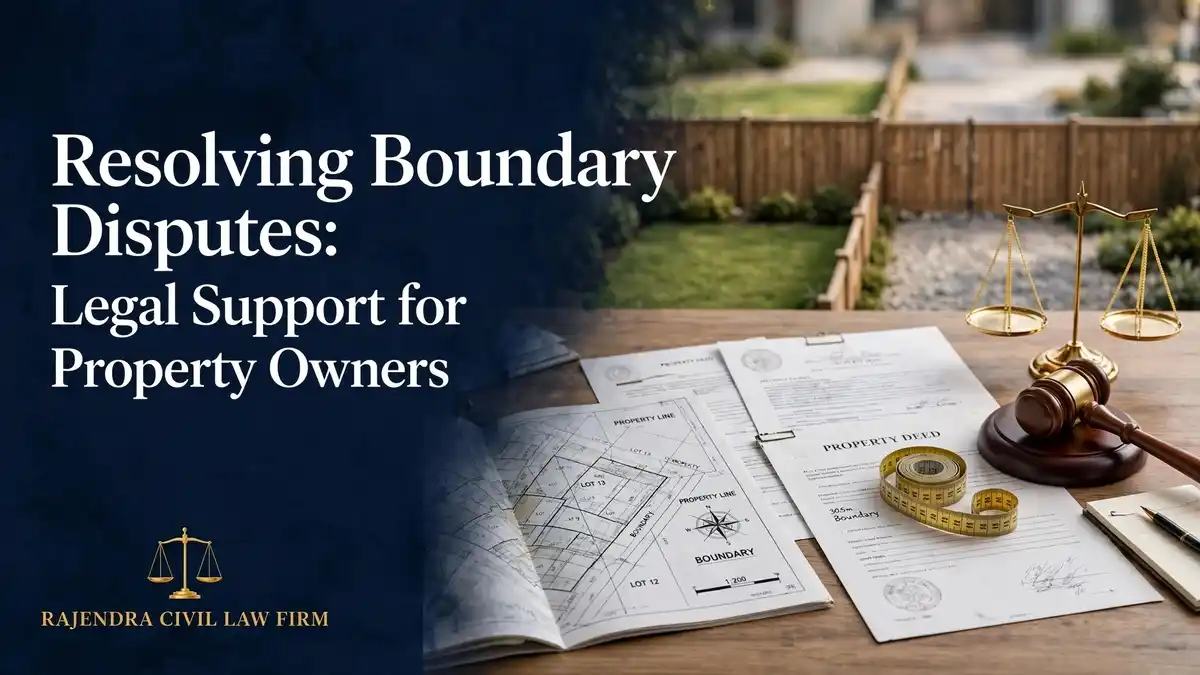
Boundary disputes often arise when physical occupation differs from registered measurements or survey records. Encroachment can involve compound walls, buildings, access paths, fences, driveways, or unauthorized extensions. Initially, parties should preserve photographs, survey documents, approved plans, and historical records. A qualified surveyor may help identify physical boundaries, while the advocate determines the appropriate legal relief. Depending on circumstances, remedies can include declaration, recovery of possession, permanent injunction, mandatory injunction, damages, or removal of an unauthorized structure. CMDA planning permission also does not itself determine property ownership. Official CMDA approvals state that title questions remain matters for competent courts. Therefore, a planning approval cannot automatically defeat an independent title claim. Property owners should avoid forcible self-help measures because confrontation can create separate criminal allegations. Instead, the legal strategy should coordinate survey evidence, civil proceedings, municipal complaints, and police action where an independent offence exists. Timely intervention can also preserve evidence before construction or occupation changes the disputed site.
Declaration of Title and Consequential Relief
A declaration suit can become important when another party raises a genuine cloud over the claimant’s property title. Section 34 of the Specific Relief Act addresses declaratory relief, subject to its statutory conditions. The Supreme Court’s decision in Anathula Sudhakar v. P. Buchi Reddy remains an important authority on property injunction suits. The Court distinguished cases involving clear title from cases involving disputed title and possession. Therefore, a plaintiff should identify whether the dispute concerns title, possession, or both. If possession has been lost, recovery relief may become necessary. If possession remains lawful but interference threatens it, an injunction may sometimes provide appropriate relief. Courts assess pleadings, evidence, admissions, and the actual nature of the dispute. Consequently, drafting should reflect the complete dispute rather than selecting the shortest possible prayer. A civil advocate can examine whether declaration, possession, injunction, cancellation, partition, or other consequential relief should accompany the principal claim.
Permanent and Temporary Injunction Remedies
Injunction proceedings can protect possession or prevent harmful conduct while a property dispute proceeds. Temporary injunction applications commonly arise when immediate interference threatens possession, construction, alienation, or another legally protected interest. Permanent injunction relief depends upon the final findings and applicable law. Under the Specific Relief Act, injunction principles operate alongside procedural rules under the Code of Civil Procedure. Courts examine prima facie case, balance of convenience, and irreparable injury when considering interim relief. However, each application depends upon its pleadings and evidence. A party seeking urgent protection should preserve documents demonstrating ownership, possession, threatened interference, and urgency. Relevant evidence can include dated photographs, notices, messages, municipal records, survey reports, and transaction documents. Therefore, applicants should present a coherent chronology rather than isolated allegations. Where title itself faces a serious cloud, the pleadings may require declaratory relief. Properly framed interim applications can reduce immediate risks while allowing the court to determine substantive rights after evidence.
Partition, Co-Ownership, and Family Property Claims
Co-owned property creates recurring disputes involving shares, possession, partition, alienation, and accounting. Family property claims may arise after inheritance, partition arrangements, wills, settlements, or disputed transfers. A legal review should identify every heir, co-owner, transferee, and relevant document. The applicable succession law must also be determined before calculating shares. In a partition action, the court may determine entitlement and provide appropriate consequential relief. Co-owners should also examine whether one party has executed a sale affecting jointly claimed property. Furthermore, settlement discussions can sometimes resolve measurement, valuation, possession, and division issues without prolonged litigation. However, settlements should receive appropriate legal drafting and registration where required. A property dispute lawyer can prepare a family tree, title chronology, share matrix, and document index. These tools simplify complicated inheritance disputes and improve pleading accuracy. Therefore, early partition advice can prevent informal arrangements from creating later conflicts among siblings, heirs, purchasers, and other stakeholders.
Sale Deeds, Agreements, and Specific Performance
Property transactions can generate disputes when parties disagree about execution, consideration, possession, completion, or contractual obligations. An agreement to sell does not automatically produce the same legal effect as a completed registered conveyance. Therefore, lawyers should examine contractual terms, payment evidence, notices, readiness, willingness, possession, and registration requirements. Specific performance claims may arise where a party seeks enforcement of contractual obligations concerning immovable property. Conversely, a purchaser may face allegations involving default, delay, insufficient authority, or defective title. The Specific Relief Act provides the statutory framework for specific relief, while limitation rules can affect the timing of claims. A lawyer should therefore calculate limitation from the relevant facts rather than relying upon assumptions. Documentary consistency also matters because courts evaluate pleadings against contracts, receipts, correspondence, and conduct. Early legal representation can support negotiation, statutory notices, contractual enforcement, cancellation strategies, or civil litigation.
Fraud, Forgery, Illegal Possession, and Criminal Elements
Some property disputes contain both civil rights questions and allegations of criminal conduct. Examples include forged documents, impersonation, cheating, criminal trespass, intimidation, dishonest transactions, document destruction, or fraudulent conveyances. Civil courts determine civil rights through appropriate proceedings, while criminal authorities investigate alleged offences under applicable criminal law. Since July 1, 2024, the Bharatiya Nyaya Sanhita, Bharatiya Nagarik Suraksha Sanhita, and Bharatiya Sakshya Adhiniyam have replaced major components of the former criminal-law framework. Consequently, legal complaints should use the current statutory framework where applicable. Police complaints may be considered when facts disclose an independent cognizable offence. Chennai residents may encounter jurisdictional police stations such as Mogappair or Ambattur, depending upon the property location and police boundaries. Tamil Nadu Police records identify Ambattur-area stations including T-1 Ambattur and T-2 Ambattur Estate. A civil advocate can coordinate civil remedies with appropriate criminal-law representation when both dimensions genuinely arise.
Forgery, Fraudulent Documents, and Police Complaints
Forgery allegations require evidence-focused legal strategy rather than relying solely upon the existence of a disputed document. Relevant evidence may include registration records, specimen signatures, identity documents, handwriting evidence, transaction histories, witnesses, digital communications, and certified copies. The BSA governs evidentiary principles for proceedings falling within its scope. A police complaint may be appropriate when facts disclose an offence under the applicable criminal law. However, a title dispute does not automatically become a criminal case merely because parties disagree about ownership. Therefore, complaints should identify concrete acts, dates, documents, persons, and supporting evidence. Where a registered instrument itself requires cancellation, a civil proceeding may also become necessary. Courts can examine the legal effect of disputed instruments through appropriate proceedings. Consequently, parties should avoid exaggerated allegations that weaken an otherwise legitimate claim. Legal counsel can prepare a chronological complaint, supporting document index, and parallel civil strategy. This coordinated approach helps preserve evidence and avoids confusion between criminal investigation and civil adjudication.
Illegal Occupation, Trespass, and Eviction Strategies
Illegal occupation requires careful assessment of title, possession, tenancy status, contractual rights, and the circumstances of entry. Property owners should first establish their legal entitlement through reliable documents and possession evidence. If a tenant remains after lawful termination, the applicable tenancy framework and contractual terms require examination. If a stranger occupies property without authority, possession and injunction remedies may become relevant. Where criminal trespass or another offence is alleged, police action may also arise under applicable law. However, owners should not use force or unlawful eviction methods. Courts can provide possession, injunction, declaration, damages, or other appropriate relief. The legal strategy should also consider limitation and evidence preservation. Photographs, notices, rent records, electricity bills, municipal records, and witness statements may become important. Therefore, professional advice should begin before physical confrontation occurs. A civil advocate can evaluate whether immediate injunction, possession proceedings, police representation, mediation, or another remedy best matches the documented facts and jurisdiction.
Evidence Strategy Under the Current Legal Framework
Property litigation depends heavily upon documentary continuity and reliable evidence presentation. The Bharatiya Sakshya Adhiniyam, 2023 is now the principal central evidence statute for relevant proceedings. Lawyers should therefore organize physical and electronic evidence before filing. Useful materials may include registered instruments, certified copies, emails, messages, photographs, videos, payment records, tax receipts, survey reports, municipal approvals, and correspondence. Digital evidence should retain sufficient authenticity and contextual information for admissibility analysis. Furthermore, advocates should identify contradictions before pleadings become final. A useful evidence workflow includes:
- Prepare a complete property document index.
- Arrange documents chronologically.
- Identify disputed signatures, measurements, and descriptions.
- Preserve original digital records and relevant metadata.
- Map each document against the legal issue.
- Prepare witness and expert evidence requirements.
Consequently, structured evidence preparation can improve pleadings, cross-examination planning, settlement discussions, and final submissions.
Jurisdiction, Limitation, and Civil Court Strategy
Choosing the correct forum is a fundamental part of property dispute litigation. The Code of Civil Procedure governs civil procedure and court processes, subject to applicable amendments and special statutes. Property disputes commonly reach appropriate District Munsif Courts, Sub Courts, City Civil Courts, District Courts, or the Madras High Court through applicable appellate or constitutional jurisdiction. Territorial jurisdiction can depend upon the property location and statutory provisions. Pecuniary jurisdiction may also influence the appropriate trial court. Meanwhile, limitation can determine whether a claim remains legally maintainable. Therefore, advocates should examine cause of action dates, acknowledgments, possession history, contractual deadlines, and statutory limitation periods. A party should also assess whether a special statute creates an alternative forum or remedy. For example, RERA provides a statutory regulatory and appellate framework for qualifying real estate disputes. Proper forum selection reduces procedural objections and supports efficient case management.
City Civil Court and District Court Proceedings
City Civil Court and other competent civil courts can address many Chennai property disputes according to jurisdictional rules. Typical proceedings can involve declaration, possession, injunction, partition, cancellation, specific performance, damages, and other civil reliefs. The correct court depends upon the property location, valuation, subject matter, and applicable statutory provisions. Consequently, lawyers should verify jurisdiction before drafting the plaint. The plaint should clearly identify the property, cause of action, parties, reliefs, valuation, and supporting documents. Interim applications may accompany the main suit where urgent protection becomes necessary. Defendants should respond promptly because procedural defaults can affect their ability to present their case. Appeals may move through the statutory hierarchy and eventually reach the Madras High Court when applicable. Section 100 CPC governs second appeals on substantial questions of law. The recent Madras High Court decision in V. Janakiyammal v. V. Elavarasi itself arose as a second appeal under Section 100 CPC.
Madras High Court Property Litigation and Appeals
The Madras High Court plays an important role in property appeals, writ proceedings, and other matters within its jurisdiction. Property litigation reaching the High Court may involve substantial questions of law, challenges to subordinate court orders, revenue decisions, registration issues, or constitutional remedies. However, the correct procedural route depends upon the nature of the challenged decision. Recent Madras High Court authority demonstrates the importance of precise reliefs. In V. Janakiyammal v. V. Elavarasi, the Court examined whether a bare injunction remained maintainable when title was disputed. The Court found sufficient admitted title and possession for the relevant extent and upheld the injunction. The judgment also reaffirmed the significance of the Supreme Court’s Anathula Sudhakar principles. Therefore, Chennai property litigants should distinguish clear possession cases from genuine title-cloud cases. Appellate strategy should focus on statutory questions, evidentiary findings, pleadings, and established precedent. Experienced civil advocates can identify appropriate grounds before an appeal is filed.
Special Forums, Government Authorities, and Alternative Remedies
Not every property-related dispute belongs exclusively before an ordinary civil court. Special legislation can create regulatory authorities, tribunals, consumer commissions, or administrative remedies. Therefore, legal classification should precede forum selection. Builder disputes may involve RERA or consumer law, depending upon the parties, transaction, and relief. Revenue issues may involve Tahsildars, Revenue Divisional Officers, District Collectors, or other statutory authorities. Planning disputes may involve CMDA or the relevant local body. Registration concerns can involve Sub-Registrar and registration authorities. Banking security disputes may involve DRT proceedings under applicable legislation. Consumer claims may reach the District Consumer Disputes Redressal Commission, State Commission, or National Consumer Disputes Redressal Commission according to statutory jurisdiction. The Consumer Protection Act, 2019 establishes the consumer dispute redressal framework. Consequently, lawyers should examine whether the claimant qualifies as a consumer and whether the dispute falls within consumer jurisdiction. Choosing the correct forum can prevent dismissal, duplication, or avoidable procedural delay.
Consumer Forums and Real Estate Disputes
Property buyers can sometimes pursue remedies before consumer commissions when a qualifying housing service dispute exists. Common allegations include delayed possession, deficient construction, promised amenities, unfair practices, defective workmanship, or service deficiencies. The Consumer Protection Act, 2019 provides the statutory framework for consumer dispute redressal. The appropriate commission depends upon the jurisdictional requirements applicable to the claim. Potential forums include the District Consumer Disputes Redressal Commission, State Consumer Disputes Redressal Commission, and NCDRC. However, a pure title dispute between competing owners may require civil adjudication rather than consumer proceedings. Therefore, advocates should examine the complainant’s consumer status, service relationship, limitation, relief sought, and statutory exclusions. RERA may also provide a separate route for qualifying real estate project disputes. Proper legal analysis prevents parties from selecting a forum merely because it appears faster. A coordinated strategy can also address contractual, regulatory, consumer, and civil remedies where legally available.
RERA, Builder Disputes, and Regulatory Relief
RERA can provide regulatory and appellate mechanisms for qualifying disputes involving registered real estate projects. The Real Estate Regulation and Development Act, 2016 aims to regulate real estate projects and protect consumer interests. Relevant disputes may involve delayed possession, project disclosures, construction obligations, promised specifications, or refund-related issues. The facts must determine whether RERA jurisdiction applies and which relief remains available. Additionally, the buyer should preserve the allotment letter, agreement for sale, payment receipts, correspondence, advertisements, specifications, and possession records. A lawyer can compare RERA remedies with consumer and civil options before proceeding. Some disputes can also require appellate proceedings before the Real Estate Appellate Tribunal. Therefore, forum strategy should consider statutory jurisdiction, limitation, relief, evidence, and parallel proceedings. Chennai projects may additionally require examination of CMDA planning permission and local building approvals. CMDA records emphasize that planning permission does not itself establish ownership or title. Thus, regulatory approval and property title remain legally distinct questions.
Revenue Authorities, Registration Offices, and CMDA Issues
Government departments often hold records that become important during property disputes, but their statutory functions have defined limits. Revenue authorities maintain patta and related land records, while registration offices record registrable instruments. Tamil Nadu’s registration system provides online encumbrance certificate application facilities. CMDA handles planning functions within the Chennai Metropolitan Area, subject to applicable jurisdiction. Planning approval, however, does not finally decide ownership. CMDA approval documents expressly recognize that ownership disputes require determination by the competent court. Property owners should therefore identify the precise administrative problem before approaching an authority. A complaint about unauthorized construction differs from a title declaration claim. Similarly, a patta correction request differs from cancellation of a fraudulent sale deed. Legal representation can help separate these issues and identify the correct remedy. This approach reduces the risk of seeking a relief that the concerned government department lacks statutory authority to grant.
Encumbrance Certificates and Registration Records
An encumbrance certificate forms an important component of property due diligence, particularly before purchase, mortgage, or litigation. The document can reveal registered transactions recorded within the relevant search period. However, an EC should not be treated as a complete substitute for title investigation. Unregistered claims, certain court proceedings, possession disputes, family arrangements, and other issues may require separate verification. Therefore, lawyers should examine registered instruments alongside revenue records and court information. Tamil Nadu’s official online EC process allows registered users to submit applications and receive processed documents through the portal. A prudent title review should compare the EC against:
- Root title and prior conveyances.
- Sale, gift, settlement, release, and mortgage deeds.
- Patta and survey records.
- Court decrees and pending litigation information.
- Property tax and municipal records.
- Planning approvals and building permissions.
Consequently, an EC works best as one component of a broader legal title verification process.
Municipal, Planning, and Building Approval Disputes
Construction disputes can involve planning permissions, building permits, deviations, unauthorized structures, and municipal enforcement. Property owners should distinguish planning approval from ownership rights before starting litigation. CMDA materials explain that planning permission does not confirm ownership or title. A building approval also does not necessarily resolve boundary or inheritance disputes. Therefore, a lawyer should examine sanctioned plans, planning permissions, completion certificates, property tax records, survey measurements, and ownership documents. Unauthorized construction complaints may require action before the relevant planning or local body authority. Meanwhile, civil courts may become relevant when construction interferes with private property rights. Interim injunctions can become important when irreversible construction threatens the subject property. Accordingly, evidence should be collected before construction changes the physical condition. Photographs, videos, survey reports, notices, and official inspection records can become valuable. A coordinated legal strategy can address municipal enforcement, civil injunctions, title disputes, and regulatory compliance without confusing their separate statutory purposes.
Debt Recovery, Mortgage, and Tribunal Proceedings
Mortgage and secured-property disputes can involve banks, borrowers, guarantors, auction purchasers, and specialized tribunals. The applicable remedy depends upon the security arrangement, statutory framework, stage of recovery, and challenged action. Debt Recovery Tribunal proceedings can arise under the Recovery of Debts and Bankruptcy Act. Secured creditor enforcement can also involve proceedings under the SARFAESI framework and challenges before the appropriate forum. Therefore, property owners should not assume that every mortgage dispute belongs before an ordinary civil court. Legal counsel should examine notices, loan documents, mortgage deeds, account statements, possession notices, auction publications, and statutory compliance. A timely response can preserve procedural rights and identify appropriate remedies. Furthermore, purchasers acquiring property connected with recovery proceedings should undertake independent title and encumbrance checks. Civil litigation may still become relevant for issues outside the tribunal’s statutory jurisdiction. Consequently, forum selection should follow the governing statute rather than the physical nature of the property alone.
Strategic Legal Representation and Civil Remedies
Effective property litigation requires more than filing a plaint or sending a legal notice. The lawyer should first identify the client’s legal objective, factual position, evidence, risks, and available remedies. Some clients need immediate possession protection, while others need title clarification or document cancellation. Certain disputes can benefit from negotiation or mediation before formal litigation. However, urgent threats may justify immediate court intervention. A complete strategy can include title due diligence, legal notices, settlement negotiations, police representations, civil suits, interim injunctions, appeals, and enforcement proceedings. The appropriate combination depends upon the facts. Rajendra Civil Law Firm | Civil Advocates can structure the case around the property’s documentary history and the client’s intended outcome. Relevant remedies may include declaration, possession, permanent injunction, temporary injunction, mandatory injunction, cancellation, specific performance, partition, damages, mesne profits, restitution, and other statutory reliefs. Therefore, legal representation should remain evidence-driven and forum-specific. A clear strategy can also reduce duplicated proceedings and inconsistent factual positions across different authorities.
Remedies Available in Property Litigation
Property law provides multiple remedies, but the appropriate relief depends upon the legal wrong and available evidence. A declaration can address disputed legal status or title where statutory requirements are satisfied. Possession relief can address wrongful occupation or dispossession. Injunctions can restrain interference or require corrective action. Cancellation may address instruments that legally require judicial invalidation. Specific performance can address enforceable contractual obligations involving property. Partition can determine shares among co-owners. Damages or mesne profits may address certain financial consequences. Consumer remedies can apply to qualifying service disputes. RERA remedies can apply to qualifying real estate project matters. Police complaints can address independent criminal offences. Therefore, the legal remedy should follow the underlying issue rather than the client’s preferred label. Courts also examine whether another equally efficacious remedy exists in relevant circumstances. Proper drafting should connect every prayer to facts, statutory provisions, and supporting evidence. This improves clarity and helps the court identify the precise dispute requiring determination.
Negotiation, Mediation, and Pre-Litigation Resolution
Negotiation and mediation can resolve suitable property disputes without requiring a complete trial. Settlement discussions can address possession dates, boundary adjustments, payment schedules, document execution, partition arrangements, or withdrawal of competing claims. However, settlement terms should clearly identify the property and each party’s obligations. Lawyers should also verify whether registration, stamping, court approval, or other formalities are required. Mediation can be particularly useful when parties expect a continuing relationship, such as family members or co-owners. Nevertheless, urgent threats involving unauthorized construction or imminent alienation may require immediate interim protection. Therefore, alternative dispute resolution should complement litigation strategy rather than delay necessary protective action. A lawyer can conduct a legal risk assessment before negotiations begin. That assessment should consider title strength, evidence gaps, limitation, litigation costs, enforcement prospects, and commercial objectives. A carefully documented settlement can reduce uncertainty and provide a structured path toward final resolution. Professional representation also helps prevent informal promises from creating another round of litigation.
24/7 Legal Support for Urgent Property Problems
Urgent property disputes can require immediate legal coordination when possession, construction, documents, or personal safety face immediate risk. A 24/7 legal support model can assist with emergency document review, legal notices, police representations, injunction preparation, evidence preservation, and urgent court coordination. The appropriate response depends upon the circumstances and available judicial procedures. Examples of urgent situations include forced entry, sudden demolition, unauthorized construction, threatened sale, document forgery, illegal occupation, or intimidation. Where criminal conduct is alleged, the relevant police jurisdiction should be identified promptly. Chennai property disputes may involve stations serving areas such as Mogappair, Ambattur, Ambattur Estate, Korattur, or surrounding localities. Police jurisdiction should always be verified against the exact property location. Tamil Nadu Police materials identify T-1 Ambattur and T-2 Ambattur Estate within the Ambattur district structure. Meanwhile, civil advocates can coordinate urgent applications before the competent court. Therefore, rapid legal triage can preserve evidence and reduce irreversible consequences.
Emergency Legal Notice and Evidence Preservation
A carefully drafted legal notice can establish chronology, communicate rights, and preserve a clear record before litigation. The notice should identify the property, documents, disputed conduct, legal rights, and requested corrective action. It should avoid unsupported allegations that could later create evidentiary problems. Where construction or demolition threatens the property, photographs and videos should be preserved immediately. Digital communications should also remain in their original form whenever possible. Lawyers can prepare a document preservation checklist covering sale deeds, tax receipts, plans, survey records, notices, messages, photographs, and correspondence. The notice can demand cessation of interference, preservation of documents, withdrawal of unauthorized claims, or another legally appropriate remedy. However, sending a notice does not automatically stop unlawful conduct. Urgent cases may require interim judicial relief. Therefore, legal counsel should evaluate whether notice, injunction, police complaint, or immediate court filing should occur first. A coordinated approach helps preserve both substantive rights and procedural credibility.
Litigation Documentation and Case Preparation
Strong property cases usually begin with disciplined documentation rather than immediate drafting. Clients should provide every relevant document, including apparently unfavorable records. Lawyers need accurate information about possession, family relationships, transactions, notices, payments, and prior litigation. Concealing adverse facts can damage credibility and complicate litigation strategy. A structured case file should contain a chronology, property description, title chain, party details, evidence index, legal issues, limitation assessment, and proposed remedies. Numbered documents should match references used in pleadings wherever practical. Furthermore, counsel should identify missing certified copies and official records early. Court pleadings should accurately describe survey numbers, boundaries, measurements, registration details, and cause of action. Therefore, clients should avoid editing or altering original documents before legal review. Digital records should also be preserved without unnecessary modification. Proper case preparation enables counsel to anticipate defenses and evidentiary objections. It also supports efficient conferences, settlement discussions, examination planning, and appellate review.
Why Experienced Civil Advocates Matter
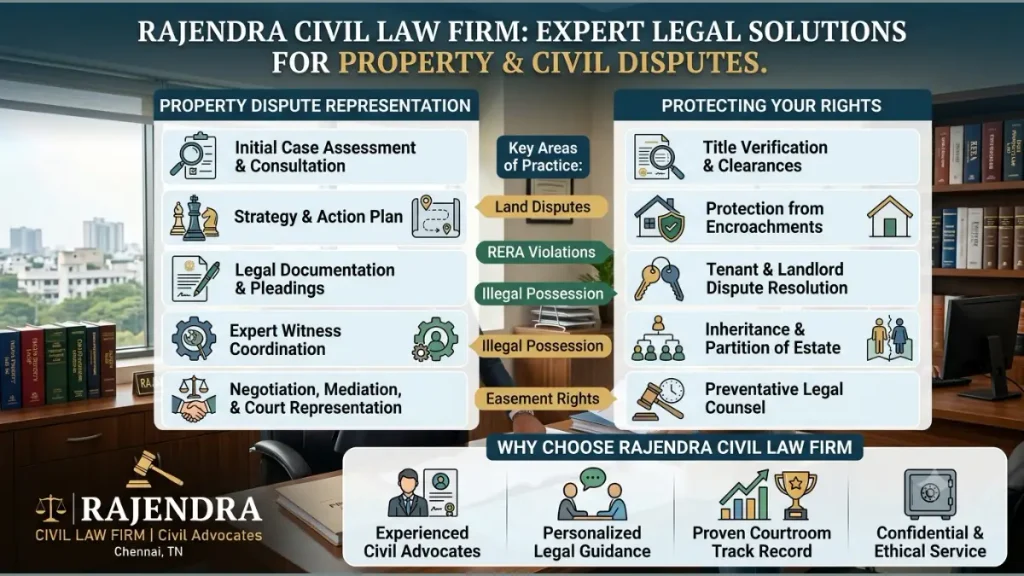
Property litigation combines substantive property law, civil procedure, evidence, local records, and practical dispute management. An experienced civil advocate can connect these areas into a coherent litigation strategy. Title disputes require more than identifying the latest document. Possession disputes require more than showing current occupation. Encroachment claims require reliable identification of the disputed land. Likewise, inheritance disputes require accurate legal heir and succession analysis. Forum disputes require careful statutory examination. Evidence disputes require disciplined document preservation and presentation. Therefore, professional representation can reduce drafting errors and improve issue identification. Rajendra Civil Law Firm | Civil Advocates can assist with title disputes, possession claims, partition proceedings, injunction suits, encroachment litigation, specific performance, cancellation matters, property fraud, registration disputes, revenue proceedings, RERA matters, consumer claims, and appellate proceedings. The firm can also coordinate related criminal and administrative proceedings when the facts require them. Accordingly, property owners should obtain legal advice before signing settlements, surrendering possession, admitting title, or commencing substantial litigation.
Property Dispute Legal Services in Chennai
Chennai property disputes can require coordinated representation across courts, authorities, police stations, and specialized forums. Legal services may cover residential properties, commercial premises, vacant land, inherited assets, apartment projects, industrial properties, and jointly owned land. Typical instructions involve title verification, encumbrance review, partition, possession, injunction, encroachment, cancellation, specific performance, lease disputes, mortgage issues, and construction conflicts. Depending upon the matter, representation may involve City Civil Court, District Courts, Madras High Court, District Consumer Disputes Redressal Commission, State Commission, NCDRC, RERA authorities, tribunals, revenue offices, registration authorities, CMDA, local bodies, or police stations. The governing law may include CPC, Specific Relief Act, Transfer of Property Act, Registration Act, Limitation Act, Consumer Protection Act, RERA, BNS, BNSS, and BSA. Therefore, Chennai property litigation should receive location-specific legal analysis. Professional advocates can also coordinate certified records, survey evidence, notices, pleadings, interim applications, appeals, and settlement documentation. Timely representation remains particularly important when possession or property value faces immediate risk.
Legal source note: The Code of Civil Procedure, Specific Relief Act, Consumer Protection Act, and RERA references were checked against India Code. The BNS, BNSS, and BSA enforcement references reflect India Code records showing commencement from July 1, 2024. The current Madras High Court authority discussed above is V. Janakiyammal v. V. Elavarasi, S.A. No.77 of 2023, pronounced February 5, 2026. The article also draws upon the Supreme Court principles in Anathula Sudhakar v. P. Buchi Reddy and Jitendra Singh v. State of Madhya Pradesh.
Frequently Asked Questions
When should I consult a property dispute lawyer?
Consult a lawyer before purchasing disputed property, signing settlements, responding to claims, or facing encroachment. Early advice can preserve evidence and identify the correct remedy.
Does patta prove property ownership?
Patta is important revenue evidence, but it does not automatically establish conclusive title. Courts examine title documents, possession, and other evidence when ownership is disputed.
Can I file an injunction without seeking declaration?
Sometimes. Courts distinguish clear-title possession disputes from cases involving a genuine title cloud. The appropriate relief depends upon title, possession, pleadings, and evidence.
Can property fraud lead to both civil and criminal proceedings?
Yes, where facts disclose independent criminal conduct alongside civil rights issues. Civil courts determine property rights, while police authorities investigate applicable criminal offences.
Can a builder property dispute go before consumer commissions?
Qualifying housing service disputes may fall under consumer law. However, pure title disputes may require civil adjudication. RERA jurisdiction should also be examined.
Which Chennai court handles a property dispute?
The appropriate forum depends upon territorial jurisdiction, valuation, subject matter, and applicable statutes. Courts can include District Courts, City Civil Court, and Madras High Court.
Conclusion: Property disputes demand prompt legal analysis because title, possession, evidence, limitation, and forum selection can interact closely. Rajendra Civil Law Firm | Civil Advocates provides civil litigation assistance for property owners, purchasers, co-owners, heirs, landlords, developers, and other stakeholders. The firm can assess documentary title, possession evidence, encroachment allegations, registration records, revenue entries, construction approvals, contractual obligations, and applicable statutory remedies. Where necessary, the legal strategy can coordinate civil proceedings with consumer, RERA, revenue, registration, tribunal, municipal, or criminal processes. Because each property dispute depends upon its documents and facts, a personalized legal assessment should precede major procedural decisions.
Read More
- Consumer Complaints in Chennai: Find the Best Reliable Advocate
- File a Suit for Injunction: Expert Civil Lawyers to Protect Your Rights
- Recovering Property: Legal Steps You Need to Know
- Partnership Firm Disputes Resolved: Expert Legal Representation
- Protecting Your Intellectual Property: Expert Patent Litigation
This article is part of our guide: Resolving Real Estate Disputes: Expert Legal Guidance and Representation.