Partition Suit Cases: Expert Legal Counsel You Can Trust

In this article (15 sections)
- Ancestral and Joint Family Property
- Rights of Legal Heirs
- NRI and Cross-State Property Claims
- Choosing the Correct Civil Court
- Essential Documents and Evidence
- Pleadings, Parties and Court Reliefs
- Preliminary and Final Decrees
- Temporary Injunctions and Property Protection
- Remedies Against Fraudulent Transactions
- Police Complaints and Criminal Proceedings
- Settlement and Family Arrangements
- Revenue Records and Registration Issues
- Limitation and Delay Risks
- Litigation Costs and Case Management
- Why Choose Rajendra Civil Law Firm
Partition Suit Cases - A partition suit seeks lawful division of jointly held property among persons having enforceable ownership rights. Usually, disputes arise when co-owners cannot agree about their respective shares. Therefore, the claimant asks a competent civil court to declare shares and provide separate possession. Hindu family disputes may involve ancestral property, coparcenary property, inherited assets, or jointly purchased property. The applicable succession law depends upon personal law, ownership history, and transaction documents. Under the Hindu Succession Act, Section 6 governs devolution of coparcenary interests. (India Code) Moreover, daughters can possess coparcenary rights under applicable statutory conditions. A partition lawyer examines title deeds, legal-heir records, wills, settlements, previous partitions, and revenue records. Consequently, proper legal analysis prevents incorrect claims and unnecessary litigation. Rajendra Civil Law Firm provides strategic civil litigation support for partition, possession, declaration, injunction, and related property disputes.
Partition Suit Cases: Expert Legal Counsel You Can Trust - Rajendra Civil Law Firm
Common Property Disputes
Ancestral and Joint Family Property
Partition disputes frequently involve ancestral homes, agricultural lands, residential plots, commercial premises, and inherited investments. However, every inherited property does not automatically become joint family property. Ownership depends upon succession, acquisition, partition history, family arrangements, and applicable personal law. A civil lawyer must therefore trace the property’s legal history before filing proceedings. Important disputes include denial of shares, illegal occupation, disputed sales, fraudulent settlements, and unequal family arrangements. Furthermore, one co-owner may attempt to transfer property beyond their lawful interest. Such conduct can create declaration, cancellation, injunction, or possession claims. The Specific Relief Act provides statutory remedies involving possession, cancellation, declarations, and injunctions. (India Code) Therefore, clients should preserve every relevant document before confronting other co-owners. Early legal review can identify stronger remedies and reduce avoidable procedural complications.
Who Can Claim Partition
Rights of Legal Heirs
Daughters, Sons, Widows and Other Heirs
Eligibility for partition depends upon the claimant’s legally recognised interest in the property. Under Hindu succession law, Section 6 addresses coparcenary property and devolution of coparcenary interests. (India Code) Additionally, Section 8 and the statutory succession schedule govern several intestate succession situations. A daughter may claim coparcenary rights subject to the applicable legal requirements and relevant judicial principles. Likewise, sons and other lawful successors may assert recognised interests. However, a widow’s rights depend upon the deceased person’s ownership and applicable succession rules. Therefore, family relationships alone cannot establish a particular share. A lawyer must examine the property’s source, succession events, previous partitions, and registered instruments. Consequently, an accurate family tree becomes essential before calculating shares. Professional legal support can identify necessary parties and prevent defective pleadings.
NRI and Cross-State Property Claims
Remote Owners and Multiple Jurisdictions
NRIs and family members living outside India can face additional difficulties in partition litigation. Property may exist in Tamil Nadu while heirs reside abroad or across several Indian States. Consequently, document execution, powers of attorney, service of notices, and court appearances require careful planning. Jurisdiction generally depends upon the nature and location of the property and applicable civil procedure rules. If several properties fall within different territorial jurisdictions, counsel must examine the statutory rules carefully. Furthermore, foreign residence does not automatically eliminate a person’s property rights. An NRI may need certified records, properly executed authorisations, and reliable communication arrangements. Legal counsel can coordinate pleadings, document verification, representation, and procedural compliance. Therefore, remote participation should begin with a jurisdiction and documentation assessment. This approach reduces delays caused by incomplete authorisations or incorrect territorial filing decisions.
Filing and Conducting Partition Litigation
Jurisdiction and Court Procedure
Choosing the Correct Civil Court
Territorial and Pecuniary Jurisdiction
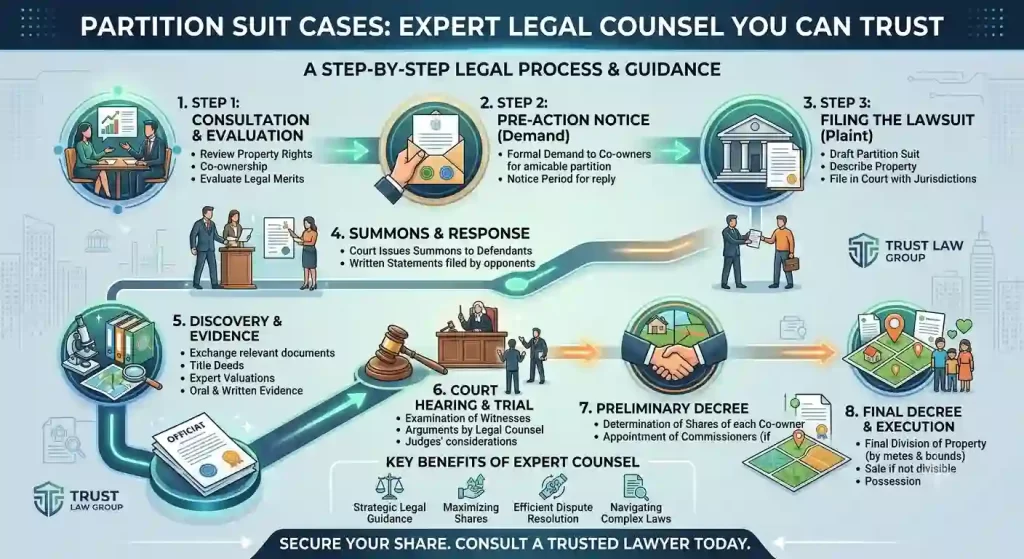
A partition suit must reach a court possessing appropriate jurisdiction over the dispute. Territorial jurisdiction often depends upon where the immovable property is situated. Pecuniary jurisdiction can also affect the appropriate court within the relevant judicial hierarchy. Therefore, valuation and court-fee requirements require careful assessment before filing. The plaint should identify parties, property descriptions, ownership history, claimed shares, and requested reliefs. Additionally, the pleadings should disclose previous proceedings and relevant transactions. Courts may examine title documents, revenue records, registered deeds, family arrangements, and evidence concerning possession. The Code of Civil Procedure governs important procedural aspects of civil litigation. Order XX Rule 18 specifically addresses decrees concerning partition and separate possession. (Live Law) Accordingly, a partition advocate should select the forum only after reviewing property location, valuation, parties, and reliefs.
Essential Documents and Evidence
Building a Strong Documentary Record
Strong evidence often determines the effectiveness of a partition claim. Clients should collect original or certified copies wherever available and legally appropriate. Useful records commonly include:
- Parent title deeds and subsequent conveyances.
- Encumbrance certificates and registration records.
- Patta, chitta, adangal, and revenue documents.
- Death certificates and legal-heir records.
- Wills, settlement deeds, release deeds, and partition deeds.
- Tax receipts, possession records, and approved plans.
Furthermore, bank records or electronic communications may support particular factual allegations. The Bharatiya Sakshya Adhiniyam, 2023 recognises electronic or digital records subject to statutory requirements. (India Code) Therefore, clients should preserve messages, emails, scanned documents, and transaction records without alteration. A lawyer can organise evidence chronologically and identify gaps requiring additional records. This preparation strengthens pleadings and improves the clarity of trial strategy.
Pleadings, Parties and Court Reliefs
Identifying Necessary Parties
Avoiding Defective Partition Claims
A partition suit requires careful identification of every person whose legal interest may affect the requested division. Omitting a necessary co-owner can create procedural objections and further litigation. Conversely, unnecessary parties may complicate proceedings without advancing the core dispute. The plaint should accurately describe each property using survey numbers, boundaries, extent, registration details, and relevant title particulars. Additionally, the claimant should clearly state the basis for claiming a particular share. Depending upon circumstances, remedies may include partition, separate possession, declaration, cancellation, injunction, mesne profits, and consequential reliefs. The Specific Relief Act expressly addresses declarations, cancellation, possession, and preventive relief. (India Code) Therefore, counsel should frame prayers according to the actual legal injury. Proper pleadings also help the court identify the precise issues requiring adjudication.
Decrees, Interim Relief and Enforcement
Preliminary and Final Decrees
Understanding the Two-Stage Process
A partition case can involve a preliminary decree declaring the parties’ respective shares. Later proceedings may determine the actual division and separate possession. Order XX Rule 18 CPC addresses this structure for partition matters. (Live Law) The Supreme Court has clarified that trial courts should proceed with necessary steps after preliminary decrees. (Live Law) Therefore, litigants should not assume that a preliminary decree alone completes physical division. The final stage may involve measurement, valuation, allotment, commission proceedings, or other directions. In appropriate cases, properties may require sale rather than convenient physical division. Consequently, lawyers should plan the final-decree strategy from the beginning. Recent Supreme Court reporting also confirms that a preliminary decree’s terms can influence enforceability. (Live Law) Effective representation therefore covers both declaration of shares and practical implementation.
Temporary Injunctions and Property Protection
Preventing Illegal Transfers
Co-owners sometimes attempt to sell, encumber, demolish, alter, or otherwise deal with disputed property during litigation. Such conduct can prejudice other claimants and create additional disputes. Therefore, an affected party may seek appropriate interim protection from the competent civil court. Depending upon facts, counsel may request temporary injunctions against alienation, construction, dispossession, or interference. The Specific Relief Act recognises preventive relief through statutory injunction provisions. (India Code) Additionally, civil procedure contains provisions governing interim orders and their enforcement. A lawyer should establish urgency through documents and credible factual circumstances. Courts generally assess the legal basis and surrounding facts before granting discretionary relief. Consequently, clients should immediately inform counsel about threatened transactions or possession changes. Prompt action may preserve the property position while the principal partition dispute remains pending.
Remedies Against Fraudulent Transactions
Cancellation, Declaration and Possession
Fraudulent sale deeds, forged signatures, sham settlements, and unauthorised transfers can complicate partition litigation. A civil court may need to determine whether an instrument affects the claimant’s rights. Depending upon circumstances, the claimant may seek declaration, cancellation, injunction, possession, or other consequential relief. The Specific Relief Act contains provisions concerning cancellation and declaratory relief. (India Code) However, alleged forgery or cheating may also create separate criminal-law consequences. The Bharatiya Nyaya Sanhita, 2023 contains offences relating to cheating and other property-related wrongdoing. (India Code) Consequently, counsel should assess both civil and criminal remedies without confusing their separate purposes. If criminal conduct appears genuine, the appropriate jurisdictional police station may receive a complaint. BNSS procedures can then become relevant to criminal investigation and related proceedings.
Police Complaints and Criminal Proceedings
When Civil Disputes Become Criminal Issues
A partition dispute normally belongs before the civil court, but certain conduct may independently constitute an offence. Examples include document forgery, cheating, criminal intimidation, or dishonest manipulation of property transactions. Therefore, parties should distinguish an ownership disagreement from genuine criminal conduct. The Bharatiya Nyaya Sanhita, 2023 replaced the Indian Penal Code framework for offences from its commencement. (India Code) The Bharatiya Nagarik Suraksha Sanhita, 2023 now governs criminal procedure. (India Code) A complainant may approach the jurisdictional police station when facts disclose a cognisable offence. However, a police complaint does not replace a necessary civil partition suit. Instead, separate proceedings may address different legal issues and remedies. Consequently, counsel should coordinate civil litigation and criminal remedies carefully. eCourts also provides FIR and case-status search facilities for relevant proceedings. (eCourt India Services)
Practical Strategy for Property Litigation
Settlement and Family Arrangements
Negotiated Partition Solutions
Litigation is not always the fastest route for resolving family property disputes. Parties can sometimes achieve a practical settlement through negotiation, mediation, or a documented family arrangement. Such solutions may preserve relationships while reducing court expenses and procedural delays. However, settlement terms must accurately identify properties, shares, consideration, possession, and future obligations. Registered instruments may become necessary depending upon the transaction and applicable registration law. Therefore, parties should obtain independent legal review before signing any release, settlement, relinquishment, or partition document. A lawyer can also assess whether an existing family arrangement creates enforceable rights. Consequently, settlement discussions should follow title verification rather than informal assumptions. If negotiations fail, properly prepared documents can still strengthen subsequent litigation. Professional counsel helps ensure that settlement proposals remain legally workable, commercially sensible, and consistent with the parties’ actual ownership interests.
Revenue Records and Registration Issues
Patta, Encumbrance and Title Verification
Revenue and registration records play important supporting roles in property disputes. However, revenue entries do not necessarily determine final title in every civil dispute. Therefore, counsel should compare patta records with registered deeds, parent documents, succession records, and court orders. An encumbrance search can also reveal registered transactions affecting the property. Registration records may identify sales, mortgages, settlements, releases, and other instruments. Furthermore, survey records can assist with property identification and physical boundaries. Disputes involving agricultural land may require coordination with relevant revenue authorities after the civil court determines legal rights. Order XX Rule 18 also recognises a role for revenue authorities in certain revenue-assessed estate partitions. (Indian Kanoon) Consequently, legal strategy should distinguish title adjudication from revenue administration. Accurate records reduce risks involving mistaken identity, duplicate claims, and incomplete property schedules.
Limitation and Delay Risks
Acting Before Rights Become Complicated
Partition claims require careful limitation analysis because different causes of action can attract different limitation rules. The Limitation Act, 1963 contains specific provisions affecting property and exclusion disputes. Article 110 concerns certain suits involving exclusion from joint family property. (Indian Kanoon) However, limitation questions depend heavily upon pleadings, possession, exclusion, knowledge, previous demands, and the precise relief claimed. Therefore, parties should avoid relying on a simple fixed period without legal examination. Delay can also allow subsequent transactions, construction, mortgage creation, or changes in possession. Consequently, early consultation helps preserve evidence and identify urgent protective remedies. A lawyer should examine previous notices, family settlements, court cases, and registered transactions. This review can reveal limitation issues before substantial litigation costs arise.
Litigation Costs and Case Management
Planning the Legal Strategy
Partition litigation can involve court fees, advocate fees, document expenses, valuation costs, commissioner expenses, and execution-related costs. The actual amount depends upon property value, reliefs, jurisdiction, complexity, and litigation duration. Therefore, clients should obtain a case-specific cost assessment rather than relying on generic estimates. Effective case management also requires organised documents, accurate addresses, timely instructions, and consistent communication. Additionally, parties should track hearings, interlocutory applications, evidence stages, and orders. eCourts provides case-status services through party name, case number, filing number, advocate name, Act, and case type. (eCourt India Services) Consequently, clients can monitor procedural developments while counsel handles legal strategy. Where eligible, legal-aid services may also provide advice and representation. Tamil Nadu State Legal Services Authority describes legal assistance covering advice and proceedings before courts and authorities. (TN Legal Services)
Why Choose Rajendra Civil Law Firm
Comprehensive Civil Litigation Support
Rajendra Civil Law Firm assists clients with complex partition and property disputes through structured legal analysis. Our approach begins with ownership verification, family-tree preparation, document review, and jurisdiction assessment. Next, counsel identifies necessary parties and formulates appropriate civil remedies. These may include partition, separate possession, declaration, injunction, cancellation, mesne profits, and execution assistance. Furthermore, the team can assess related allegations involving forged documents, cheating, intimidation, or unlawful transfers. Such matters may require coordinated civil and criminal strategies under current Indian laws. The firm also supports clients facing ancestral property disputes, coparcenary claims, NRI property issues, and contested family settlements. Therefore, legal advice focuses on the actual property history rather than assumptions about inheritance. Clients can also use official eCourts services to monitor case status and orders. (eCourt India Services) Early legal consultation can help protect ownership interests and develop a practical litigation strategy.
Frequently Asked Questions
1. What is a partition suit A partition suit asks a competent civil court to determine ownership shares and provide separate possession of jointly held property.
2. Can a daughter claim ancestral property Eligible daughters can have coparcenary rights under Section 6 of the Hindu Succession Act, subject to applicable legal conditions.
3. Can an NRI file a partition suit in India Yes. An NRI can pursue property rights in India, subject to jurisdiction, documents, authorisation, and applicable procedural requirements.
4. Can I stop a co-owner from selling disputed property You may seek appropriate interim injunctions when facts justify protection against alienation or interference with disputed property.
5. What happens after a preliminary partition decree Further proceedings can determine physical division, allotment, possession, and other steps required for implementing the declared shares.
6. Can forged property documents create criminal proceedings Yes. Genuine forgery, cheating, or intimidation allegations may require separate criminal remedies under the BNS and BNSS.
Read More
- Expert Representation at National Company Law Tribunal (NCLT)
- Championing Motor Vehicle Accident Claims: Expert Legal Support
- Motor Accidents Claim Tribunal: Fighting for Your Rights
- Pursuing Medical Malpractice Claims: Expert Legal Representation
- Media Law and Disputes: Expert Legal Counsel You Can Count On
- National Judicial Data Grid (NJDG)
This article is part of our guide: Resolving Real Estate Disputes: Expert Legal Guidance and Representation.