Limitation Period for Civil Suits in India: Key Articles
In this article (10 sections)
Every civil right has a shelf life. The limitation period for civil suits is fixed by the Limitation Act, 1963, and a suit filed after it is liable to be dismissed, even if the claim is otherwise good. Understanding limitation at the start can save a case, or defeat a weak one. This guide covers the main periods and exceptions.
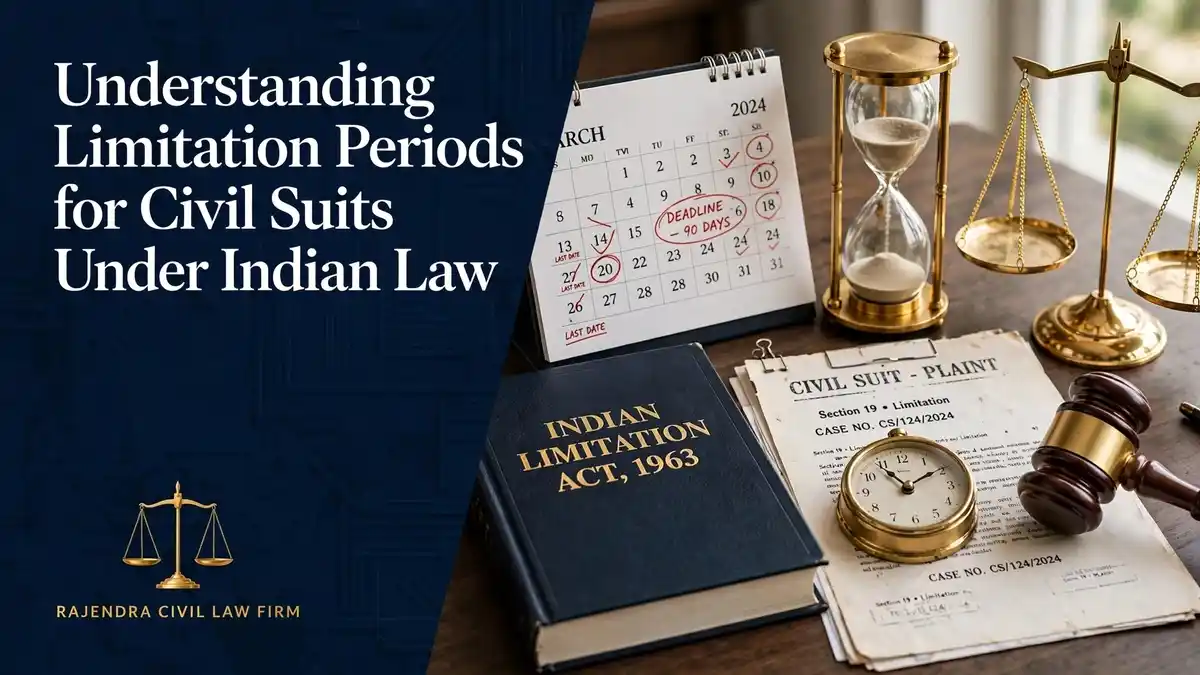
Understanding Limitation Periods for Civil Suits Under Indian Law
The basic rule: Section 3
Section 3 requires the court to dismiss a suit, appeal or application filed after the limitation period, even if limitation is not raised as a defence. Limitation is therefore a matter the court examines by itself, and a time-barred plaint can be rejected under Order 7 Rule 11(d) CPC.
When does time start to run
Each Article in the Schedule specifies the starting point. It may be the date of the breach, the date when the right to sue first accrues, the date fixed for performance, or the date of knowledge. Always identify the correct Article for your cause of action.
Limitation period for civil suits: common periods
- Money suits (loan, goods sold, price due): Three years, commonly from the date when payment became due.
- Breach of contract (compensation): Three years from the date of the breach.
- Specific performance of a contract (Article 54): Three years from the date fixed for performance, or if no date is fixed, when the plaintiff has notice that performance is refused.
- Declaration (Article 58): Three years from when the right to sue first accrues.
- Cancellation or setting aside of an instrument (Article 59): Three years from when the facts entitling the plaintiff to cancel first become known.
- Possession of immovable property based on title (Article 65): Twelve years from the date when the defendant’s possession becomes adverse to the plaintiff.
- Possession based on previous possession (Article 64): Twelve years from the date of dispossession.
- Residuary suits (Article 113): Three years from when the right to sue accrues.
Limitation for appeals
- First appeal from a decree to the District Court: Thirty days, and to the High Court: Ninety days, from the date of the decree or order.
- Second appeal to the High Court: Ninety days.
- Applications: The residuary period for applications under Article 137 is three years, though specific articles apply to many applications, such as setting aside an ex parte decree under Order 9 Rule 13, which has a thirty-day period.
Always confirm the period applicable to the particular forum and type of order, since the periods differ.
Important sections that extend or save time
- Section 5: The court can condone delay in filing an appeal or application on proof of sufficient cause. It does not apply to suits.
- Section 12: Excludes the day of the order and the time taken to obtain copies of the judgment or decree for appeals.
- Section 14: Excludes the time spent bona fide prosecuting another proceeding in a court without jurisdiction, with due diligence.
- Section 17: Extends the period where the suit is based on fraud or mistake, or where the document was concealed, from the date the plaintiff discovers it.
- Section 18: A written acknowledgement of liability signed before the period expires gives a fresh period from the date of acknowledgement.
- Section 19: A payment on account of a debt, made before expiry, gives a new period from the date of payment, if acknowledged in the debtor’s handwriting or signed.
- Section 6: Persons under disability, such as minors, can sue within the specified period after the disability ceases.
Continuing wrongs
Where a wrong continues, such as an ongoing nuisance, a fresh cause of action arises every day for the purposes of Section 22. Suits for such continuing breaches can be filed within the period counted from the time the breach ceases, in suitable cases.
Extension during the pandemic
In *In Re: Cognizance for Extension of Limitation*, the Supreme Court excluded the period from 15 March 2020 to 28 February 2022 for calculating limitation. This applies to cases where the period expired within that window, with a specified minimum remaining time afterwards. It is rarely relevant for new claims, but matters for old disputes.
Strategy in practice
- Calculate the limitation date when you first receive the instructions in a dispute.
- Send a legal notice early. Remember that a notice does not extend limitation by itself.
- Get a written acknowledgement of debt from the debtor if the period is near expiry.
- For a related remedy, see summary suits under Order 37 CPC.
- Do not wait for settlement talks to finish. Courts rarely excuse delay due to negotiations.
- For suits on contracts, see our guide on specific performance suits.
- The Act can be read on India Code.
Defences based on limitation
A defendant who suspects a time-barred claim can take the plea in the written statement, or apply under Order 7 Rule 11(d) where the plaint on its face shows a bar. Where limitation depends on disputed facts, courts decide it as a mixed question during trial.
Frequently Asked Questions
What is the limitation period for recovering money in India?
The limitation period for recovering money is generally three years from the date the money became due. A written acknowledgement or a part payment made before expiry can give a fresh three-year period under Sections 18 and 19.
Is the limitation period for filing a suit for specific performance three years?
Yes. Article 54 gives three years from the date fixed for performance, or from the date the plaintiff has notice of refusal.
How long can I take to sue for possession of property?
Generally twelve years under Articles 64 and 65 of the Limitation Act. Article 65 applies when the claim is based on title and runs from when the defendant’s possession becomes adverse, while Article 64 applies when it is based on previous possession.
Can the court condone delay in filing a suit?
No. Section 5 allows condonation of delay for appeals and applications on sufficient cause, but not for suits. A time-barred suit is liable to be dismissed under Section 3, even if the defendant does not raise the plea.
Does a legal notice extend limitation?
No. Sending a legal notice does not stop time running. Only a written acknowledgement or part payment by the debtor before expiry can give a fresh period, so file the suit within the original limitation period.
Does acknowledgement of a debt extend limitation?
Yes, if it is in writing, signed by the debtor and made before the period expires, a fresh period starts from the acknowledgement.
Can a court reject a plaint as barred by limitation?
Yes. Under Order 7 Rule 11(d), the court can reject a plaint where the statements in it show the suit is barred by law, including limitation. If limitation depends on disputed facts, the court decides it at trial.
Read More
- Specific Performance of Contract in India: Specific Relief Act Guide
- National Green tribunal: How to find the Best Senior Attorney
- NDDB Act The National Dairy Development Board Act 1987
- Championing Partition Suit Cases: Expert Legal Advice
- Expert Legal Representation for Property Disputes: Protecting Your Rights
This article is general legal information and not a substitute for advice on your specific case. Consult an advocate before acting.
This article is part of our guide: How to file a civil case in Chennai ?.