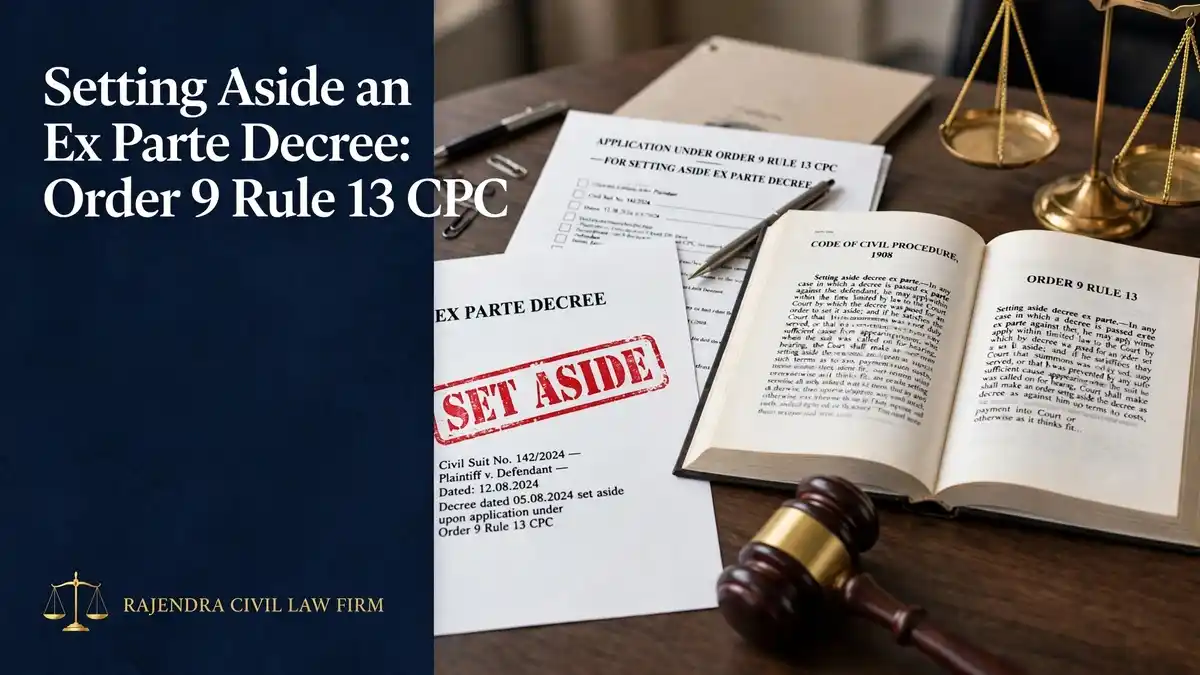
Setting Aside an Ex Parte Decree: Order 9 Rule 13 CPC
In this article (11 sections)
Missing a hearing can cost you a case. When a defendant does not appear, the court can proceed ex parte and pass a decree against him. The law, however, gives a remedy. This guide explains the process of setting aside an ex parte decree under Order 9 Rule 13 of the Code of Civil Procedure, 1908 (CPC), with the grounds, time limit and strategy.
Ex Parte Decree Against You How to Get it Set Aside Under Order 9 Rule 13 CPC
What is an ex parte decree
An ex parte decree is a decree passed against a defendant who was absent, after the court proceeded in his absence under Order 9 Rule 6. It is binding, and the plaintiff can begin to execute it, so the defendant must act quickly.
Setting aside an ex parte decree: remedies available
A defendant against whom an ex parte decree is passed generally has these routes:
- Application under Order 9 Rule 13 to the same court, to set aside the decree.
- First appeal under Section 96(2) CPC against the ex parte decree on merits.
- Review in limited cases.
- Both an application and an appeal can be pursued, but the position must be handled carefully, and the Supreme Court has discussed the interplay in cases such as Bhanu Kumar Jain v. Archana Kumar (2005).
Grounds under Order 9 Rule 13
The court can set aside the decree if the defendant satisfies it that:
- The summons was not duly served, or
- He was prevented by sufficient cause from appearing when the suit was called for hearing.
A decree will not be set aside merely for an irregularity in the service of summons or the proceedings, unless the defendant has been prejudiced and has a defence on the merits.
What counts as sufficient cause
There is no fixed list. Courts have accepted reasons such as:
- Serious illness of the defendant or an immediate family member.
- Absence caused by an accident, or an unavoidable emergency.
- Lack of knowledge, because the notice was not delivered.
- The advocate’s wrong advice or the advocate’s absence in genuine cases.
- A mistake in the date, where it was bona fide.
Courts do not accept casual neglect or deliberate delay. In Parimal v. Veena (2011), the Supreme Court explained that sufficient cause means a cause that is beyond the party’s control, and the party must show he acted with due care and attention.
Time limit
An application under Order 9 Rule 13 must be filed within thirty days from the date of the decree, or, where the summons was not duly served, from the date the defendant gained knowledge of the decree (Article 123 of the Limitation Act, 1963). Section 5 of the Limitation Act allows the court to condone delay in filing such an application for sufficient cause. See our guide on the limitation period for civil suits for related rules.
Procedure
- Step 1: Application. Draft the application with an affidavit stating the facts, the dates, the sufficient cause and the defence.
- Step 2: Court fee and documents. Attach a copy of the decree, the summons and proof of the reason for absence.
- Step 3: Stay of execution. Apply for stay of execution under Order 9 Rule 13 read with Order 21, because the plaintiff may attach property meanwhile.
- Step 4: Notice to the plaintiff. The plaintiff files a reply, and the court hears both sides.
- Step 5: Order. The court may set aside the decree on terms, such as payment of costs or a deposit, or dismiss the application.
If the application is dismissed
An order rejecting the application is appealable under Order 43 Rule 1(d) CPC. The defendant can also consider a first appeal against the decree, depending on the facts.
Plaintiff’s side: when a suit is dismissed for default
If the plaintiff does not appear and the suit is dismissed, the plaintiff can apply under Order 9 Rule 9 to restore it, also within thirty days, showing sufficient cause.
Summary suits
In a summary suit, the remedy is under Order 37 Rule 4, which allows the court to set aside the decree on special circumstances. See our guide on summary suit under Order 37 CPC.
Practical tips
- Never ignore a summons. Appear, even if only to ask for time, and file a written statement within the period allowed.
- Keep the records of service, courier receipts and addresses.
- Apply immediately after knowing about the decree. Delay weakens the case.
- Show a good defence along with the sufficient cause, since courts do not restore a hopeless case.
- Ask for stay of execution to protect assets.
Frequently Asked Questions
What is an ex parte decree?
A decree passed against a defendant in his absence, after the court proceeds ex parte under Order 9 Rule 6 CPC.
How do I get an ex parte decree set aside?
By an application under Order 9 Rule 13 CPC within thirty days, showing that summons was not duly served or that sufficient cause prevented your appearance.
What is the limitation period for Order 9 Rule 13?
Thirty days from the date of the decree, or from the date of knowledge if summons was not duly served. Delay can be condoned under Section 5 for sufficient cause.
Can I file an appeal against an ex parte decree?
Yes, a first appeal lies under Section 96(2) CPC on merits. Legal advice is needed on whether to pursue the application, the appeal or both.
What if the court rejects my application?
An order rejecting an Order 9 Rule 13 application can be appealed under Order 43 Rule 1(d) CPC.
Will the court stay execution of the decree?
It can, on application, usually with conditions such as a deposit. Ask for stay at the time of filing.
What if the plaintiff did not appear and my suit was dismissed?
You can apply under Order 9 Rule 9 to restore it, generally within thirty days, showing sufficient cause.
Read More
- SET-ASIDE and EX-PARTE decree: Expert Legal advice
- Temporary Injunction in a Civil Suit: Order 39 CPC Guide for Chennai
This article is general legal information and not a substitute for advice on your specific case. Consult an advocate before acting.
This article is part of our guide: How to file a civil case in Chennai ?.