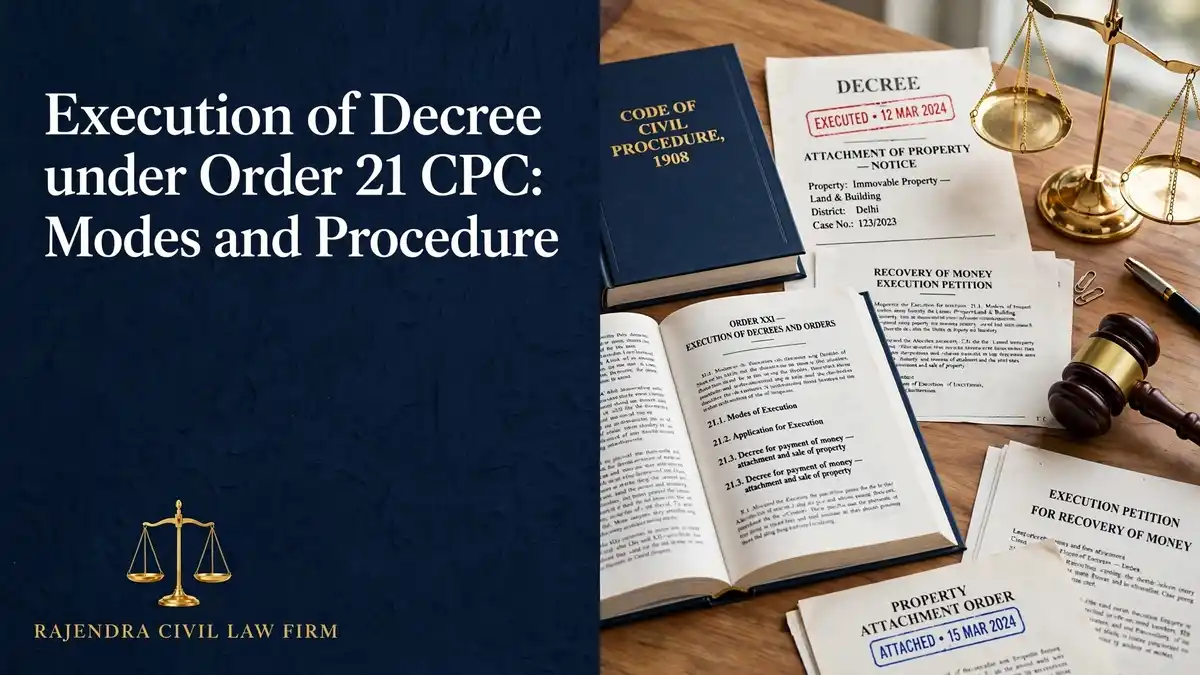
Execution of Decree under Order 21 CPC: Modes and Procedure
In this article (12 sections)
- Execution of decree: what does it mean
- Which court executes the decree
- Modes of execution under Section 51
- Step-by-step procedure
- Arrest and civil prison
- Property exempt from attachment
- Delivery of possession and obstruction
- Limitation for execution
- The six-month direction of the Supreme Court
- Objections by the judgment-debtor
- Practical tips for decree-holders
- Frequently Asked Questions
Winning a suit is only half the battle. Many decree-holders wait for years to recover money or possession. Execution of decree is the process by which a civil court enforces its own decree. The law is in Section 36 to 74 and Order 21 of the Code of Civil Procedure, 1908 (CPC). This guide explains the modes, the steps and the common obstacles.
Execution of Civil Decrees Under CPC Order 21: Procedure and Methods
Execution of decree: what does it mean
A decree states the rights of the parties. Execution is the stage where the decree-holder asks the court to compel the judgment-debtor to obey it, whether by paying money, delivering property or doing an act. A decree-holder who has obtained a money decree in a summary suit under Order 37 must still execute it to recover the amount.
Which court executes the decree
- The court that passed the decree can execute it (Section 38).
- It can also transfer the decree for execution to another court, where the judgment-debtor resides or has property (Sections 39 and 40).
- A decree of another State can be executed by filing a certified copy in the proper court.
Modes of execution under Section 51
The court can order execution in these ways:
- Delivery of property specifically decreed, such as possession of land or a house.
- Attachment and sale of the judgment-debtor’s property, movable or immovable.
- Arrest and detention in civil prison, in suitable cases.
- Appointment of a receiver.
- Any other manner the nature of the relief requires.
Step-by-step procedure
- Step 1: Execution petition. File an application under Order 21 Rule 11 in the prescribed format, giving particulars of the decree, the amount due, and the mode of execution sought.
- Step 2: Notice to the judgment-debtor. The court issues notice under Order 21 Rule 22 in certain cases, such as when the application is made after two years from the decree.
- Step 3: Examination of the judgment-debtor. Under Rule 41, the court can ask the debtor to disclose his assets on oath.
- Step 4: Attachment. The court attaches the property, with a prohibitory order, so that he cannot transfer it.
- Step 5: Claims and objections. Third parties can claim the property under Rule 58, and the court decides the claim.
- Step 6: Sale. Immovable property is sold by public auction after a proclamation of sale under Rule 66, and the sale is confirmed by the court.
- Step 7: Distribution of proceeds. The money is paid to the decree-holder, and any surplus is returned to the debtor.
Arrest and civil prison
The court can order arrest and detention of a judgment-debtor who has the means to pay but refuses, or who has hidden or disposed of property to avoid the decree. Safeguards apply, and women cannot be arrested in execution of a money decree (Section 56). The debtor can be released on payment or on satisfaction of the court.
Property exempt from attachment
Section 60 CPC lists items that cannot be attached, such as the necessary wearing apparel, cooking vessels, tools of an artisan, agricultural implements, and a portion of salary and wages. Always check the list before attaching.
Delivery of possession and obstruction
For possession decrees, the court orders delivery through its bailiff. If the judgment-debtor or any other person obstructs the delivery, Rules 97 to 101 allow the decree-holder to apply to remove the obstruction, and the court decides the objection as if it were a suit. Courts take a firm view of resistance that defeats a decree.
Limitation for execution
An application to execute a decree must be filed within twelve years from the date of the decree, or from when the decree becomes enforceable, under Article 136 of the Limitation Act, 1963. A fresh period can start after a step-in-aid of execution. Do not wait: delay makes it harder to trace assets.
The six-month direction of the Supreme Court
In Rahul S. Shah v. Jinendra Kumar Gandhi (2021), the Supreme Court expressed concern over delays and directed courts to dispose of execution petitions within six months of filing, in writing, with reasons for any delay. It also directed measures such as asking the judgment-debtor to disclose assets, and the use of the court’s powers to compel compliance. This is a useful argument when execution drags.
Objections by the judgment-debtor
- A decree that is a nullity for lack of jurisdiction can be questioned in execution, but a court executing a decree cannot go behind it.
- Questions about satisfaction, discharge or execution are decided under Section 47, and no separate suit lies.
- Technical objections should not defeat a valid decree.
Practical tips for decree-holders
- Trace the debtor’s assets early: property, bank accounts, vehicles and receivables.
- Choose the mode that suits the asset, such as attachment of a bank account for a quick result.
- File the application along with the certified copy of the decree and a list of assets.
- Follow up on every listing and apply for the court’s directions on the assets.
- Check limitation for your claim before relying on old decrees.
Frequently Asked Questions
Which provisions of the CPC deal with execution of decrees?
Sections 36 to 74 and Order 21 of the CPC set out the courts, modes and procedure of execution.
What is the time limit to file an execution petition?
Generally twelve years from the date the decree becomes enforceable, under Article 136 of the Limitation Act.
Can a court arrest a judgment-debtor for non-payment?
Yes, in suitable cases where he has means to pay but refuses or has disposed of assets, subject to safeguards. Women cannot be arrested in execution of money decrees.
What is attachment of property?
It is a court order stopping the judgment-debtor from transferring or dealing with the property, which is then sold to satisfy the decree.
Can any property be attached?
No. Section 60 lists exempted items, such as necessary clothing, cooking vessels, tools of an artisan, and a part of salary and wages.
What can the decree-holder do if someone obstructs possession?
He can apply under Order 21 Rules 97 to 101 for removal of the obstruction, and the court will decide the objection.
How long should an execution petition take?
The Supreme Court in Rahul S. Shah (2021) directed that execution petitions should be disposed of within six months, though delays remain common.
Read More
- Execution of Decree: Ensuring Timely Enforcement
- SET-ASIDE and EX-PARTE decree: Expert Legal advice
- Specific Performance of Contract in India: Specific Relief Act Guide
- Suit for Declaration of Title: Section 34 Explained
- Set-aside or ex-parte decree case: What is the role of an Expert lawyer
This article is general legal information and not a substitute for advice on your specific case. Consult an advocate before acting.
This article is part of our guide: Money suit: Find the Right Lawyers in Chennai.